

Article details
Introduction
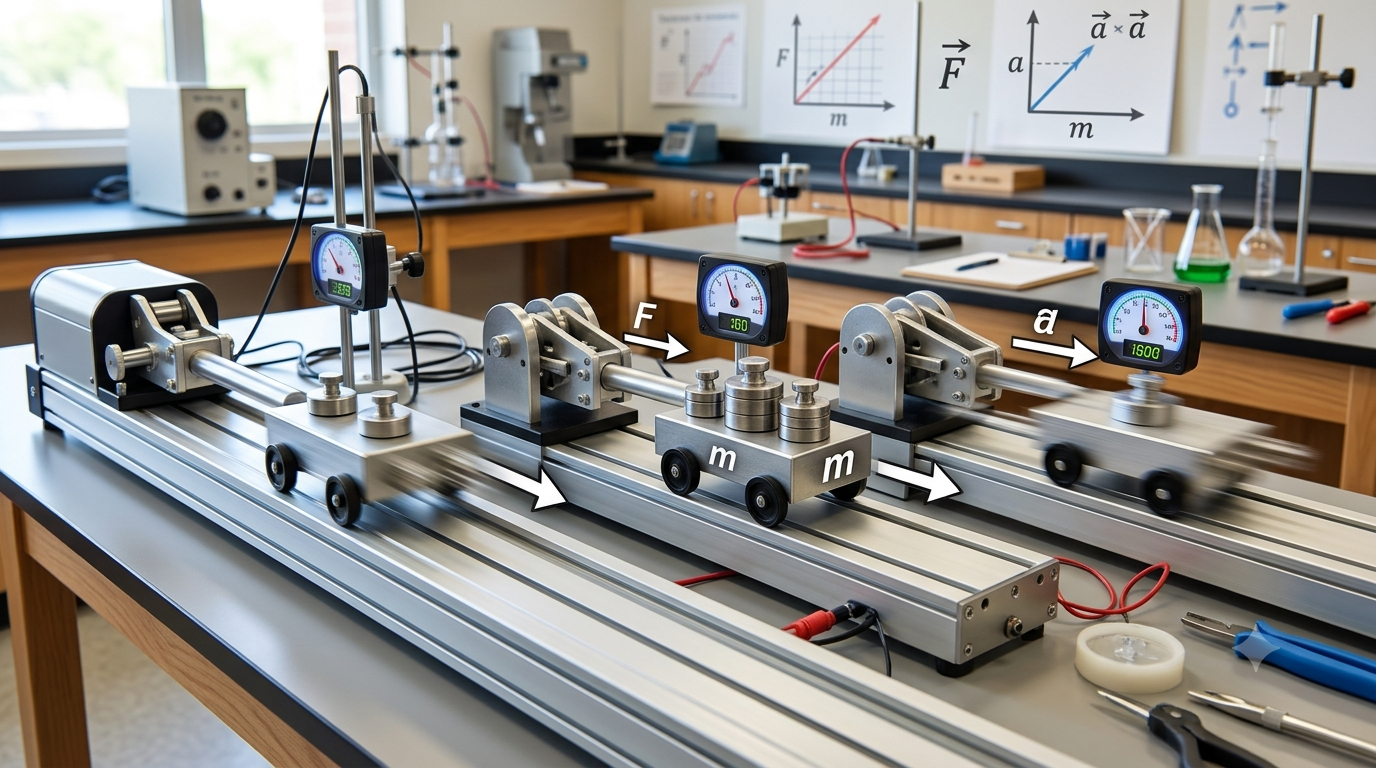
Motion is a part of our everyday lives. A car accelerates when the driver presses the accelerator, a football moves when a player kicks it, and a trolley moves faster when someone pushes it with greater force. These situations demonstrate the relationship between force and motion.
Newton’s Second Law of Motion is one of the fundamental principles of classical physics. It explains how an object’s motion changes when an external force acts on it. The law connects three important quantities: force, mass, and acceleration.
Understanding this principle is essential in physics, mechanical engineering, automotive design, aerospace engineering, and many other technical fields.
What Is Newton’s Second Law of Motion?
Newton’s Second Law states that the acceleration of an object depends on the net force acting on it and its mass. Acceleration increases when the net force increases and decreases when the mass increases, provided the net force remains constant.
In simple terms, a stronger push produces a greater change in motion, while a heavier object requires more force to achieve the same acceleration.
The law also explains why an object may not accelerate when several forces acting on it balance each other. In this situation, the net force is zero, so its acceleration is zero.
Newton’s Second Law Formula
The mathematical expression for Newton’s Second Law is:
F = ma
Where:
F = Net force acting on the object, measured in newtons (N)
m = Mass of the object, measured in kilograms (kg)
a = Acceleration of the object, measured in metres per second squared (m/s²)
The formula shows that force is directly proportional to mass and acceleration.
If the mass or acceleration changes, the force required to produce that motion also changes.
Understanding Net Force
Net force is the combined effect of all external forces acting on an object. Forces can act in the same direction or in opposite directions.
For example, if two people push a box in the same direction with forces of 20 N and 15 N, the total force is 35 N, assuming no other horizontal forces.
However, if one person pushes with 20 N to the right and another pushes with 15 N to the left, the net force is 5 N to the right.
Newton’s Second Law uses this net force rather than considering just one force in isolation.
Relationship Between Force and Acceleration
Force and acceleration are directly proportional when the mass of an object remains constant.
This means that increasing the net force increases the acceleration by the same proportion. For example, doubling the net force doubles the acceleration if the mass does not change.
Consider a trolley with a mass of 10 kg. If a net force of 20 N acts on it, its acceleration is 2 m/s². If the net force increases to 40 N, the acceleration becomes 4 m/s².
This relationship helps engineers calculate the force required to accelerate vehicles, machines, industrial equipment, and moving components.
Relationship Between Mass and Acceleration
Mass and acceleration have an inverse relationship when the net force remains constant.
A heavier object accelerates less than a lighter object under the same net force. This happens because more force is required to produce the same acceleration in an object with greater mass.
For example, imagine pushing two trolleys with the same force. One trolley is empty, while the other carries heavy boxes. The empty trolley will generally accelerate more because its total mass is lower, assuming similar external resistance.
This principle is important when designing vehicles, lifting systems, robots, and industrial machinery.
Worked Examples of Newton’s Second Law
Example 1: Calculating Force
A body with a mass of 5 kg accelerates at 3 m/s². Calculate the net force acting on it.
Given:
Mass = 5 kg
Acceleration = 3 m/s²
Using the formula:
F = ma
F = 5 × 3
Net force = 15 N
Therefore, a net force of 15 N is required to produce the specified acceleration.
Example 2: Calculating Acceleration
A force of 60 N acts on an object with a mass of 12 kg. Find its acceleration.
Given:
Net force = 60 N
Mass = 12 kg
Using the formula:
a = F/m
a = 60/12
Acceleration = 5 m/s²
The object accelerates at 5 m/s² in the direction of the net force.
Example 3: Calculating Mass
An object experiences a net force of 100 N and accelerates at 4 m/s². Determine its mass.
Given:
Net force = 100 N
Acceleration = 4 m/s²
Using the formula:
m = F/a
m = 100/4
Mass = 25 kg
Therefore, the object's mass is 25 kg.
SI Unit of Force
The SI unit of force is the newton (N). One newton is defined as the net force required to accelerate a mass of one kilogram at one metre per second squared.
1 N = 1 kg·m/s²
This definition connects force directly to mass and acceleration.
In engineering calculations, using consistent SI units helps prevent errors. Mass should be expressed in kilograms, acceleration in metres per second squared, and force in newtons.
Everyday Applications of Newton’s Second Law
Newton’s Second Law can be observed in many daily activities and practical situations.
1. Vehicle Acceleration
When a driver presses the accelerator, the vehicle's engine and drivetrain produce a force that helps accelerate the vehicle. The acceleration depends on the net force and the total mass of the vehicle, along with resistance from the road and air.
A heavily loaded vehicle generally requires greater net force to achieve the same acceleration as a lighter vehicle.
2. Sports and Ball Movement
When a football player kicks a ball, the applied force changes the ball’s velocity. A stronger kick can produce greater acceleration, depending on the ball’s mass and the duration and direction of the force.
This principle also applies to cricket, tennis, basketball, and other sports involving moving objects.
3. Industrial Machines
Factories use motors and mechanical systems to move heavy loads, conveyor belts, and machine components. Engineers calculate the required force and acceleration to ensure that equipment operates safely and efficiently.
These calculations help determine suitable motor capacities and mechanical component specifications.
4. Aerospace Engineering
Aircraft and spacecraft depend on forces to change their motion. For example, the thrust produced by a rocket engine creates a net force that accelerates the spacecraft. The resulting acceleration depends on the net force and the spacecraft’s instantaneous mass.
Engineers use Newton’s laws to analyse vehicle motion, propulsion, and flight dynamics.
Difference Between Force, Mass, and Acceleration
Force, mass, and acceleration are related, but each represents a different physical quantity.
Force: A push or pull that can change an object's motion.
Mass: A measure of an object's inertia, or resistance to changes in its motion.
Acceleration: The rate at which velocity changes with time.
Newton’s Second Law connects these three quantities mathematically. It allows engineers and scientists to predict how an object responds to a known net force.
Common Mistakes to Avoid
When solving problems involving Newton’s Second Law, it is important to identify the net force correctly.
Do not automatically use the largest applied force without considering opposing forces such as friction or air resistance.
Always check that mass is expressed in kilograms and acceleration in metres per second squared before calculating force.
Remember that acceleration occurs in the direction of the net force. If the net force is zero, the acceleration is zero, but the object may still be moving at a constant velocity.
Conclusion
Newton’s Second Law of Motion explains how force, mass, and acceleration work together to determine an object's motion. Its formula, F = ma, provides a straightforward method for calculating the net force, mass, or acceleration when the other two quantities are known.
From vehicle performance and sports to industrial machinery and aerospace systems, this law plays a vital role in understanding and predicting motion. Learning how to apply it helps students build a strong foundation in physics and enables engineers to design safer, more efficient mechanical systems.
