

Article details
Introduction
Air is one of the most important working fluids in engineering. Although it is invisible, its physical and thermal properties play a major role in heating, ventilation, and air conditioning (HVAC), mechanical engineering, fluid mechanics, thermodynamics, aerospace engineering, and industrial process systems.
Understanding the properties of air helps engineers predict how it behaves under different temperatures and pressures. These properties are essential for designing ventilation systems, calculating heat transfer, analyzing airflow, selecting equipment, and improving energy efficiency.
Air is a mixture of gases, primarily nitrogen and oxygen, along with argon, carbon dioxide, and other trace gases. Its properties change with temperature, pressure, humidity, and operating conditions. Therefore, engineers must use suitable property values when performing calculations.
1. What Are the Physical Properties of Air?
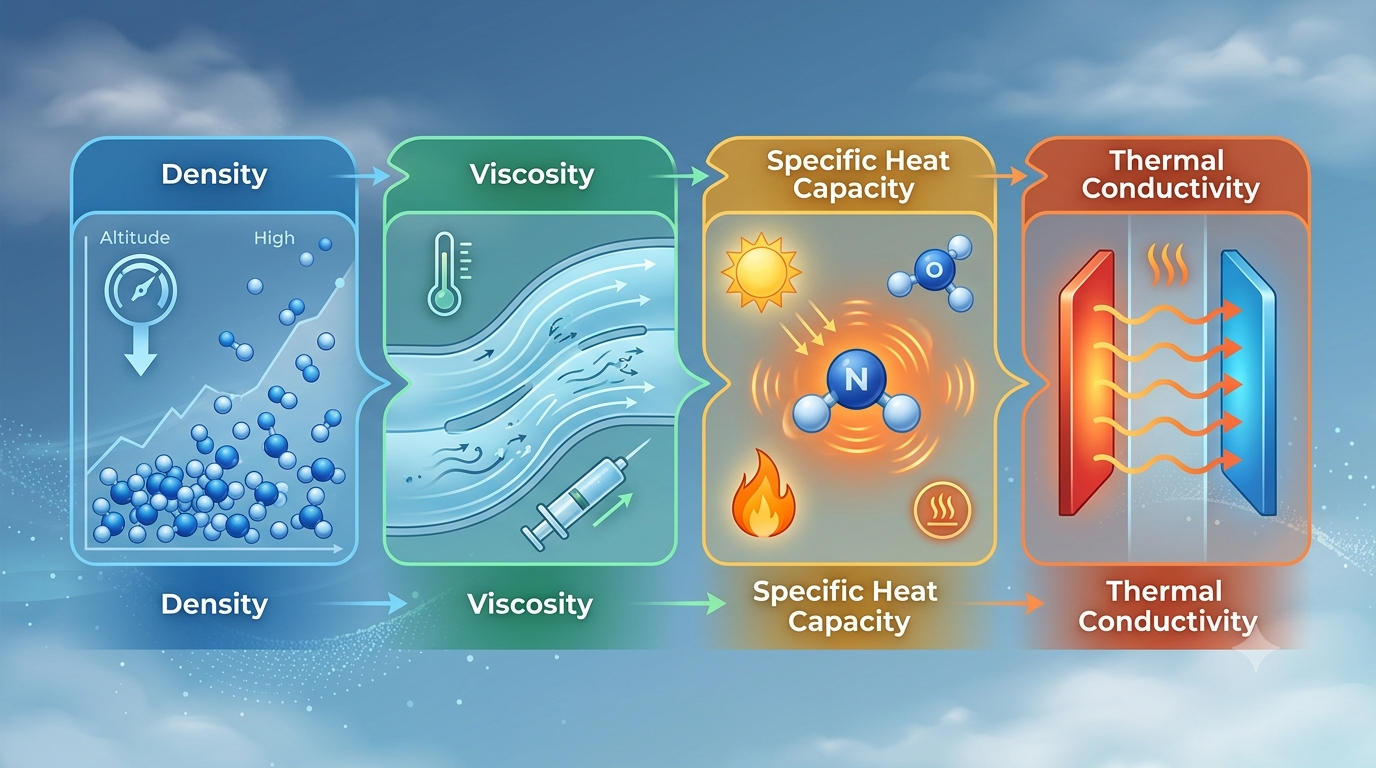
The physical properties of air describe how it behaves under specific conditions. The most important properties used in engineering calculations include density, viscosity, specific heat capacity, thermal conductivity, molecular weight, and thermal expansion.
Each property influences the movement of air, its ability to transfer heat, and its response to changes in temperature and pressure.
For engineering applications, air is often treated as an ideal gas at ordinary temperatures and relatively low pressures. This assumption simplifies calculations while providing sufficiently accurate results for many practical applications.
2. Density of Air
Air density is the mass of air contained in a given volume. It is commonly expressed in kilograms per cubic metre (kg/m³).
At approximately 0°C and 1 atmosphere of pressure, the density of dry air is about 1.275 kg/m³. At 20°C and the same pressure, it decreases to approximately 1.20 kg/m³.
How Temperature and Pressure Affect Air Density
Air density generally decreases as temperature increases at constant pressure. When air is heated, it expands, causing the same mass of air to occupy a larger volume.
Conversely, increasing pressure at a constant temperature increases air density. These relationships are important when calculating airflow, compressor performance, ventilation requirements, and buoyancy forces.
Air Density Formula
For air behaving approximately as an ideal gas, density can be calculated using:
ρ = P / (R × T)
Where:
ρ = density of air (kg/m³)
P = absolute pressure (Pa)
R = specific gas constant for dry air, approximately 287 J/(kg·K)
T = absolute temperature (K)
Example: At 20°C and standard atmospheric pressure, air density is approximately 1.20 kg/m³. Therefore, 10 m³ of air has a mass of approximately 12 kg.
This calculation is useful in ventilation design, duct sizing, and estimating the mass flow rate of air through industrial equipment.
3. Viscosity of Air
Viscosity describes a fluid's resistance to relative motion between its layers. In air, viscosity influences how easily the gas flows and how much resistance develops near surfaces.
Two types of viscosity are commonly used in engineering: dynamic viscosity and kinematic viscosity.
Dynamic Viscosity
Dynamic viscosity, represented by μ, measures the resistance to shearing motion. Its SI unit is pascal-second (Pa·s).
At approximately 0°C and atmospheric pressure, the dynamic viscosity of air is around 1.72 × 10⁻⁵ Pa·s. For gases, dynamic viscosity generally increases as temperature rises because faster-moving molecules transfer momentum more effectively.
Kinematic Viscosity
Kinematic viscosity, represented by ν, is the ratio of dynamic viscosity to density.
ν = μ / ρ
It is expressed in square metres per second (m²/s).
Kinematic viscosity is particularly important in fluid mechanics because it is used to calculate the Reynolds number, which helps engineers determine whether airflow is predominantly laminar or turbulent.
These viscosity properties are essential for analyzing flow through ducts, pipes, fans, heat exchangers, and aerodynamic surfaces.
4. Specific Heat Capacity of Air
Specific heat capacity describes the amount of energy required to raise the temperature of one kilogram of a substance by one kelvin.
For air, two specific heat values are commonly used: specific heat at constant pressure (Cp) and specific heat at constant volume (Cv).
Specific Heat at Constant Pressure (Cp)
Cp represents the energy required to raise the temperature of air while maintaining constant pressure. For dry air near ordinary temperatures, it is approximately 1.005 kJ/(kg·K).
This property is widely used in HVAC calculations, heating and cooling systems, combustion analysis, and heat exchanger design.
Specific Heat at Constant Volume (Cv)
Cv describes the energy required to raise the temperature of air when its volume remains constant. Near ordinary temperatures, its value is approximately 0.718 kJ/(kg·K).
The difference between Cp and Cv is important in thermodynamics, particularly when analyzing compressors, gas turbines, and other systems involving compression or expansion.
5. Thermal Conductivity of Air
Thermal conductivity measures a material's ability to transfer heat through conduction. It is represented by the symbol k and expressed in watts per metre-kelvin (W/m·K).
At approximately 0°C and atmospheric pressure, the thermal conductivity of dry air is around 0.024 W/(m·K). Its value generally increases as temperature rises.
Air has relatively low thermal conductivity compared with metals such as copper and aluminium. This characteristic explains why trapped air can provide useful insulation in building materials, insulated panels, and double-glazed windows.
However, heat transfer through air also occurs by convection and radiation. Therefore, the insulating performance of an air gap depends on its thickness, orientation, temperature difference, and the movement of the surrounding air.
6. Thermal Expansion of Air
Thermal expansion refers to the increase in volume that occurs when a substance is heated under suitable conditions.
When air is heated at approximately constant pressure, its volume increases and its density decreases. When air is cooled, it generally contracts and becomes denser.
For an ideal gas at constant pressure, the volume is directly proportional to its absolute temperature.
V₁ / T₁ = V₂ / T₂
Where V₁ and V₂ are the initial and final volumes, while T₁ and T₂ are the corresponding absolute temperatures.
This relationship is important in hot-air ventilation, natural circulation, building airflow, and buoyancy-driven systems. It also helps explain how warm air rises relative to cooler surrounding air.
7. Important Properties of Air at Standard Conditions
The following approximate values provide a useful starting point for engineering calculations involving dry air at atmospheric pressure.
Property | Approximate value | Unit |
|---|---|---|
Density at 0°C | 1.275 | kg/m³ |
Density at 20°C | 1.20 | kg/m³ |
Dynamic viscosity at 0°C | 1.72 × 10⁻⁵ | Pa·s |
Specific heat at constant pressure | 1.005 | kJ/(kg·K) |
Specific heat at constant volume | 0.718 | kJ/(kg·K) |
Thermal conductivity at 0°C | 0.024 | W/(m·K) |
Molar mass of dry air | 28.97 | g/mol |
Specific gas constant | 287 | J/(kg·K) |
Note: These are rounded reference values. Exact values depend on temperature, pressure, humidity, and the property dataset used. Always select values appropriate to the design conditions.
8. Engineering Applications of Air Properties
HVAC and Building Services
Air density, specific heat, and thermal conductivity are used to estimate heating and cooling loads, determine airflow requirements, and design ventilation ducts. Accurate calculations support indoor comfort and energy-efficient operation.
Mechanical and Process Engineering
Air properties help engineers evaluate compressed-air systems, pneumatic equipment, blowers, fans, and gas-handling processes. Density and viscosity are particularly important when calculating pressure losses and flow rates.
Heat Exchanger Design
Specific heat capacity and thermal conductivity help determine heat-transfer rates and equipment performance. Engineers must also consider airflow velocity, convection coefficients, and operating temperatures.
Aerospace and Aerodynamics
Air density affects aerodynamic forces, lift, drag, and engine performance. Changes in atmospheric pressure and temperature can significantly influence aircraft and other aerodynamic systems.
Industrial Energy Systems
Air properties are used in combustion calculations, cooling equipment, industrial furnaces, and energy recovery systems. Reliable property data help improve system efficiency and operational safety.
9. Factors to Consider When Using Air Property Data
Before applying air properties to an engineering calculation, consider the actual operating conditions.
Temperature: Density generally decreases as temperature rises at constant pressure, while gas viscosity typically increases.
Pressure: Density increases with pressure at a fixed temperature. Compressed air may require a more detailed analysis, depending on the pressure and temperature range.
Humidity: Moist air has different properties from dry air. At the same temperature and pressure, humid air is generally less dense than dry air because water vapour has a lower molecular mass than the average dry-air mixture.
Altitude: Atmospheric pressure decreases with elevation, reducing air density and affecting ventilation, combustion, cooling, and aerodynamic performance.
Accuracy requirements: Preliminary estimates may use standard property values, but detailed equipment design should use verified data at the relevant operating conditions.
Conclusion
The properties of air are fundamental to engineering calculations involving fluid flow, heat transfer, thermodynamics, and energy systems. Density determines the mass contained in a given volume, viscosity influences flow resistance, specific heat capacity describes energy requirements, and thermal conductivity affects heat transfer.
Understanding how these properties respond to temperature, pressure, humidity, and altitude enables engineers to make more reliable design decisions. Whether designing an HVAC system, evaluating a compressor, sizing ventilation ducts, or analyzing an industrial heat exchanger, selecting appropriate air property values is an essential step toward safe, accurate, and efficient engineering performance.
