

Article details
Introduction to Radians and Degrees
Angles are fundamental to mathematics, physics, and engineering. They describe the orientation of objects, the direction of movement, and the amount of rotation around a fixed point. Two commonly used units for measuring angles are radians and degrees. Although both represent the same physical quantity, they differ in their definitions, measurement systems, and mathematical applications.
Degrees are commonly used in geometry, navigation, technical drawings, and everyday measurements. Radians are widely used in advanced mathematics, calculus, physics, and engineering calculations involving circular motion and rotational systems. Understanding both units is important for interpreting mathematical equations and performing accurate engineering calculations.
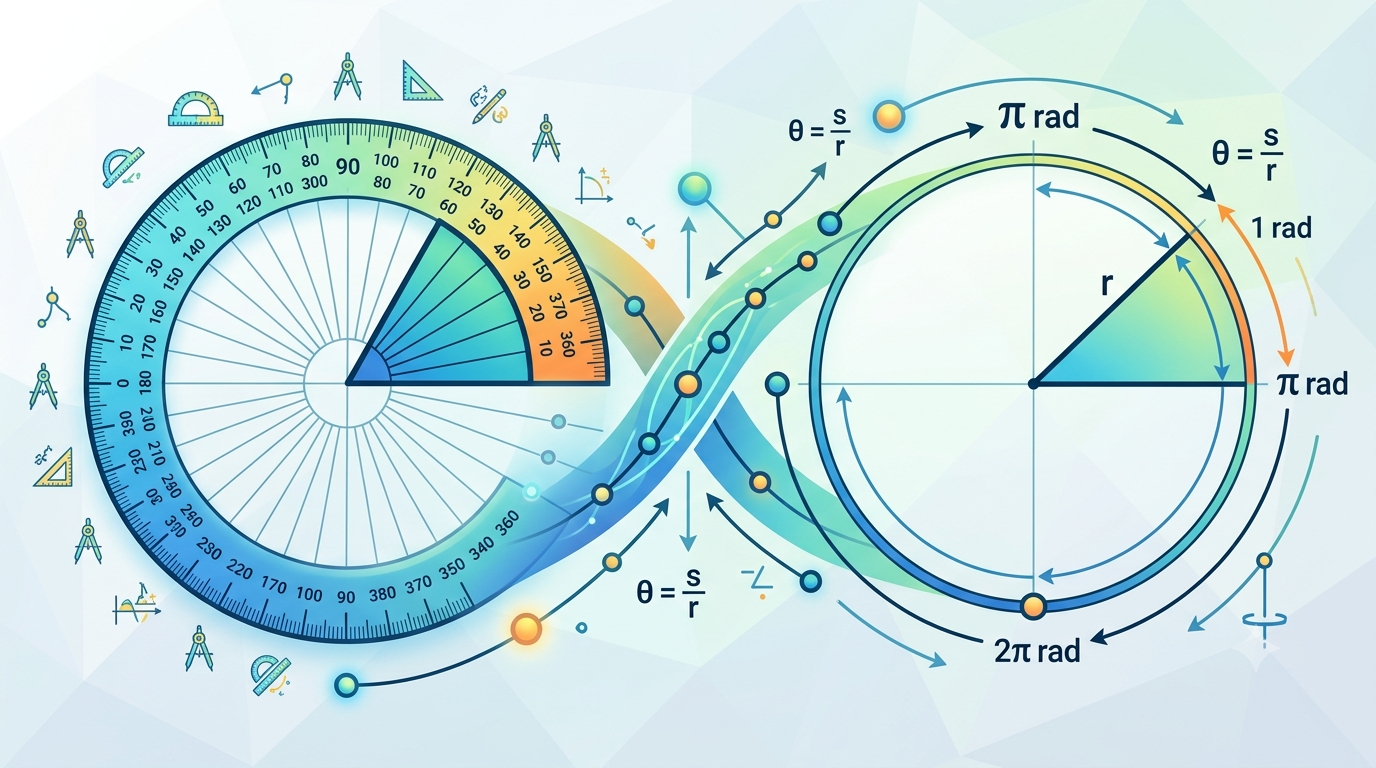
A complete circle measures 360 degrees or (2\pi) radians. This relationship forms the basis for converting angles between the two units. While degrees provide a familiar way to express angular measurements, radians offer a direct mathematical connection between the radius of a circle and the length of its arc.
Definition of a Radian
A radian is an angular measurement defined by the ratio of the arc length to the radius of a circle. One radian is the angle subtended at the center of a circle when the length of the intercepted arc is equal to the radius.
The relationship between the arc length, radius, and angle is expressed as:
[
\theta=\frac{s}{r}
]
Where:
(\theta) represents the angle in radians.
(s) represents the length of the arc.
(r) represents the radius of the circle.
This definition makes radians a natural unit for measuring angular displacement. Since the arc length and radius are measured using the same unit, their ratio is dimensionless.
Radians are particularly important in calculus because many mathematical relationships involving trigonometric functions are expressed most naturally in this unit. For example, the standard derivative of the sine function is valid when the angle is measured in radians. Radians are also used to represent angular velocity, angular acceleration, and rotational displacement in engineering calculations.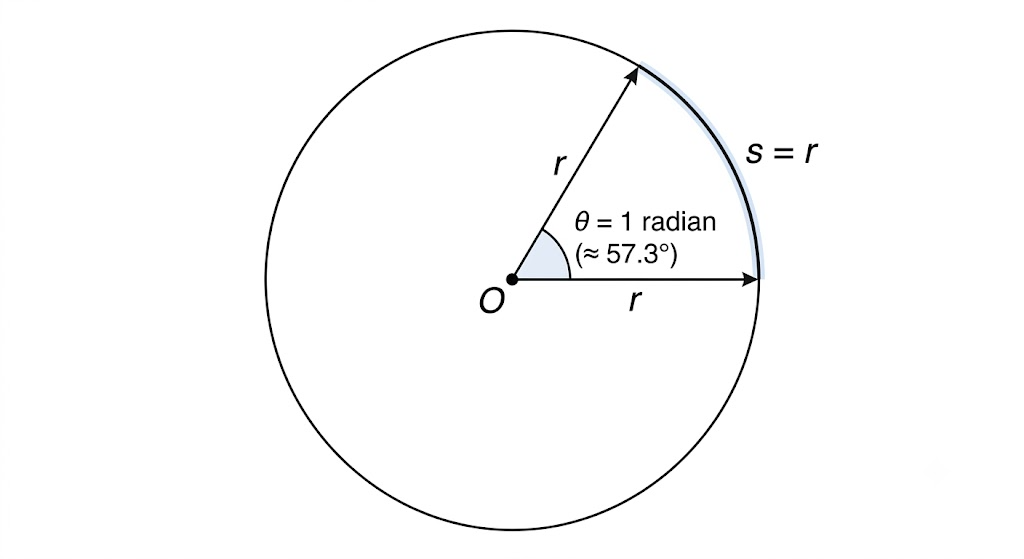
Definition of a Degree
A degree is a unit of angular measurement in which a complete circle is divided into 360 equal parts. Each part represents one degree, symbolized by °.
A right angle measures 90°, a straight angle measures 180°, and a complete revolution measures 360°. This system is widely recognized because it provides a straightforward method for describing angles in geometric and practical applications.
Degrees are frequently used in construction, surveying, mechanical design, navigation, and the specification of component orientations. They are also commonly used in technical drawings and measurement instruments where angular positions must be communicated clearly.
Smaller angular measurements can be expressed using degrees, minutes, and seconds. One degree contains 60 minutes, and one minute contains 60 seconds. These subdivisions are useful in applications that require precise angular measurements, such as land surveying and geographical positioning.
Relationship Between Radians and Degrees
Radians and degrees measure the same quantity but use different reference systems. The relationship between them is established by considering the circumference of a circle.
The circumference of a circle is given by:
[
C=2\pi r
]
According to the definition of a radian, the angle subtended by a complete circumference is:
[
\theta=\frac{C}{r}
]
Substituting the circumference formula gives:
[
\theta=\frac{2\pi r}{r}=2\pi
]
Therefore, a complete circle measures (2\pi) radians, which is equivalent to 360°.
The fundamental relationship is:
[
180^\circ=\pi\text{ radians}
]
From this relationship, several standard angular equivalents can be established. A half-circle measures 180° or (\pi) radians, a right angle measures 90° or (\pi/2) radians, and a quarter of a right angle measures 45° or (\pi/4) radians.
These standard relationships are widely used in trigonometry, mathematical modeling, and engineering analysis.
Conversion Between Radians and Degrees
Converting between radians and degrees is a fundamental mathematical operation. The conversion depends on whether the original angle is expressed in radians or degrees.
To convert radians into degrees, the angle is multiplied by (180/\pi). The formula is:
[
\text{Degrees}=\text{Radians}\times\frac{180^\circ}{\pi}
]
For example, an angle of (\pi/3) radians is equivalent to 60°, while an angle of (\pi/2) radians is equivalent to 90°. An angle of 2 radians is approximately equal to 114.59°.
To convert degrees into radians, the angle is multiplied by (\pi/180^\circ). The formula is:
[
\text{Radians}=\text{Degrees}\times\frac{\pi}{180^\circ}
]
Using this formula, 30° is equivalent to (\pi/6) radians, 45° is equivalent to (\pi/4) radians, and 180° is equivalent to (\pi) radians.
These conversion formulas ensure consistency when angular measurements are transferred between mathematical calculations, technical specifications, and engineering software. Exact expressions involving (\pi) are generally preferred during intermediate calculations because they help minimize rounding errors.
Differences Between Radians and Degrees
The primary difference between radians and degrees lies in how they define angular measurement. Degrees divide a complete circle into 360 equal parts, whereas radians use the relationship between arc length and radius.
Degrees are generally convenient for describing geometric angles, installation positions, slopes, and directions. Radians are particularly suitable for mathematical expressions involving circular motion, trigonometric functions, and calculus.
Another important difference concerns mathematical calculations. Standard calculus formulas involving derivatives and limits of trigonometric functions generally assume that angles are expressed in radians. When degrees are used, additional conversion factors may be required.
Neither unit is inherently more accurate than the other. Both can represent the same angle precisely when used correctly. The appropriate unit depends on the requirements of the mathematical equation, measurement system, or engineering application.
2. Importance and Applications of Radians and Degrees
Radians and degrees are important in several engineering disciplines because angular measurements influence the design, analysis, and operation of mechanical and electrical systems. Their applications depend on whether an angle is being used for a practical specification or a mathematical calculation.
In mechanical engineering, degrees are commonly used to specify the orientation of machine components, gear positions, and installation angles. Radians are frequently used in calculations involving rotating shafts, wheels, turbines, and motors. The relationship between angular displacement and linear distance is expressed as (s=r\theta), where the angle must be measured in radians.
In electrical engineering, both units are used to describe phase differences and sinusoidal signals. Degrees are common in circuit diagrams and phasor representations, while radians are widely used in mathematical expressions involving angular frequency. Angular frequency is calculated using (\omega=2\pi f), where (f) represents frequency in hertz and (\omega) represents angular frequency in radians per second.
In civil engineering and surveying, degrees are used to specify road gradients, structural orientations, land boundaries, and directional measurements. Radians may be used in analytical models involving circular curves and structural calculations. Accurate conversion is important when measurements are transferred between instruments, drawings, and calculation systems.
Radians are also essential in calculus and mathematical modeling. The derivative of the sine function is expressed as (\frac{d}{dx}(\sin x)=\cos x) when (x) is measured in radians. This property simplifies many equations used in physics and engineering. Radians are also important in small-angle approximations, where (\sin\theta\approx\theta) and (\tan\theta\approx\theta) for sufficiently small angles expressed in radians.
In robotics and automation, angular measurements determine the positions and movements of robotic joints, servo motors, and automated mechanisms. Some systems use degrees for operator input, while programming libraries and mathematical models may require radians. Correct unit selection is therefore essential for accurate positioning and motion control.
Although conversion between radians and degrees is straightforward, errors can occur when incorrect conversion factors are used or calculator settings are overlooked. Scientific calculators may operate in either degree or radian mode, and engineering software may require a specific angular unit. Maintaining consistency across calculations is important for obtaining reliable results.
In conclusion, radians and degrees are essential units of angular measurement with applications throughout mathematics, physics, and engineering. Degrees provide a convenient method for expressing practical angles, while radians establish a direct relationship between angular displacement and circular geometry. Understanding their definitions, mathematical relationship, conversion formulas, and applications enables accurate calculations and supports effective engineering analysis.
