

Article details
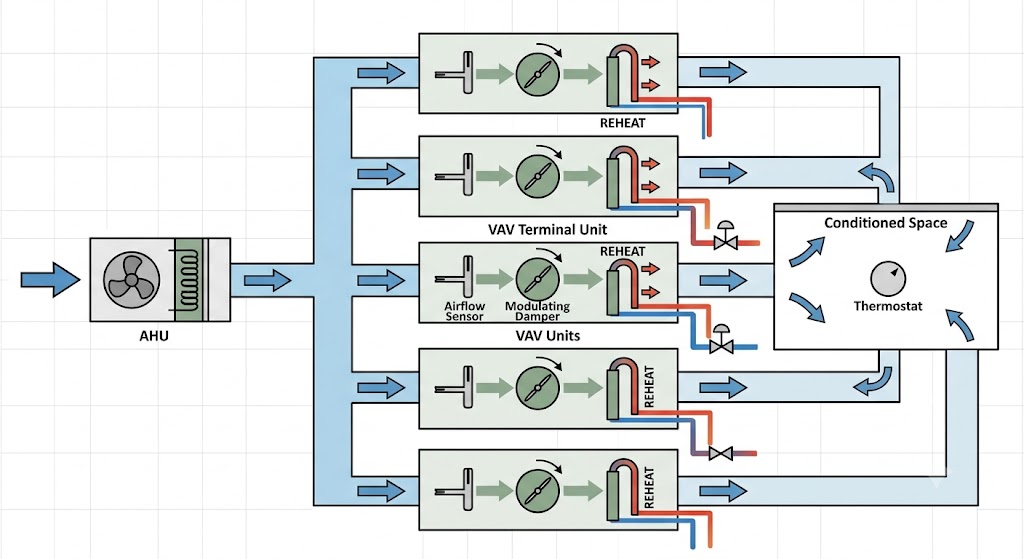
When a zone cools below its heating setpoint, a VAV box has to add heat to air that arrives cold from the central system. The interesting design question is not whether it reheats, but in what order it changes airflow and heat, and how it keeps the air it delivers from getting so hot that it never reaches the occupants. The answer is a short sequence of steps, and each step exists for a reason.
Two Kinds of Reheat Coil
VAV boxes usually carry a hot water coil or an electric coil. Hot water coils modulate through a control valve. Electric coils either switch in stages or modulate smoothly using a silicon-controlled rectifier.
The difference has a practical consequence. Electric coils with staged heating need a minimum airflow across them to keep the element temperature regulated, while an SCR controlled coil modulates continuously and has no such minimum. That affects how low the box's airflow can go while heating.
The Single Maximum Reheat Sequence
In the conventional single maximum sequence, the box drops to its minimum airflow when the zone cools and holds it there. When the zone reaches the heating setpoint, the coil is activated and modulates to hold temperature while the airflow stays unchanged. Heat is varied, air is not. It is simple, but because the airflow is the minimum airflow, the minimum has to be large enough to carry the heating load, which is the problem the dual maximum sequence was designed to solve.
The Dual Maximum Reheat Sequence, Step by Step
The dual maximum sequence changes the order of operations.
Step one: airflow stays at minimum, heat comes on. When the zone temperature falls to the heating setpoint, the coil activates, either increasing electric power or opening the hot water valve, while the airflow remains at the low minimum.
Step two: the discharge temperature climbs. Guideline 36 style logic lets the heating loop output reset the discharge temperature setpoint upward, from the system supply air temperature toward a limit above the space setpoint, while the coil modulates to hold that discharge temperature.
Step three: airflow increases only after heat is exhausted. Once the coil reaches maximum capacity, or the discharge temperature reaches its limit, a further drop in zone temperature increases the airflow, from the minimum up to a heating maximum airflow. That heating maximum is typically around half the cooling maximum.
The logic is deliberate. Raising the temperature of a small airflow costs less fan energy and less reheat than delivering a large airflow of lukewarm air, and the airflow increase is held back as a reserve.
The Discharge Air Temperature Limit
The ceiling on the discharge temperature is not arbitrary. ASHRAE 90.1 limits the reheat supply air temperature setpoint to twenty degrees Fahrenheit above the space temperature setpoint, which is ninety degrees at a seventy degree space. The reason is stratification. Very warm air supplied overhead rises, collects at the ceiling, and can short circuit to the return, leaving the floor level cold and wasting the heat. ASHRAE 62.1 adds a penalty to the ventilation effectiveness of the zone when the heating air is supplied more than fifteen degrees above the space temperature.
To enforce the limit, the box uses cascaded control. A discharge air temperature sensor is installed at the coil outlet, and the hot water valve is controlled to hold that temperature at a setpoint that is itself reset by the room's heating loop. The inner loop watches the air leaving the coil, and the outer loop watches the room.
Sizing the Coil for the Right Airflow
A common mistake is sizing the reheat coil for the minimum airflow. If the heating sequence can increase airflow up to the heating maximum, the coil must be able to deliver the heating load at that airflow and the maximum discharge temperature. A coil sized only for the minimum has insufficient capacity, and the result is a valve that sits fully open while the zone stays cold.
One selection method works as follows. Calculate the heating maximum airflow as the airflow needed to meet the zone heating load at the maximum discharge temperature. If that airflow turns out to be lower than the box's controllable minimum, set the heating maximum equal to the controllable minimum and recalculate the required discharge temperature. The two constraints, controllable minimum and discharge limit, meet at a workable design point.
Low temperature hot water makes this harder, because a coil fed with cooler water has less temperature difference to work with and may need more airflow, more rows, or a larger coil to reach the same output. Energy modeling guidance reflects the practical limits too, since standard compliance restricts the fraction of maximum airflow allowed during reheat, with half being typical.
A Hidden Detail: Damper Position and Coil Performance
Research on reheat boxes has found that the position of the damper significantly affects both discharge air stratification inside the box and the capacity the coil actually delivers. The airflow pattern entering the coil changes with how far the damper is open, so a coil that performs well at one damper position may deliver a different leaving temperature at another. This is one reason tested performance and catalog assumptions do not always match field behavior, and why coil circuiting and box design can improve results without adding cost.
The Neutral Air Case: Small Reheat in Interior Zones
A related design point applies to interior zones that never need heating. Delivering minimum airflow of very cold air to such a zone can still cause discomfort. Some designers therefore specify a small reheat coil even in interior zones, to bring the minimum airflow up to a neutral discharge temperature.
What to Check When a Zone Is Cold
When a reheat zone stays cold, a few checks follow directly from the sequence. Is the valve fully open while the discharge temperature is still below its setpoint? That suggests an undersized coil or low hot water temperature. Is the discharge temperature at its limit while the airflow is still at minimum? Then the sequence may not be increasing airflow as intended. Is the airflow at the heating maximum and the zone still cold? Then the maximum itself may be too low for the load. And for staged electric coils, is there enough airflow across the element to allow the stages to operate?
The Practical Takeaway
Reheat sequencing is an ordering problem. Add heat to a small airflow first, raise the discharge temperature up to a limit set by stratification and by the energy standard, and increase airflow only when heat alone cannot meet the load. The coil has to be sized for the heating maximum airflow, the discharge temperature must be sensed and limited, and the sequence has to match the coil type. Done well, the zone is kept warm with a small, hot airflow instead of a large, lukewarm one.
EveryEng. For everyone in Engineering.
