

Article details
A VAV box has a minimum airflow for good reasons, including ventilation and the ability to control airflow accurately. But every cubic foot of cooled air delivered at that minimum to a zone that does not need cooling is a cubic foot someone has to reheat. The conventional sequence ties the minimum airflow to the heating airflow, which forces the minimum high. The dual maximum sequence cuts that tie, and the result is one of the best documented energy saving changes in VAV design.
The Single Maximum Sequence
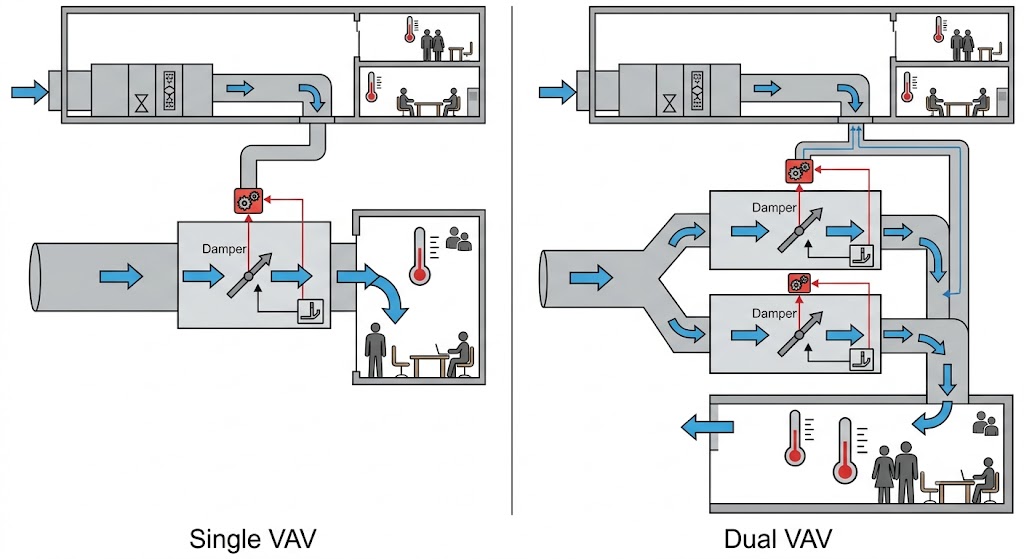
In the conventional single maximum sequence, the box has one maximum airflow setpoint, the airflow needed at peak cooling. As the zone cools toward its cooling setpoint, airflow is reduced toward the minimum, and it stays there as the zone temperature falls further, through the deadband and into heating. When the zone needs heat, the airflow stays at that same minimum and the reheat coil modulates to hold the zone temperature.
This is the sequence most older VAV systems use, and it has a hidden coupling. The minimum airflow is also the heating airflow. It has to be high enough to deliver the zone's design heating load with supply air at a reasonable temperature, and since heating air is limited in temperature, that pushes the minimum up. Typical single maximum minimums are around thirty to fifty percent of the cooling maximum.
The Cost of a High Minimum
A high minimum creates two problems, both rooted in delivering cool air when it is not wanted.
Overcooling in the deadband. When a zone has no cooling load, the box still delivers thirty to fifty percent of its design cooling airflow. That cool air can drag the zone temperature down until it falls into the heating range, which then triggers reheat to undo the cooling. Heat is spent to cancel cooling that was never needed.
Wasted reheat and fan energy. The reheat coil has to warm a large airflow, and the fan has to move it. Both scale with the minimum airflow.
The Dual Maximum Sequence: Two Maximums, One Lower Minimum
The dual maximum sequence introduces a second airflow limit. There is a cooling maximum, as before, and a separate heating maximum. Once the two are decoupled, the minimum airflow no longer has to deliver the heating load, so it can be much lower, typically around ten to twenty percent of the cooling maximum.
The sequence runs in stages.
Cooling. Airflow modulates from the cooling maximum down to the minimum as the zone cools toward setpoint, exactly as before.
Deadband. The box holds the low minimum airflow, delivering little air, so the zone is not overcooled.
Heating. As the zone falls below the heating setpoint, airflow stays at the minimum while the discharge air temperature is reset upward and the reheat coil ramps up. If the zone still needs more heat once the discharge air temperature reaches its design limit, the airflow is increased, from the minimum up toward the heating maximum. That heating maximum is typically up to about fifty percent of the cooling maximum, and the standard allows it to be as high as that.
The key difference is the order of operations. Heat is first added by raising the temperature of a small airflow, and only when that is not enough is more air delivered.
Why Discharge Air Temperature Matters
Dual maximum control depends on a discharge air temperature sensor in the box, because the sequence manages the temperature of the supply air in heating mode. The discharge air temperature is typically held at or below roughly ninety degrees Fahrenheit. Keeping the air from getting too hot matters because very warm air from overhead diffusers tends to stratify at the ceiling and short circuit to the return, leaving occupants cold at floor level. Guideline 36 notes that the energy standard also limits overhead supply air to twenty degrees Fahrenheit above space temperature.
This is also why the sequence needs modulating heat, a modulating hot water valve or modulating electric heater, so it can hold a steady discharge air temperature instead of switching on and off.
What the Minimum Becomes
With the minimum no longer tied to heating, what sets it? Under Guideline 36's dual maximum logic, the minimum airflow setpoint is the larger of two values: the zone's minimum outdoor air rate and the lowest setpoint the box controls can reliably maintain. In other words, the minimum falls to the ventilation requirement, or to the controllable limit of the box, whichever is higher. This is the same set of constraints discussed in the article on reading a VAV box sequence.
What Savings to Expect
The research on lower minimums is substantial, though results depend on building and climate. ASHRAE Research Project 1515 compared high minimums of thirty to fifty percent with low minimums of ten to fifteen percent in a large campus facility, finding reductions in heating energy of about twelve percent and in cooling and fan energy of about fifteen percent. A separate study across ASHRAE climate zones reported average savings of roughly thirty one percent from reducing minimums from thirty percent to ten percent. Another analysis found that resetting the minimum from thirty to twenty percent reduced reheat energy by as much as forty percent. These figures come from different buildings and models, and should be read as indications of scale, not guarantees.
Dual maximum control also tends to improve comfort. Because heat is added at lower airflow and controlled by discharge temperature, there is less supply air temperature overshoot and better modulation of the hot water valve.
Requirements and Practical Considerations
The sequence is not free of requirements. It needs a discharge air temperature sensor and modulating heat in every box, and it needs a controller capable of running the staged logic. Many control vendors supply the sequence as standard. The box must also be able to control airflow stably at the lower minimum, which loops back to the accuracy limits discussed in the first article of this series. And a low minimum cannot go below the zone's ventilation requirement.
Energy codes have caught up with the research. One analysis reports that dual maximum logic has been required for new construction in California's Title 24 since 2008 and in ASHRAE 90.1 since 2013, with minimum flow no larger than twenty percent, so many new buildings already use it. Single maximum sequences remain common in existing buildings, which is where the retrofit opportunity lies.
The Practical Takeaway
The single maximum sequence forces a high minimum airflow because the minimum doubles as the heating airflow. The dual maximum sequence separates the two, letting the minimum fall to the ventilation or controllability limit while heating airflow rises only when the discharge air temperature limit is reached. The result is less overcooling, less reheat, and lower fan energy, in exchange for a discharge air temperature sensor, modulating heat, and a box that can control reliably at low flow.
EveryEng. For everyone in Engineering.
