

Article details
Introduction
Maintaining the correct humidity level is an important part of indoor air quality and HVAC system performance. In commercial buildings, hospitals, industrial facilities, laboratories, and manufacturing plants, humidity control helps protect equipment, improve comfort, and maintain suitable environmental conditions.
Steam humidification is a widely used method of increasing the moisture content of air. It works by introducing steam into an air stream, allowing the steam to mix with the air and raise its relative humidity.
Understanding steam humidifiers, their working principles, sizing calculations, and installation requirements helps HVAC engineers design reliable and energy-efficient systems.
What Is Steam Humidification?
Steam humidification is the process of adding water vapour to air by injecting steam into a room or ventilation system. The steam mixes with the surrounding air and increases its moisture content.
Unlike conventional humidification methods that rely on spraying water droplets or evaporating liquid water, steam humidification introduces moisture in vapour form. This makes it suitable for applications that require accurate and responsive humidity control.
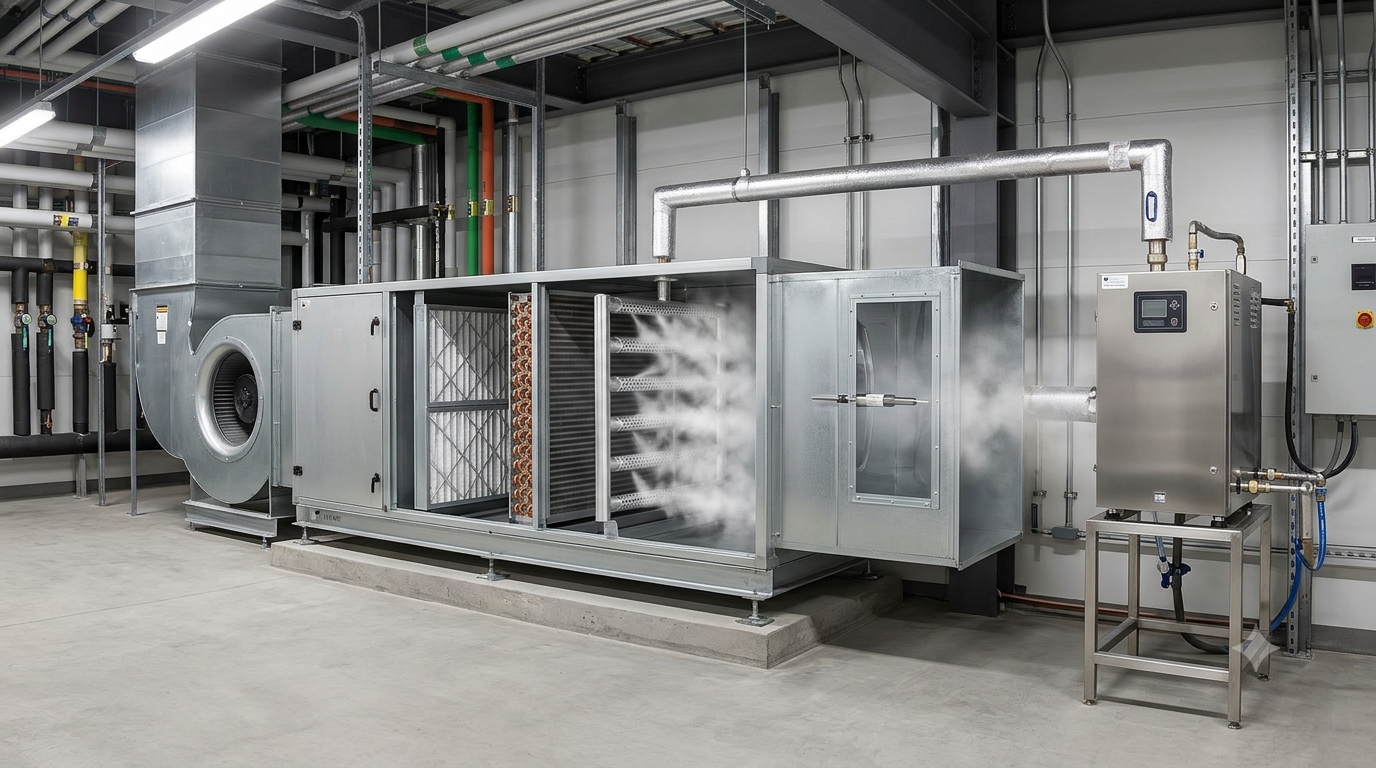
Steam humidifiers can be installed directly in a room or integrated into an air handling unit (AHU) or ventilation duct. The selection depends on the required humidity level, air volume, available steam supply, and building application.
How Does a Steam Humidifier Work?
A steam humidifier converts water into steam and delivers it into the air through a distribution system. The moisture then mixes with the air to achieve the required humidity level.
The basic working process involves the following steps:
Water supply: Water enters the humidifier or steam-generating equipment.
Steam generation: Water is heated until it changes into steam, either within the humidifier or through an external steam supply.
Steam distribution: Steam travels through pipes to a distribution tube or nozzle.
Moisture mixing: Steam is released into the airflow and mixes with the air.
Humidity control: Sensors measure the humidity level, and the control system adjusts steam output according to demand.
Proper steam distribution is essential. If the steam does not mix evenly with the air, it may cause condensation on duct surfaces, damage nearby equipment, or create moisture-related problems.
Types of Steam Humidifiers
Different types of steam humidifiers are available to meet the requirements of HVAC systems and industrial applications.
1. Electric Steam Humidifiers

Electric steam humidifiers use electricity to heat water and produce steam. Depending on the design, they may use electrodes or resistance heating elements.
They are suitable for commercial buildings, offices, laboratories, and facilities where an independent steam supply is unavailable.
2. Direct Steam Injection Humidifiers

Direct steam injection humidifiers use steam supplied by a central boiler or another external source. Steam is introduced into the airflow through specially designed distribution pipes or manifolds.
These systems are commonly used in industrial facilities with an existing steam network. Steam quality, pressure, condensate drainage, and the risk of contamination must be carefully evaluated.
3. Steam Humidifiers with Distribution Manifolds
These systems distribute steam across a wider section of an air duct. The manifold design helps achieve more uniform moisture distribution and supports effective mixing.
The correct manifold size and installation position depend on the duct dimensions, airflow velocity, steam capacity, and required absorption distance.
Steam Humidifier Sizing Calculation
Correct sizing is essential for maintaining the required humidity without wasting energy or creating condensation problems.
The calculation depends on the airflow rate and the difference between the moisture content of the entering air and the desired air condition.
The basic formula is:
[ dot m_w=dot m_{da}(W_2-W_1) ]
Where:
(dot m_w) = required moisture addition rate (kg/h)
(dot m_{da}) = dry-air mass flow rate (kg/h)
(W_1) = entering humidity ratio (kg water/kg dry air)
(W_2) = target humidity ratio (kg water/kg dry air)
Example Calculation
Consider an HVAC system with an airflow of 3,000 m³/h. Assume that the air density is 1.2 kg/m³ and the humidity ratio must increase from 0.004 to 0.010 kg/kg.
The air mass flow rate is:
[ 3000 times1.2=3600 text{ kgh} ]
The required moisture addition is:
[ 3600 times(0.010-0.004) ]
[ boxed{21.6 text{ kg/h}} ]
Therefore, the theoretical humidification requirement is approximately 21.6 kg/h of steam, assuming the airflow and humidity ratios specified remain constant.
Final equipment selection should also consider design conditions, control range, steam pressure, and manufacturer recommendations.
Factors Affecting Steam Humidifier Performance
Several engineering factors influence the effectiveness of a steam humidification system.
Airflow rate: Higher airflow can increase the amount of moisture required to achieve the target humidity.
Outdoor air conditions: Cold, dry outdoor air can significantly increase humidification demand during winter.
Target relative humidity: Higher humidity requirements generally demand greater moisture addition.
Steam pressure and quality: These affect steam delivery and distribution performance.
Duct dimensions: Duct width and height influence the distribution arrangement and mixing conditions.
Absorption distance: Sufficient space is needed for steam to mix with the air before reaching downstream components.
Engineers should evaluate these factors during system design to avoid insufficient humidification, excessive energy consumption, and condensation.
Installation and Maintenance Requirements
Proper installation helps maintain system efficiency and prevents moisture-related damage.
The steam distribution assembly should be installed where the airflow can absorb the injected steam before it reaches filters, coils, dampers, or other sensitive components.
Steam pipes must be correctly sized, insulated where required, and arranged to manage condensate safely. Humidity sensors should be positioned where they can measure representative air conditions after sufficient mixing.
Regular maintenance should include checking steam distribution components, valves, drains, sensors, electrical connections, and water quality. Maintenance intervals depend on the equipment type, operating hours, and water characteristics.
Applications of Steam Humidification
Steam humidification is used across many industries where stable humidity is important.
Healthcare facilities: Helps maintain specified environmental conditions in selected clinical and healthcare spaces.
Pharmaceutical manufacturing: Supports controlled humidity conditions for manufacturing and storage processes.
Data centres: Helps manage humidity where required by equipment and facility design.
Museums and archives: Helps protect sensitive documents, artwork, and historical materials from unsuitable humidity fluctuations.
Textile manufacturing: Supports process conditions for fibres and fabrics.
Commercial buildings: Improves humidity control in offices, hotels, and large ventilation systems.
The required humidity range varies by application and should be established using the relevant engineering standards and process requirements.
Common Problems in Steam Humidification
Common problems include inadequate moisture output, uneven steam distribution, excessive condensation, sensor errors, and frequent equipment cycling.
These issues may result from incorrect sizing, poor installation, unsuitable control settings, or inadequate maintenance.
To improve performance, engineers should verify the design humidity ratio, confirm the actual airflow, check the steam supply, and ensure that the distribution system provides sufficient absorption distance.
Conclusion
Steam humidification is an important technology for controlling humidity in HVAC systems and industrial environments. By introducing steam into an air stream, it helps maintain suitable moisture levels for occupant comfort, equipment protection, and specialised processes.
Successful system design requires an understanding of humidity ratios, airflow, steam generation, equipment sizing, and installation requirements. Accurate calculations and regular maintenance help engineers achieve reliable humidity control while minimising energy waste and condensation risks.
