

Article details
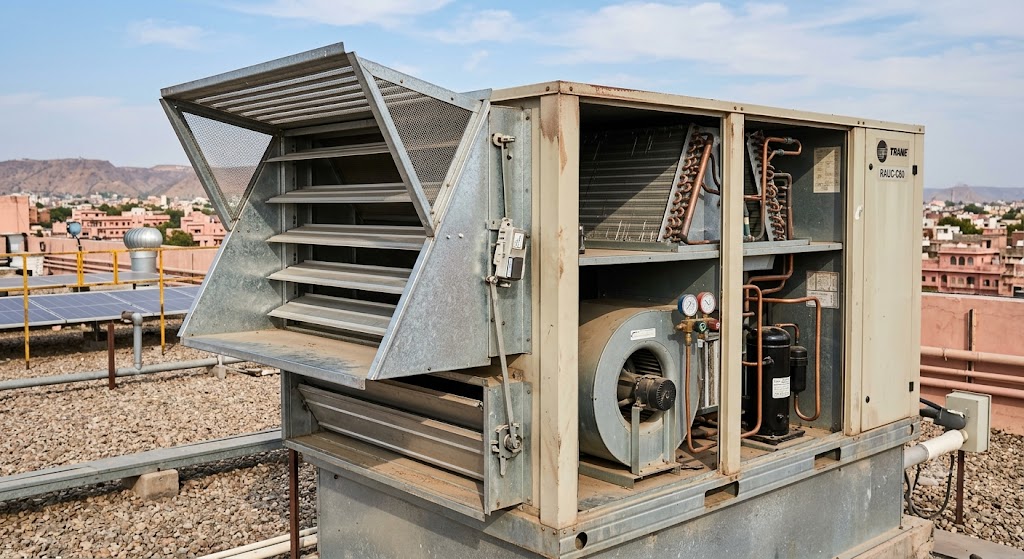
Integrating an economizer with mechanical cooling captures free cooling that an either/or sequence would waste. When the mechanical side is a direct expansion (DX) system, though, integration asks the refrigeration cycle to do something it handles poorly: supply a small, intermittent amount of cooling while very cold outdoor air flows across the coil. Understanding why this goes wrong, and how it is managed, explains a lot about why economizer sequences are designed the way they are.
What the DX System Is Actually Being Asked to Do
In a typical packaged DX unit, an integrated sequence works in stages. On the first call for cooling, the dampers open and the fan runs, so outdoor air alone tries to satisfy the space. If that is not enough, the second call for cooling brings the compressor in alongside the economizer.
On a cool day, this means the economizer covers most of the load, and the compressor is only needed to make up a small remainder. The mechanical system is therefore asked to deliver a fraction of its capacity, for short periods, while the air entering the coil is far colder than the coil was designed to see. That combination is the root of the instability.
Why Cold Entering Air Is the Problem
A DX evaporator is designed around entering air at a typical return or mixed air temperature, with enough heat available to boil the refrigerant at a stable pressure. When the mixed air is mostly cold outdoor air, there is far less heat to absorb. The refrigerant boils less vigorously, suction pressure and evaporating temperature fall, and the coil surface can drop below freezing.
Engineering guidance on economizer design has long noted that operating a simple DX system on one hundred percent outdoor air at low loads can cause coil frosting. Once frost forms, it acts as insulation and as an airflow restriction. Reduced airflow lowers the evaporating temperature even further, which grows the frost, in a self reinforcing loop. This is the same low suction pressure symptom covered in the article on diagnosing suction and head pressure, only here it is produced by the sequence itself, not by a dirty filter or a failing blower.
How Low Load Turns Into Short Cycling
A compressor asked to supply only a small remainder of the load tends to run briefly, satisfy the demand, shut off, and then start again. That is the short cycling pattern, and every cause and cost described in the earlier article on short cycling applies, including the startup stress that wears compressors disproportionately.
The problem compounds because the safeguards that protect the system can make the swings worse. A low pressure cutout or a coil freeze protection device can interrupt a run before the load is met. An anti short cycle timer, covered in the article distinguishing protection from true short cycling, then holds the compressor off for a set period, during which the economizer alone may be unable to hold the space temperature. Engineering guidance describes this chain as low load compressor short cycling leading to refrigerant system instability and coil frosting.
There is also a liquid control risk. A frosted coil cannot boil off refrigerant normally, and if refrigerant leaves the evaporator without enough superheat, liquid can reach the compressor. As covered in the pressure and temperature article, keeping liquid out of the compressor is the reason superheat matters. Service guidance for frozen coils warns against restarting a system with ice still on the coil for exactly this reason. Expansion devices can also struggle to hold stable control when load changes abruptly, which shows up in the field as hunting suction pressure and erratic superheat readings.
Why Standards Do Not Simply Solve It
Energy standards push toward integration, yet they also acknowledge the limits of DX equipment. Earlier approaches to keeping a compressor running at low load often relied on artificially loading it, for example with hot gas bypass, which keeps the compressor on at the price of wasted energy. Later editions of the standard restrict that practice and, according to a conference summary of the 2013 requirements, require certain single zone systems to have a minimum number of cooling stages that depends on capacity. The intent is to give the mechanical side more natural ways to deliver small increments without cycling hard or wasting energy.
The Toolbox for Managing the Risk
Low ambient compressor lockout. The compressor is simply disabled when outdoor air is cold enough that the economizer alone should carry the load. One field study of economizer performance recommended lockout thresholds in roughly the mid fifties to sixty degrees Fahrenheit range, and noted that real installations often had them set lower than necessary. The trade off is that if the economizer fails while the compressor is locked out, there is no mechanical backup in that temperature range, and the result is a hot space and a complaint.
Non integrated sequencing in cold conditions. Some designs deliberately avoid integrated operation for simple DX systems precisely to prevent unstable refrigerant operation and frosting, accepting that they will capture less of the partial free cooling.
Staged or variable capacity compression. A compressor that can run at several capacity levels, or modulate its speed, can supply the small remainder steadily rather than in short bursts, which is the part load behavior discussed in the article on fixed versus variable speed compressors.
Pumped refrigerant economizers. In some data center cooling equipment, the system switches between compressor mode and a mode in which a refrigerant pump circulates liquid with the compressor off. This sidesteps low load compressor cycling entirely, though it introduces its own control considerations, including capacity control, evaporator freeze prevention, and pump protection.
Verification during commissioning. Temperature loggers on the supply, mixed, and return air streams can confirm that the unit behaves as intended. When an integrated economizer is operating correctly and outdoor air sits between supply and return temperature, mixed air and outdoor air temperatures should be nearly identical. A gap suggests damper leakage or a control problem that can quietly feed the instability above.
Why This Is Largely a DX Problem
This risk is mostly specific to compressor based DX equipment, where the cooling source can only be added in steps. A chilled water coil, as noted in the article on integrated and non integrated economizers, can modulate its output smoothly through a control valve, so the economizer and the coil can blend continuously. The mismatch between very small loads and a compressor's minimum practical operating point simply does not arise in the same way.
The Practical Takeaway
Integrated economizers on DX equipment ask the refrigeration cycle to supply small, brief amounts of cooling across very cold air, which promotes coil frosting, compressor short cycling, and unstable refrigerant control. That is why DX economizer sequences rely on tools such as low ambient lockouts, additional cooling stages, variable capacity compression, and in some cases deliberately non integrated operation. The goal of integration is to capture more free cooling. The goal of these safeguards is to make sure that capture does not come at the expense of the compressor.
EveryEng. For everyone in Engineering.
