

Article details
Introduction
Water is one of the most widely used fluids in engineering, industrial processing, and everyday applications. Its unique thermal properties make it essential for heat transfer, cooling systems, steam generation, and energy management. Understanding the thermal properties of water helps engineers design efficient equipment, improve system performance, and maintain safe operating conditions.
These properties vary with temperature and pressure, making them important considerations in thermal and fluid engineering calculations.
Key Thermal Properties of Water
1. Specific Heat Capacity
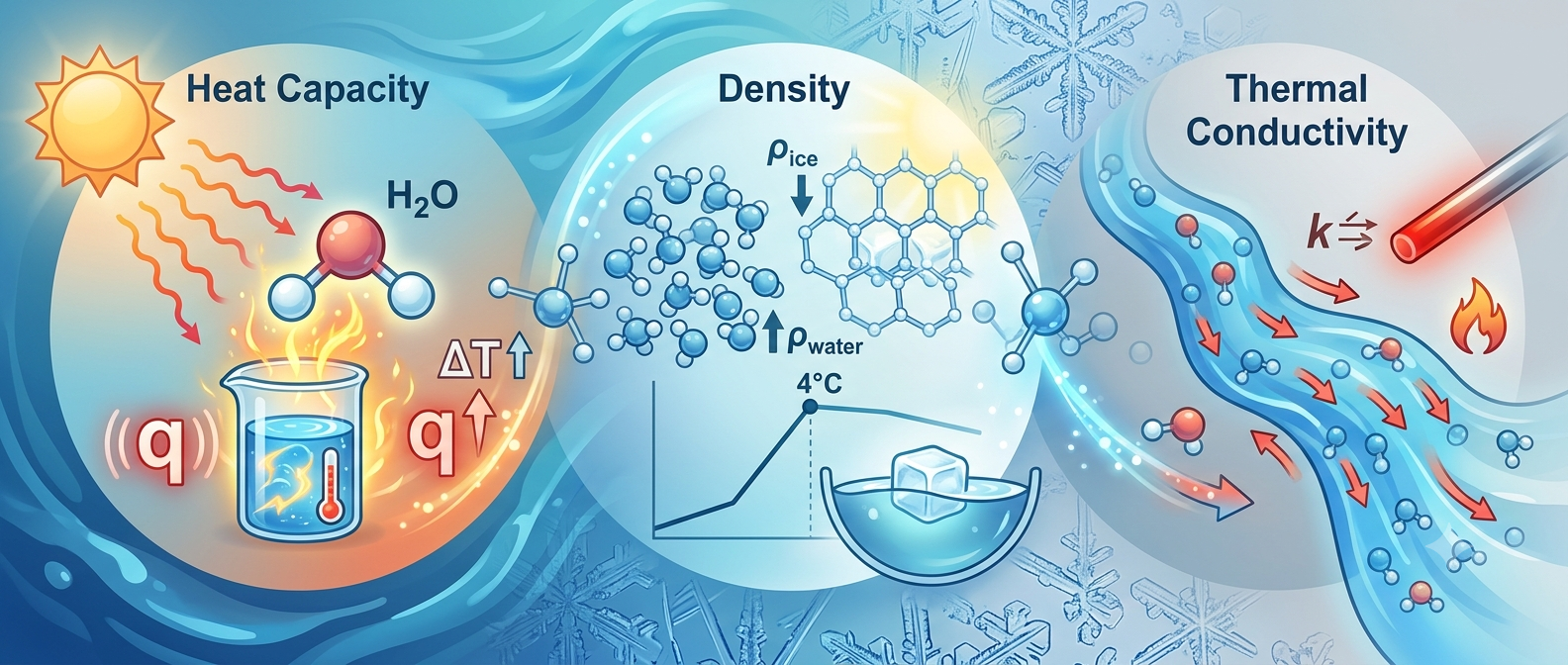
Specific heat capacity is the amount of heat required to raise the temperature of one kilogram of a substance by one degree Celsius. Water has a high specific heat capacity of approximately 4.18 kJ/kg·K under ordinary liquid-water conditions.
This means water can absorb or release significant amounts of heat with relatively small temperature changes. This property makes it suitable for industrial cooling, heating systems, thermal energy storage, and heat exchangers.
Engineers use specific heat capacity to estimate the energy required to heat or cool water in different applications.
2. Density of Water
Density refers to the mass of a substance per unit volume. Water has a density of approximately 998 kg/m³ at 20°C and reaches its maximum density of nearly 1,000 kg/m³ at around 4°C.
As water temperature increases above 4°C, its density generally decreases. This variation affects fluid flow, pressure calculations, pump selection, and hydraulic system design.
Water also behaves unusually when freezing. Ice is less dense than liquid water, which explains why ice floats on the surface.
3. Thermal Conductivity
Thermal conductivity measures a material's ability to transfer heat. Liquid water has a thermal conductivity of approximately 0.60 W/m·K at 20°C.
Although water conducts heat less effectively than metals, it is widely used as a heat-transfer medium because of its combination of thermal conductivity, high specific heat capacity, availability, and relatively low cost.
Thermal conductivity is an important parameter in heat exchanger design, cooling equipment, and industrial temperature-control systems.
4. Viscosity
Viscosity describes a fluid's resistance to flow. Water's viscosity decreases as its temperature rises, meaning warmer water generally flows more easily than colder water under comparable conditions.
This property influences pressure losses in pipelines, pumping power requirements, flow rates, and the performance of hydraulic systems. Engineers consider viscosity when selecting pumps and designing piping networks.
5. Thermal Expansion and Phase Changes
Water expands when heated over most of its liquid temperature range. However, between 0°C and 4°C, its behavior is unusual: it contracts as it warms toward 4°C. Above this temperature, it generally expands with further heating.
At standard atmospheric pressure, water freezes at approximately 0°C and boils at approximately 100°C. During these phase changes, water absorbs or releases latent heat. This characteristic is essential for understanding refrigeration, evaporation, condensation, and steam generation.
Engineering Applications of Water's Thermal Properties
Water's thermal properties are important across several engineering industries:
Mechanical Engineering: Cooling systems, heat exchangers, and thermal equipment.
Chemical Engineering: Process heating, cooling, and temperature control.
HVAC Engineering: Chilled-water systems, boilers, and building climate control.
Power Generation: Steam production, condensers, and cooling circuits.
Civil and Environmental Engineering: Water supply systems, treatment facilities, and thermal studies.
Conclusion
The thermal properties of water, including specific heat capacity, density, thermal conductivity, viscosity, and thermal expansion, play a significant role in engineering design and performance. Understanding how these properties change with temperature and pressure helps engineers make accurate calculations, select suitable equipment, and improve energy efficiency.
For precise engineering applications, property values should be selected for the actual operating temperature and pressure rather than relying solely on standard reference values.
