

Article details
Introduction
Air conditioning systems play an important role in maintaining comfortable indoor temperatures and improving air quality in residential, commercial, and industrial buildings. They help regulate temperature, control humidity, circulate air, and create a suitable indoor environment for people, equipment, and industrial processes.
Different types of air conditioning systems are available to meet specific cooling requirements. The right choice depends on factors such as room size, building design, energy efficiency, installation cost, maintenance needs, and climate conditions.
Understanding the major types of air conditioning systems helps homeowners, engineers, HVAC professionals, and facility managers select the most suitable solution for their applications.
How Does an Air Conditioning System Work?
An air conditioning system removes heat from an indoor space and transfers it to the outdoor environment. Most conventional systems use a refrigeration cycle to achieve this process.
The main components include a compressor, condenser, expansion device, and evaporator. These components work together to circulate refrigerant and transfer heat.
The compressor increases the pressure and temperature of the refrigerant. The condenser releases heat, while the expansion device reduces refrigerant pressure. The evaporator absorbs heat from indoor air, producing a cooling effect.
Depending on the system design, air conditioning equipment may also include air filters, fans, ducts, thermostats, and humidity-control components.
Major Types of Air Conditioning Systems
1. Split Air Conditioning System

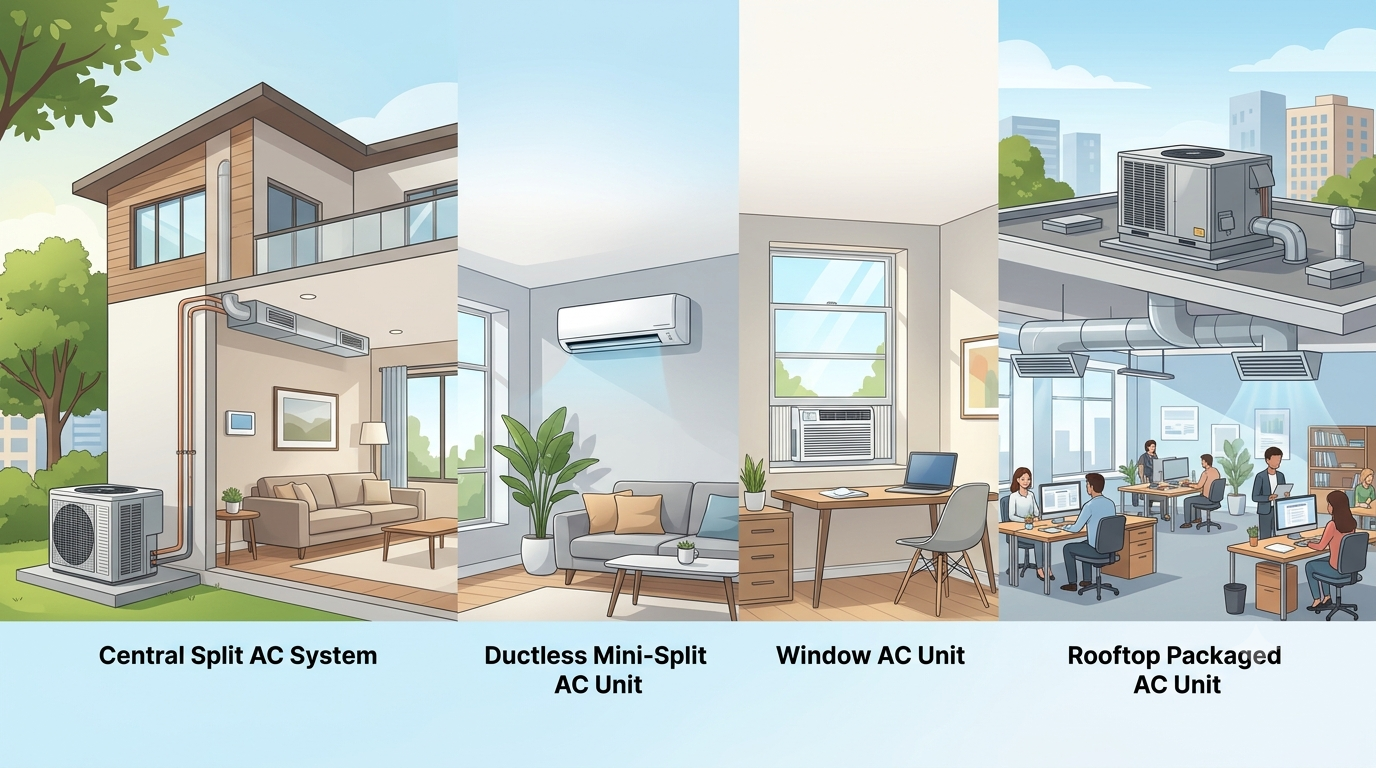
A split air conditioning system consists of two main units: an indoor unit and an outdoor unit. The indoor unit distributes cool air inside the room, while the outdoor unit contains components such as the compressor and condenser.
Refrigerant pipes and electrical connections link the two units. Split systems are commonly used in homes, offices, small shops, and individual rooms.
Key features:
Quiet indoor operation.
Independent temperature control for individual spaces.
No extensive ductwork required.
Available in different cooling capacities.
Advantages: Split air conditioners are relatively easy to install in suitable buildings and offer good comfort for individual rooms.
Applications: Bedrooms, living rooms, offices, small commercial spaces, and meeting rooms.
2. Window Air Conditioning System

A window air conditioner combines the major refrigeration components into a single unit. It is installed in a suitable window or wall opening, allowing the indoor side to cool the room while the outdoor side releases heat.
These systems are often selected for small spaces where a simple, self-contained cooling solution is needed.
Key features:
Compact, single-unit construction.
Relatively straightforward installation.
No separate refrigerant piping between indoor and outdoor units.
Suitable for cooling individual rooms.
Advantages: Window air conditioners can be economical for smaller spaces and are generally easier to replace than complex central systems.
Limitations: They may produce more indoor noise and require a suitable opening with adequate structural support.
Applications: Small apartments, bedrooms, cabins, and compact offices.
3. Central Air Conditioning System

A central air conditioning system provides cooling to multiple rooms or large areas through a central cooling unit and a network of air ducts. Conditioned air is distributed through supply ducts, while return ducts carry air back to the system.
Depending on the design, central systems may use an outdoor condensing unit, an indoor evaporator coil, a furnace or air handler, or chilled water supplied by a central plant.
Central air conditioning is suitable for buildings that require consistent temperature control across several spaces.
Key features:
Cooling for multiple rooms or zones.
Integration with ventilation and air filtration systems.
Potential for centralized monitoring and control.
Compatibility with building management systems.
Advantages: Central systems can provide consistent comfort and keep major equipment away from occupied rooms.
Limitations: Installation can be expensive, particularly when ductwork must be added. Poorly designed or maintained ducts can also cause energy losses.
Applications: Large houses, hotels, hospitals, shopping centres, and office buildings.
4. Ductless Mini-Split System

A ductless mini-split system uses one outdoor unit connected to one or more indoor units. Unlike conventional central air conditioning, it does not require a network of air ducts to distribute cooling.
Multi-zone systems can connect several indoor units to a shared outdoor unit. Each indoor unit may provide separate temperature control for its designated room or zone.
Key features:
Flexible installation.
Individual room temperature control.
Reduced need for ductwork.
Inverter-driven models available for improved efficiency.
Advantages: Ductless systems are useful for buildings without existing ducts and for projects requiring independent room control.
Limitations: Multiple indoor units may affect the appearance of interior spaces, and correct equipment selection is essential for efficient operation.
Applications: Apartments, renovated buildings, small offices, hotels, and room additions.
5. Packaged Air Conditioning System

A packaged air conditioning system combines most or all major refrigeration components in a single cabinet. The unit is commonly installed outdoors, on a rooftop, or in a dedicated service area.
The system supplies conditioned air to the building through ductwork. Packaged units are available in different configurations to suit commercial and light-industrial cooling requirements.
Key features:
Integrated equipment design.
Reduced indoor equipment space requirements.
Compatibility with ducted air distribution.
Available in different capacities and configurations.
Advantages: Packaged systems simplify equipment placement and can make maintenance access easier when the installation is properly planned.
Limitations: Outdoor exposure, installation access, noise, and equipment capacity must be considered during system selection.
Applications: Retail stores, restaurants, schools, small commercial buildings, and offices.
6. Variable Refrigerant Flow (VRF) and Variable Refrigerant Volume (VRV) Systems

VRF and VRV systems use variable refrigerant flow to provide cooling or heating to multiple indoor units connected to one or more outdoor units. VRV is a name associated with a particular manufacturer's technology, while VRF is the general industry term.
The system adjusts refrigerant flow according to the cooling or heating demand of different zones. Heat-recovery configurations can transfer heat from areas requiring cooling to other areas requiring heating, subject to system design.
Key features:
Multiple independently controlled zones.
Variable-capacity operation.
Flexible indoor-unit configurations.
Advanced controls and monitoring options.
Advantages: VRF systems can improve part-load efficiency and provide flexible temperature management in buildings with varying occupancy and thermal loads.
Limitations: Initial costs can be high, and design, refrigerant piping, commissioning, and maintenance require appropriate technical expertise.
Applications: Hotels, office buildings, commercial complexes, and multi-room residential properties.
7. Chilled Water Air Conditioning System

Chilled water systems use a chiller to cool water, which is then circulated to air-handling units or fan coil units throughout a building. The air-handling equipment transfers heat from indoor air to the chilled water, cooling the occupied space.
Chillers may be air-cooled or water-cooled. Water-cooled systems generally use additional heat-rejection equipment, such as cooling towers, where required by the design.
Key features:
Suitable for large cooling loads.
Centralized cooling production.
Integration with building automation systems.
Flexible distribution through chilled-water piping.
Advantages: Chilled water systems are well suited to large facilities where centralized cooling and coordinated plant operation are important.
Limitations: They require more complex equipment, piping, controls, and maintenance than small room air conditioners.
Applications: Hospitals, airports, industrial plants, universities, shopping centres, and large office buildings.
Comparison of Air Conditioning Systems
System type | Best suited for | Main consideration |
|---|---|---|
Split AC | Individual rooms | Requires indoor and outdoor units |
Window AC | Small rooms | Needs a suitable window or wall opening |
Central AC | Whole buildings | Requires distribution ductwork |
Ductless mini-split | Multiple rooms or zones | Indoor units need suitable locations |
Packaged AC | Small to medium commercial buildings | Requires space for a complete unit |
VRF/VRV | Buildings with multiple zones | Advanced design and controls |
Chilled water | Large buildings and facilities | Requires a central chiller plant |
Factors to Consider When Selecting an Air Conditioning System
Choosing an air conditioning system requires more than comparing equipment prices. Engineers and building owners should consider several technical and operational factors.
1. Cooling Load
Cooling load is the amount of heat that must be removed to maintain the required indoor temperature. It depends on room dimensions, occupancy, lighting, equipment, windows, insulation, outdoor conditions, and ventilation requirements.
An HVAC engineer should calculate the cooling load before selecting equipment. Oversized systems may cycle inefficiently or struggle with humidity control, while undersized systems may fail to maintain comfortable temperatures.
2. Energy Efficiency
Energy efficiency affects electricity consumption and operating costs. Equipment ratings such as SEER2, EER, or COP may be relevant depending on the equipment type, market, and applicable standards.
High-efficiency equipment, suitable controls, and correct system sizing can help reduce energy use.
3. Installation Cost and Available Space
The installation cost depends on equipment capacity, piping, ductwork, electrical requirements, structural work, and labour. Buildings with limited ceiling or service space may benefit from ductless or compact equipment configurations.
4. Maintenance Requirements
Regular maintenance helps maintain system performance and reliability. Typical activities include cleaning filters and coils, checking refrigerant circuits, inspecting electrical connections, clearing condensate drains, and verifying control operation.Large systems may also require planned inspections of pumps, cooling towers, water treatment equipment, and air distribution components.
5. Indoor Air Quality
Air conditioning and ventilation are related but different functions. Cooling equipment alone does not necessarily provide sufficient fresh outdoor air. System design should consider ventilation rates, filtration, humidity control, and the intended occupancy of the space to support healthy indoor conditions.
Applications of Air Conditioning Systems
Air conditioning systems are used across many sectors.
Residential buildings: Maintain comfortable indoor temperatures in homes and apartments.
Commercial buildings: Support comfortable environments in offices, shops, hotels, and restaurants.
Healthcare facilities: Help control temperature, humidity, filtration, and ventilation according to specific clinical requirements.
Industrial facilities: Maintain suitable conditions for workers, manufacturing processes, and sensitive equipment.
Data centres: Remove heat generated by servers and other electronic equipment.
Educational institutions: Improve comfort in classrooms, laboratories, libraries, and lecture halls.
Each application may require different temperature, humidity, ventilation, and reliability criteria.
Conclusion
Air conditioning systems range from simple window units and split air conditioners to advanced VRF systems and large chilled water plants. Each type offers different benefits in terms of installation, cooling capacity, energy efficiency, flexibility, and maintenance.
Selecting the right system requires careful evaluation of cooling load, building layout, operating costs, indoor air quality, and long-term maintenance needs. For large commercial and industrial projects, professional HVAC design is especially important to ensure reliable operation and efficient energy use.
A properly selected and maintained air conditioning system can improve occupant comfort, support building operations, and contribute to long-term energy savings.
