

Article details
Introduction
A ventilation system is an essential part of modern buildings, providing fresh air and removing stale air, excess moisture, unwanted odours, and indoor pollutants. It helps maintain a healthy indoor environment while supporting the comfort and well-being of occupants.
Ventilation is important in residential buildings, offices, hospitals, factories, commercial spaces, and other enclosed environments. Without proper airflow, indoor air quality can deteriorate, leading to condensation, mould growth, and discomfort.
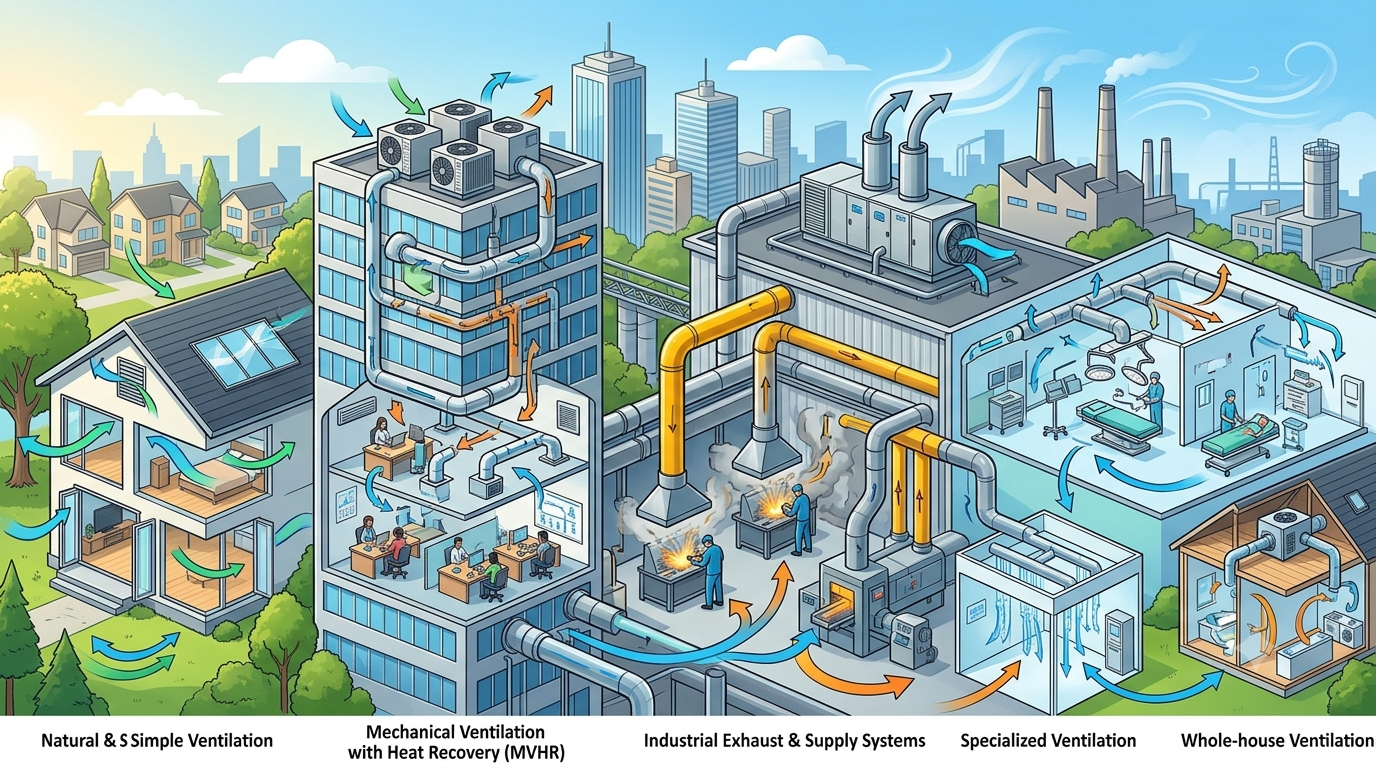
Modern ventilation systems combine natural airflow, mechanical equipment, filtration, and heat recovery technologies to improve indoor air quality and energy efficiency. Choosing the right system depends on building design, climate, occupancy, and ventilation requirements.
What Is a Ventilation System?
A ventilation system is an arrangement designed to introduce fresh outdoor air into a building and remove indoor air that contains pollutants, moisture, heat, or unpleasant odours.
The system may use natural forces, such as wind and temperature differences, or mechanical equipment, such as fans, ducts, filters, and air-handling units, to control airflow.
The main purpose of ventilation is to maintain acceptable indoor air quality and provide a comfortable environment. In industrial facilities, ventilation can also help control airborne contaminants, manage heat, and support workplace safety.
How Does a Ventilation System Work?
The working principle of a ventilation system depends on its design. However, most systems follow a basic process of supplying fresh air, distributing it throughout the building, and removing contaminated indoor air.
1. Fresh Air Intake
Outdoor air enters the building through windows, vents, grilles, or mechanical air intakes. In mechanical systems, filters may remove dust, pollen, and other airborne particles before the air enters occupied spaces.
2. Air Distribution
Fresh air moves through rooms using natural airflow or a network of ducts and diffusers. Proper air distribution helps prevent stagnant areas and supports consistent ventilation.
3. Pollutant and Moisture Removal
Stale air is removed through exhaust vents, extract fans, or mechanical ventilation equipment. This is particularly important in kitchens, bathrooms, laboratories, and industrial workspaces where moisture, odours, or contaminants may accumulate.
4. Airflow Control
Fans, dampers, sensors, and control systems regulate airflow according to occupancy, humidity, air quality, and operating conditions. Advanced systems can adjust ventilation automatically to reduce unnecessary energy consumption.
Types of Ventilation Systems
Different buildings require different ventilation arrangements. The most suitable option depends on the required airflow, energy performance, indoor conditions, and installation costs.
1. Natural Ventilation
Natural ventilation uses wind pressure and temperature differences to move air through a building without relying on powered ventilation fans.
Air enters through windows, doors, vents, and other openings, while stale air exits through available openings or dedicated ventilation paths.
Advantages:
Low operating costs and minimal equipment requirements.
Reduced electricity consumption.
Simple installation in suitable building designs.
Limitations:
Airflow depends on outdoor weather conditions.
Limited control over ventilation rates.
Outdoor noise, dust, humidity, and pollution may enter the building.
Natural ventilation is commonly used in homes, schools, and other buildings where the climate and building layout support effective airflow.
2. Mechanical Ventilation
Mechanical ventilation uses fans and powered equipment to supply fresh air, extract stale air, or perform both functions. It provides greater control over airflow than natural ventilation.
The system may include fans, ducts, air filters, dampers, and control devices. It is suitable for buildings where natural airflow is insufficient or unreliable.
Mechanical ventilation is widely used in commercial buildings, hospitals, factories, underground spaces, and modern residential properties.
3. Exhaust Ventilation
Exhaust ventilation removes indoor air from selected areas using extract fans. As air is removed, replacement air enters through windows, vents, or other openings.
This type of ventilation is commonly installed in bathrooms, kitchens, utility rooms, and small enclosed spaces.
It helps control humidity, remove odours, and reduce the accumulation of airborne contaminants. However, replacement air must enter the building adequately to maintain effective airflow.
4. Supply Ventilation
Supply ventilation uses fans to introduce outdoor air into a building. The incoming air can be filtered and, depending on the system design, heated, cooled, or otherwise treated.
This approach can improve control over the quality and quantity of incoming air. It is useful in buildings that require filtered outdoor air or controlled indoor air pressure.
However, the system must be designed to manage moisture movement, pressure differences, and the removal of stale air.
5. Balanced Ventilation
Balanced ventilation uses separate supply and exhaust fans to introduce fresh air and remove indoor air in a controlled manner.
When properly designed, it helps maintain consistent airflow and reduces dependence on uncontrolled air leakage. It can be particularly useful in airtight buildings where natural air exchange is limited.
Balanced systems may also incorporate heat recovery to improve energy performance.
6. Heat Recovery Ventilation (HRV)
Heat recovery ventilation transfers heat between outgoing stale air and incoming fresh air without intentionally mixing the two airstreams.
During cold weather, heat from the exhaust air can warm the incoming outdoor air. This reduces the heating energy required to maintain indoor comfort.
HRV systems are particularly suitable for energy-efficient buildings in climates where heating demand is significant.
7. Energy Recovery Ventilation (ERV)
Energy recovery ventilation transfers heat and, depending on the equipment, some moisture between outgoing and incoming air streams.
This can help manage both temperature and humidity, especially in climates with high cooling or dehumidification requirements.
ERV systems are often considered for modern homes, offices, and commercial buildings where indoor humidity control and energy efficiency are important.
Benefits of a Proper Ventilation System
A well-designed ventilation system offers several advantages for building occupants and facility operators.
1. Improved Indoor Air Quality
Ventilation dilutes indoor pollutants and removes stale air, odours, and airborne contaminants. When combined with suitable filtration, it can also reduce the amount of dust and pollen entering occupied spaces.
2. Moisture and Humidity Control
Cooking, bathing, cleaning, and industrial processes generate moisture. Proper ventilation removes excess humidity and helps reduce condensation, dampness, and mould growth.
3. Better Comfort and Productivity
Fresh air and effective airflow help create a more comfortable indoor environment. In offices, schools, and workplaces, appropriate ventilation can support occupant well-being and concentration.
4. Improved Energy Efficiency
Ventilation systems equipped with heat or energy recovery can reduce the energy required to heat or cool incoming outdoor air. Automated controls and efficient fans can further improve system performance.
5. Protection of Buildings and Equipment
Controlling humidity and airborne contaminants helps protect building materials, furnishings, sensitive equipment, and industrial machinery from moisture-related damage and unwanted deposits.
Applications of Ventilation Systems
Ventilation systems are used across residential, commercial, and industrial sectors.
Residential buildings: Provide fresh air in bedrooms and living rooms while removing moisture from kitchens and bathrooms.
Commercial buildings: Maintain indoor air quality in offices, shopping centres, hotels, and conference rooms.
Hospitals and healthcare facilities: Support air quality, pressure control, and contamination management according to the requirements of each space.
Industrial facilities: Remove heat, fumes, dust, and process-related contaminants through appropriately designed ventilation and local exhaust systems.
Educational institutions: Improve indoor environmental conditions in classrooms, laboratories, libraries, and workshops.
Warehouses and manufacturing plants: Help manage heat accumulation and provide suitable air movement for workers and operations.
Specialised spaces may require dedicated exhaust systems, local extraction, or controlled-pressure ventilation rather than a standard building ventilation arrangement.
Factors to Consider When Choosing a Ventilation System
Selecting the right ventilation system requires careful assessment of building requirements and operating conditions.
Building Type and Size
The size, layout, occupancy, and intended use of a building determine its ventilation requirements. A small residence may need a simple mechanical system, while a large industrial facility may require several ventilation zones.
Indoor Air Quality Requirements
Buildings with high occupancy, moisture generation, chemical processes, or airborne contaminants may need specialised ventilation and filtration arrangements.
Climate and Humidity
Local weather conditions influence system selection. Heat recovery may be valuable in cold climates, while energy recovery and humidity management can be important in hot or humid environments.
Installation and Operating Costs
The total cost includes equipment, ductwork, installation, electricity consumption, filters, and maintenance. A system with a higher initial cost may provide long-term savings through better energy performance.
Energy Efficiency
Consider fan efficiency, heat recovery performance, airflow controls, and compatibility with the building's heating, ventilation, and air conditioning (HVAC) system.
Maintenance Requirements
Filters, fans, ducts, heat exchangers, and air intakes require periodic inspection and cleaning. Accessible components make routine maintenance easier and help maintain the intended airflow.
Ventilation System Maintenance and Best Practices
Regular maintenance is essential for reliable operation and good indoor air quality
Clean or replace air filters according to manufacturer recommendations.
Inspect fans, motors, belts, and electrical components for wear or damage.
Check air intakes and exhaust outlets for obstructions.
Clean ducts and ventilation grilles when necessary.
Inspect heat recovery components and condensate drainage systems.
Verify airflow rates and system balance during commissioning and periodic checks.
Monitor humidity and indoor air quality where appropriate.
Maintenance schedules should reflect equipment specifications, operating hours, environmental conditions, and the type of contaminants present.
A ventilation system should also be designed and installed by qualified professionals to meet applicable building codes, fire safety requirements, and ventilation standards.
Ventilation vs. Air Conditioning
Ventilation and air conditioning perform different functions, although they often work together within an HVAC system.
Ventilation introduces outdoor air and removes indoor air to support indoor air quality. Air conditioning primarily controls indoor temperature and may also manage humidity and filter recirculated air.
An air conditioner does not necessarily provide sufficient outdoor air for ventilation. Similarly, a ventilation system does not always provide the cooling or heating required to maintain thermal comfort.
Combining appropriately designed ventilation and air conditioning helps maintain both healthy indoor air and comfortable temperatures.
Conclusion
Ventilation systems play an important role in maintaining indoor air quality, controlling moisture, improving occupant comfort, and supporting energy-efficient building operation. Natural ventilation, mechanical ventilation, exhaust systems, supply systems, balanced ventilation, HRVs, and ERVs each offer different benefits depending on the application.
Choosing the right system requires consideration of building design, climate, indoor air quality, energy consumption, installation costs, and maintenance needs. With proper design, installation, and regular servicing, a ventilation system can provide reliable airflow and contribute to a healthier, more comfortable, and more efficient indoor environment.
