

Article details
A horizontal refrigerant line only has to push oil along. A vertical riser has to lift it against gravity, and it has to keep doing so on the worst day, when the system is running at a fraction of capacity. That combination makes the suction riser the single most failure prone piece of refrigerant piping. Understanding why, and what the double riser does about it, is the heart of getting oil return right.
Why Risers Are Harder Than Horizontal Runs
In a vertical suction line, oil is carried up the pipe by the moving refrigerant vapor. If the vapor slows below a certain speed, the oil stops climbing and drains back down the wall. It collects at the bottom of the riser, where it can pool and, over time, deprive the compressor of lubricant.
Gravity works in your favor in the opposite case. When flow in a vertical line is downward, oil returns at any velocity, even the lowest, because gravity carries it along with the gas. This is why the concern is concentrated in upward risers.
Minimum Velocity: The Numbers Vary
How fast is fast enough depends on the pipe, the refrigerant, and the oil, and published guidance does not agree on a single figure. A few representative values:
Source type | Horizontal minimum | Vertical riser minimum |
|---|---|---|
Manufacturer piping guide | about 800 fpm | about 1,200 fpm |
Rooftop unit installation manual | not stated | 1,000 fpm general guideline, 1,500 fpm for variable capacity compressors at full load with flow up |
Metric trade guidance | 2.5 m/s | 5 m/s |
The same rooftop manual also notes that the velocity required to return oil depends on the pipe diameter, which is a reminder that a single number is always a simplification. These are illustrations of scale. Actual design should follow the manufacturer's guidance for the specific refrigerant, oil, and equipment.
Why Part Load Breaks a Riser
Velocity in a pipe is proportional to the refrigerant flow through it, and flow falls with capacity. A riser that carries oil comfortably at full load can fall well below its minimum velocity when the system unloads.
Part load comes in several forms: a compressor with capacity steps that unloads, a multiple compressor system with some compressors off, a variable capacity compressor running slowly, or a multi evaporator system where only one evaporator is calling for cooling. In one patent example, the minimum expected load arose when a single evaporator was running while the others were shut off.
One manufacturer's worked example illustrates the scale. A ten ton system with a minimum capacity of thirty five percent produces 3.5 tons at its lowest step. At that load, the riser sized for full capacity delivered a velocity of roughly 400 feet per minute, far below the riser minimum of about 1,200. That riser would not return oil at part load.
The obvious fix is to make the riser smaller, but that creates a different problem. A riser sized for the minimum load would carry the combined flow of the full capacity case at a very high velocity, producing a pressure drop that is excessive whenever the load exceeds the design load of the small riser. The designer is caught between oil return at low load and pressure drop at high load.
The Check: Oil Return at Minimum Load
Manufacturer procedures treat oil return at minimum load as an explicit step in line sizing. Estimate the minimum capacity by multiplying the unit capacity by its turndown ratio. Then compare that to the minimum capacity at which the chosen riser size will return oil, which is published in tables by pipe size.
A worked example from one guide: a 250 ton unit with a turndown of 0.33 gives a minimum capacity of 82.5 tons. The riser size under consideration needs at least 62 tons to return oil, so the riser is acceptable. If the minimum riser capacity had been above 82.5 tons, the riser would have failed the check and the design would need to change.
The Double Riser: How It Works
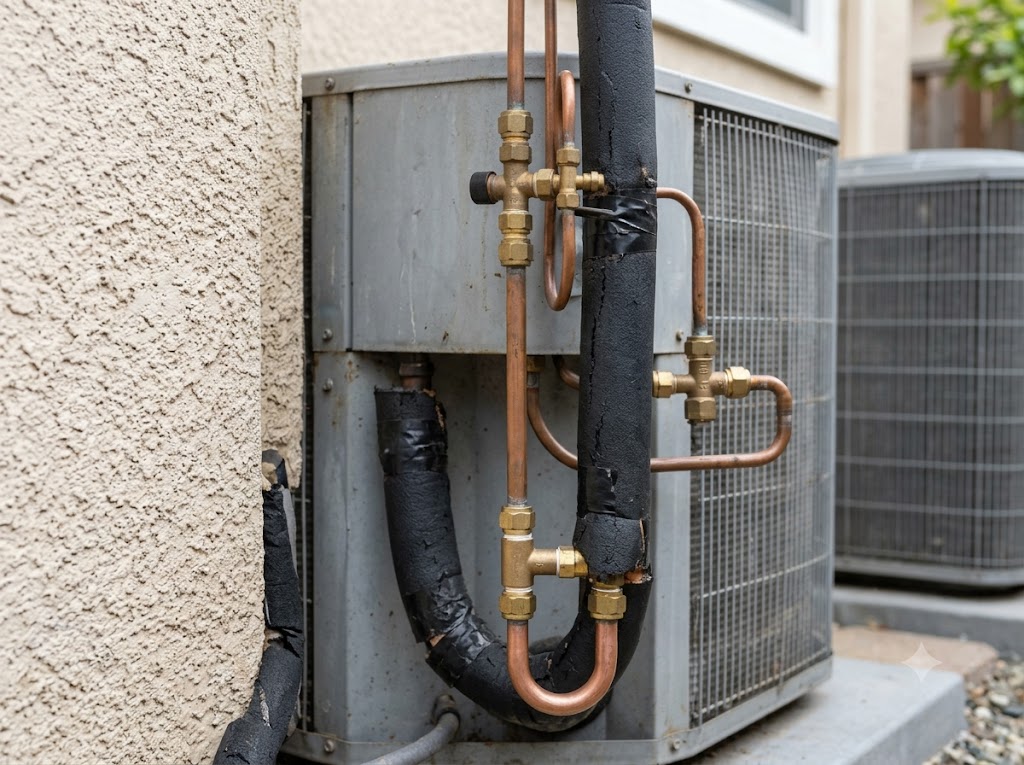
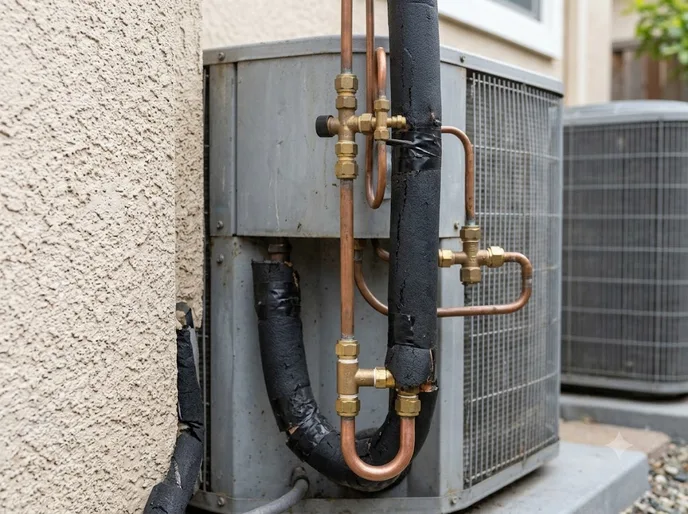
When a single riser cannot satisfy both conditions, the classic answer is the double riser, which uses two risers in parallel with a trap at the base of the larger one.
At full capacity, the gas velocity is high enough to carry oil up both risers, so refrigerant flows through both and the combined area keeps pressure drop acceptable.
At minimum capacity, the gas slows and cannot lift oil up the larger riser. Oil drains back and gradually fills the trap at the bottom of the large riser, sealing it off. All of the refrigerant is now forced up the smaller riser, which is sized so that velocity is sufficient to return oil at minimum capacity.
When capacity rises again, the gas flow clears the oil out of the trap and refrigerant returns to the larger riser.
In sizing terms, the small riser is sized for oil return at the lowest capacity step, and the large riser is sized so that the two together give an acceptable pressure drop at full load.
The Costs of a Double Riser
A double riser solves the velocity dilemma, but not without costs. The trap holds a significant amount of oil, which is oil that is not in the compressor sump. And when capacity increases, that stored oil can be blown through the piping and back to the compressor in a large slug. Guidance therefore calls for the trap to be close coupled to the large riser, keeping its oil holding capacity to a minimum.
Some manufacturers go further and recommend designing systems without a double suction riser wherever the application allows it, noting that many applications can be met with a single riser and sensible circuiting. They also point out that in systems with multiple compressors, the oil lost to the trap is less problematic than it would be in a single compressor system. This is a real design preference, not just a theoretical one, and it is worth knowing before reaching for a double riser by habit.
Traps in Tall Risers
Tall risers pose a related problem. Oil that falls back must have somewhere to collect, and a long vertical run without interruption lets it fall a long way. Guidance for traps in tall risers differs. One rooftop manual suggests a trap every twenty feet in vertical suction riser sections, while another guide calls for an additional trap for each 7.5 metres of rise above the base trap, and says a trap may be eliminated entirely on a very short riser of less than about 2.5 metres.
The Practical Takeaway
A suction riser has to lift oil against gravity, and the speed needed to do that is fixed by the pipe, not by the load. When the system unloads, velocity falls and oil return is at risk. The designer has to confirm oil return at the minimum load, not just the pressure drop at full load. When no single riser satisfies both, a double riser with a base trap keeps oil moving at low load and low pressure drop at high load, at the price of stored oil and a risk of oil slugs when the system loads up. Many guides therefore treat the double riser as a last resort, not a default.
EveryEng. For everyone in Engineering.
