

Article details
A system that turns on, runs for just a few minutes, and shuts off again, then repeats this pattern over and over, is short cycling. It's one of the most common HVAC complaints in the field, and also one of the most consistently misunderstood, because the symptom (rapid on/off cycling) can point to several genuinely different underlying causes, each with a different fix and a different long-term cost.
What Short Cycling Actually Is
A properly operating system should run for a reasonable, sustained period once it starts, long enough to actually satisfy the load it was sized for, then shut off and stay off for a reasonable period before starting again. Short cycling breaks that pattern: the system starts, runs briefly, stops, and starts again far more frequently than normal operation would require.
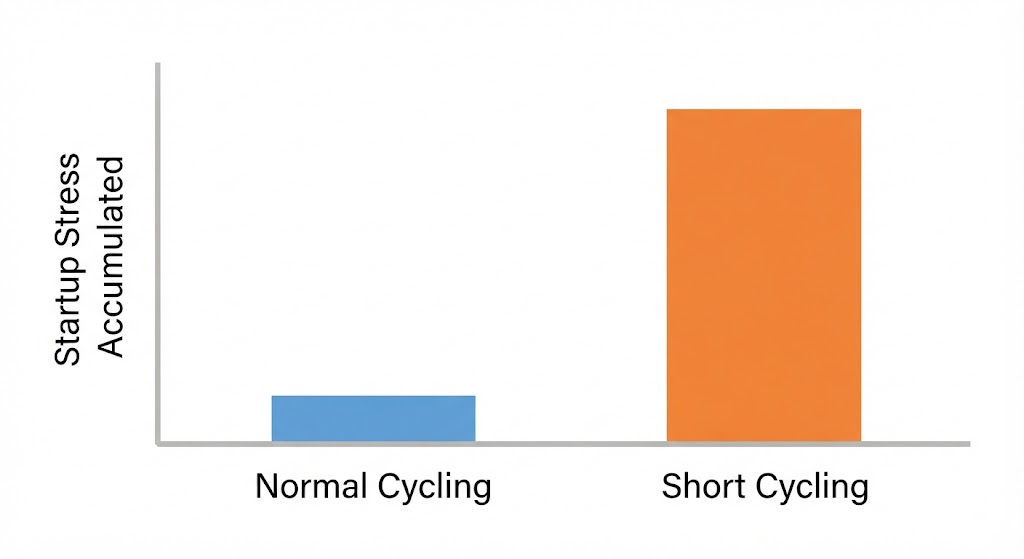
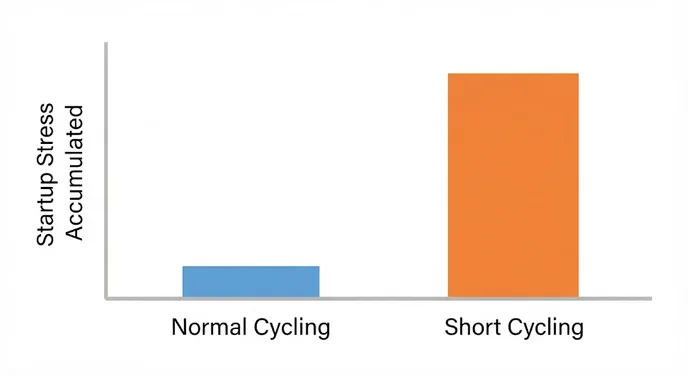
This matters because a compressor's startup moment is mechanically and electrically the most stressful part of its operating cycle. Starting current draw is significantly higher than running current, and the mechanical components experience the highest stress during that initial startup surge. A system that starts and stops constantly is subjecting its compressor to that stressful startup condition far more often than a properly cycling system would.
The Common Causes, and Why They Matter Individually
Oversized equipment is one of the most frequent root causes. A system sized well beyond the actual load of the space satisfies the thermostat setpoint very quickly, simply because it has more capacity than the space needs, then shuts off, only to need to restart again soon after because it never ran long enough to stabilize conditions properly. This is a design and selection problem, not a mechanical fault, and it's why correct load calculation matters well beyond simply avoiding an undersized system that can't keep up. Oversizing carries its own real cost.
A dirty or restricted air filter reduces airflow across the evaporator coil. Reduced airflow can cause the coil to get too cold, sometimes cold enough to freeze, which trips a safety control and shuts the system down prematurely, well before the actual load has been satisfied. The system then restarts once things thaw and return to normal, only to repeat the same restricted airflow problem again shortly after.
A malfunctioning or poorly placed thermostat can cause short cycling in a different way entirely. A thermostat placed near a heat source, in direct sunlight, or near a supply air vent can read temperatures that don't represent the actual space, causing it to satisfy and call for cooling far more erratically than the real conditions in the room would justify.
Refrigerant charge problems, whether undercharged or overcharged, can cause abnormal pressures that trip safety controls (high pressure or low pressure switches) prematurely, shutting the system down before it's actually satisfied the load, then allowing it to restart once pressures normalize enough for the safety switch to reset.
Electrical control issues, a failing contactor, a faulty capacitor, or a compromised control board, can also cause erratic starting and stopping that has nothing to do with the refrigeration cycle itself, but produces the same visible symptom.
What This Actually Costs Over Time
Short cycling isn't just an annoyance or an inefficiency. It has real, compounding costs that often aren't obvious until a failure actually happens.
Compressor wear accelerates disproportionately. Because startup is the most mechanically and electrically stressful moment in a compressor's operating cycle, a system that starts far more often than it should is accumulating a disproportionate share of its total lifetime wear during those startup events, not during steady running time. A compressor rated for a certain number of operating hours can fail well before reaching that hour count if a large share of its cycles are short, stressful starts rather than longer, steady runs.
Energy efficiency drops. A compressor uses more energy relative to the cooling or heating it actually delivers during startup and the first portion of a run, before it stabilizes into efficient steady state operation. A system that never runs long enough to reach that stable, efficient portion of its cycle is spending a disproportionate share of its total runtime in the least efficient part of its operation.
Comfort and humidity control suffer. As covered in the distinction between sensible and latent heat, adequately dehumidifying a space requires sustained coil runtime, not just satisfying a temperature setpoint. A short cycling system, even one keeping temperature technically within range, often fails to run long enough to meaningfully address humidity, leaving a space feeling worse than the thermostat reading would suggest.
Component fatigue compounds across the whole system, not just the compressor. Contactors, capacitors, and other electrical components are also rated for a certain number of switching cycles, and excessive cycling shortens their expected service life in the same way it shortens the compressor's.
Diagnosing Rather Than Just Treating the Symptom
Because short cycling has several genuinely different root causes producing the same visible symptom, the diagnostic approach matters. Checking airflow and filter condition first is usually the quickest and cheapest thing to rule out. Confirming the thermostat's location and readings against actual space conditions is next. Verifying refrigerant charge against manufacturer specifications, and inspecting electrical components for wear or failure, generally follow if the simpler causes have been ruled out. Treating the symptom (for example, adjusting a control timer to artificially limit cycling frequency) without identifying and correcting the actual root cause typically just masks the problem rather than solving it, while the underlying issue continues degrading the system in the background.
EveryEng. For everyone in Engineering.