Skip to main contentEngineering Courses, Mentoring & Jobs | EveryEng
Analysis of Simply Supported Beam with UDL using Ansys APDL banner

Analysis of Simply Supported Beam with UDL using Ansys APDL

Analysis of Simply Supported Beam with UDL using Ansys APDL banner
Self-paced Beginner

Analysis of Simply Supported Beam with UDL using Ansys APDL

4(1581)
11 enrolled
2534 views
FREE
11 min
Anytime
English
2534 views
Team EveryEng
Team EveryEngMechanical Engineering
  • Lifetime access
  • Certificate of completion
  • Foundational Learning
  • Access to Study Materials

Why enroll

By the end of the course, students will have developed a proficient understanding of the analysis of simply supported beams with UDLs using ANSYS APDL. They will be equipped with practical skills that can be applied to solve complex engineering problems and optimize the design of structural systems in diverse industries.

What enrolled engineers say

10 verified reviews
  • Feb 25, 2026

    At first glance, the topics looked familiar, but the depth surprised me. The walkthrough of a simply supported beam with UDL in ANSYS APDL was basic in theory, yet it forced a more disciplined setup than what many of us do out of habit. In aerospace work on wing secondary structures and in automotive chassis rail analysis, these beam assumptions show up more often than we like to admit, especially early in concept phases. One challenge was translating textbook boundary conditions into APDL commands without accidentally over‑constraining the model. The course highlighted that edge case well—how a “simple support” in theory can quietly become fixed if you’re not careful with DOFs. That’s something I’ve seen cause stiffness errors in both fuselage floor beams and ladder-frame automotive designs. A practical takeaway was the parametric definition of load intensity and span. That approach mirrors industry practice when running quick load sweeps before committing to detailed shell or solid models. It also made the system-level implication clear: even a small modeling shortcut at the beam level can cascade into bad load paths later in an assembly. The examples stayed grounded, and the APDL focus helped reinforce why automation still matters despite modern GUIs. It definitely strengthened my technical clarity.

    Piyush P. Verified
  • Feb 25, 2026

    Coming into this course, I had some prior exposure to the subject, mostly from hand calculations and black‑box FEA runs at work. What was missing was a clear link between theory and how to actually set it up in ANSYS APDL. The walkthrough on simply supported beams under UDL helped close that gap. The examples felt relevant to things I see in practice, like checking load paths in an automotive ladder frame cross‑member or doing first‑pass sizing on an aerospace wing spar. Seeing how boundary conditions and UDLs are defined in APDL, rather than just clicking through Workbench, was useful. One challenge was getting comfortable with the APDL syntax and understanding why a small mistake in constraints completely changes the bending moment diagram. That took a bit of trial and error. A practical takeaway was learning how to parametrize beam length and load so results can be quickly rerun for different cases. That’s something I can apply right away for quick sanity checks before heavier models. It’s a beginner course, but it filled a real knowledge gap for scripting-based analysis. Overall, it felt grounded in real engineering practice.

    sarath S. · Offshore Construction Engineer Verified
  • Feb 25, 2026

    This course turned out to be more technical than I anticipated. Even at a beginner level, it went straight into how a simply supported beam with a UDL is actually set up and solved in ANSYS APDL, not just the theory from textbooks. Coming from automotive structures work, the beam modeling felt very similar to early chassis rail studies, and the same logic clearly applies to aerospace components like wing spars under distributed loads. One challenge was getting comfortable with APDL syntax, especially defining boundary conditions correctly at the supports and applying the UDL without over‑constraining the model. A small mistake there throws off deflection results quickly. The walkthrough helped close a knowledge gap around how BEAM elements behave compared to hand calculations. A practical takeaway was learning how to build a reusable, parametric APDL script that outputs deflection and bending stress directly. That’s already been useful for quick checks before running heavier FEA models on real projects. The content felt aligned with practical engineering demands.

    Prathik P. Verified

Is this course for you?

You should take this if

  • You work in Aerospace or Automotive
  • You're a Civil & Structural / Mechanical Engineering professional
  • You prefer self-paced learning you can revisit

You should skip if

  • You need a different specialisation outside Civil & Structural
  • You need live interaction with an instructor

Course details

This course offers a detailed exploration into the analysis of simply supported beams subjected to uniformly distributed loads (UDL) using ANSYS APDL (ANSYS Parametric Design Language). Simply supported beams are common structural elements found in various engineering applications, and understanding their behavior under UDLs is crucial for designing safe and efficient structures.

Course suitable for

Key topics covered

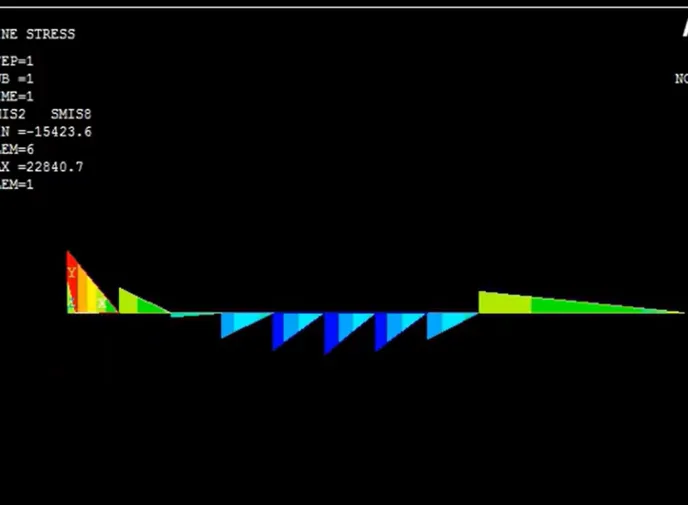
  • Shear Force and Bending Moment Diagram

  • Modeling of beam

Course content

The course is readily available, allowing learners to start and complete it at their own pace.

2 lectures11 min
  1. Shear Force and Bending Moment Diagram
    5 min
  2. Modeling of beam
    6 min

Opportunities that await you!

Skills & tools you'll gain

ANSYS

Career opportunities

Why people choose EveryEng

Industry-aligned courses, expert training, hands-on learning, recognized certifications, and job opportunities-all in a flexible and supportive environment.

What learners say about this course

Engineering Academy
Engineering Academy Engineer
Aug 4, 2026

Execellent Course

Aryan Raj Pandey
Aryan Raj Pandey Social Media Manager
Feb 25, 2026

At first glance, the topics looked familiar, but the depth surprised me. The course isn’t about engineering theory, yet it solved a real workflow problem I kept running into at work. Uploading technical material sounds trivial until you’re dealing with mixed content like an automotive CAN bus overview and a household appliance teardown on motor control. The demo showed exactly how to structure courses versus articles, and where seminars fit, which cleared up a gap I had around categorization. One challenge during my first try was getting the formatting right so diagrams and code snippets didn’t break on the site. The course walked through that process step by step, including image sizing and basic metadata, which saved me time. Another useful part was understanding how tags affect discoverability; that’s something I hadn’t paid attention to before. The biggest practical takeaway was a simple upload checklist that I now follow before publishing anything. It’s already helped me push internal training content faster without rework. Overall, it felt grounded in real engineering practice.

MILIND AMBARDEKAR
MILIND AMBARDEKAR Self employed
Feb 25, 2026

Initially, I wasn’t sure what to expect from this course. Coming from an automotive background, CFD had always felt a bit like a black box beyond post-processing plots. The sections on the Navier–Stokes equations and finite volume discretization helped connect the math to what’s actually happening in the solver. Seeing how grid generation and boundary layer resolution affect results made a lot of sense, especially when thinking about under-hood airflow and thermal management in automotive applications. One area that stood out was the discussion around convergence and stability. A real challenge during the assignments was dealing with a case that simply wouldn’t converge because of poor meshing near walls. That was frustrating, but also realistic. In aerospace projects, especially around external aerodynamics and airfoil analysis, the same issues show up if y+ and turbulence modeling aren’t handled carefully. A practical takeaway was learning a basic checklist before trusting results: mesh quality, residual trends, and sensitivity to boundary conditions. That’s already been applied to a cooling flow study at work. Overall, it felt grounded in real engineering practice.

Ayshwarya Mahadevan
Ayshwarya Mahadevan Engineer
Jan 27, 2026

good

FREE

Access anytime

Questions and Answers

A: Midspan moment comes from wL^2/8. No load sharing fantasy — supports don't reduce peak moment. The 192 MPa path mixes N/mm with meters. The 64 MPa route uses the second moment formula as if it were section modulus, a classic units slip.

A: Contracts lock the technical baseline. Auditors don't rewrite contracts. Picking the most conservative value sounds safe but can breach agreed requirements. Internal standards don't outrank external codes without contractual teeth.

A: BEAM188 uses local axes for surface loads. Units are user-consistent; APDL doesn't auto-convert but that's not the mismatch here. Arrows are clear enough. The support statement ignores basic statics.

A: Plugging rough numbers gives millimeter scale. Microns ignore L^4. Centimeters overshoot because EI isn't that low. Assuming fixity invents stiffness not in the problem.