<link href="https://fonts.googleapis.com/css2?family=Caveat:wght@500;700&family=JetBrains+Mono:wght@400;500;600&display=swap" rel="stylesheet" /> Skip to main contentEngineering Courses, Mentoring & Jobs | EveryEng
Design and Selection of Spring Hanger Supports using Caesar II banner
Preview this course

Design and Selection of Spring Hanger Supports using Caesar II

Design and Selection of Spring Hanger Supports using Caesar II banner
Preview this course
Self-paced Beginner

Design and Selection of Spring Hanger Supports using Caesar II

4(408)
4 enrolled
3532 views
₹ 699
133 min
Anytime
English
3532 views
Anup Kumar Dey
Anup Kumar DeyOwner of https://whatispiping.com/
  • 7-day money-back guarantee
  • Lifetime access
  • Certificate of completion
Volume pricing for groups of 5+

Why enroll

Completing "Design of Spring Hanger Supports using Caesar II for Pipe Stress Analysis" elevates career prospects for pipe stress engineers, designers, and analysts in the oil and gas, chemical, and process industries. Professionals can transition into senior roles like Senior Pipe Stress Engineer, Support Systems Specialist, or Design Lead, or specialize in pipe support design, spring hanger selection, and stress analysis. Mastering the design of spring hanger supports using Caesar II enhances job prospects, earning potential, and leadership opportunities, ensuring efficient and safe piping system operation, and optimal support system design.

What enrolled engineers say

5 verified reviews
  • Feb 25, 2026

    Initially, I wasn’t sure what to expect from this course, especially with it being labeled beginner. Coming from oil & gas projects and some exposure to energy utilities work, spring hangers were something handled before, but mostly by rule of thumb or vendor input. The course helped close that gap by walking through how variable and constant spring hangers are actually sized and checked inside Caesar II. The most useful parts were the load analysis discussion and how thermal expansion drives support selection on hot lines, like refinery steam and heater outlet piping. Seeing how operating vs. sustained cases affect spring selection was directly relevant to issues seen on a gas processing project last year. One challenge was keeping track of the different load components and not over‑constraining the model in Caesar II, especially when space constraints were introduced. A practical takeaway was a clearer step‑by‑step approach for setting up spring hanger data and verifying load variation limits before finalizing supports. That alone should cut down on back-and-forth with stress and support teams. This feels applicable beyond training exercises, and I can see this being useful in long-term project work.

    Fadzilah S. Verified
  • Feb 25, 2026

    Coming into this course, I had some prior exposure to the subject from oil & gas piping work, mostly reviewing spring hanger datasheets rather than actually sizing them. The Caesar II walkthrough helped connect the theory to what we typically see in refinery and power plant layouts, especially around thermal expansion cases and sustained vs operating load checks. The discussion on variable versus constant spring hangers was useful, including edge cases where small vertical movements can still drive you toward a constant due to load variation limits. One challenge was that the course is labeled beginner, but keeping track of load combinations in Caesar II can still get confusing if you’re not careful with boundary conditions and support stiffness assumptions. A few examples required slowing down and re-running models to see why results shifted. A practical takeaway was being more deliberate about checking installation constraints and travel limits early, not after stress results are finalized. That aligns better with how energy utilities projects avoid late field changes. Compared to some industry practices, this approach felt more systematic. The content felt aligned with practical engineering demands.

    Murali S. · sr mechanical engineer Verified
  • Feb 25, 2026

    This course turned out to be more technical than I anticipated. Even though it’s tagged beginner, the walkthrough in Caesar II went deeper than the slide titles suggest, especially around variable versus constant spring selection. The examples felt familiar to oil & gas steam lines and energy utilities piping, where sustained loads and hot operating cases don’t always behave cleanly. One challenge was mentally reconciling the simplified training model with messy real layouts. In actual refineries or power plant headers, installation constraints and steel congestion often force compromises that Caesar II doesn’t flag unless you deliberately test edge cases. That gap took some effort to bridge while following along. What worked well was the focus on load breakdown—pipe, fluid, insulation—and how that feeds directly into spring sizing. The practical takeaway was learning to sanity-check spring travel and load variation against typical industry limits, instead of blindly accepting the software output. That’s something junior engineers often miss in practice. Compared to how spring hangers are sometimes selected from vendor tables under schedule pressure, this approach was more systematic. It definitely strengthened my technical clarity.

    Elamurugu P. · Senior engineer Verified

Is this course for you?

You should take this if

  • You work in Oil & Gas Downstream or Energy & Utilities
  • You're a Piping & Layout Engineering / Mechanical Engineering professional
  • You prefer self-paced learning you can revisit

You should skip if

  • You need a different specialisation outside Piping & Layout Engineering
  • You need live interaction with an instructor

Course details

One critical component in this support system is the spring hanger, a device designed to absorb and isolate the dynamic forces that can impact a piping system.

Spring hangers are mechanical devices used to support piping systems by compensating for thermal expansion, vibration, and other dynamic forces. By providing a flexible connection between the pipe and its support structure, spring hangers help mitigate the stresses that can lead to premature wear, fatigue, and failure of the piping system. These devices are particularly crucial in industrial settings where temperature variations, machinery vibrations, and other external forces are common.

Design Considerations:

1.     Load Analysis:

o   Conduct a thorough analysis of the loads acting on the piping system. Consider static loads, thermal movements, and dynamic forces such as vibrations.

o   Take into account the weight of the pipe, fluid, insulation, and any additional equipment attached to the piping system.

2.     Operating Temperature Range:

o   Determine the expected temperature fluctuations in the system. This is critical in selecting spring hangers that can accommodate thermal expansion and contraction.

3.     Installation Constraints:

o   Evaluate the available space for installation and any restrictions that may impact the selection of spring hangers. Consider factors such as clearance requirements and the need for specialized installation equipment.

The design and selection of spring hangers are critical steps in ensuring the reliability and longevity of piping systems. This course will provide most of the required information for the design and selection of both variable and constant spring hanger supports. A case study of spring hanger design and selection method using Caesar II software is also provided.

Course suitable for

Key topics covered

- Why to use Spring Hangers

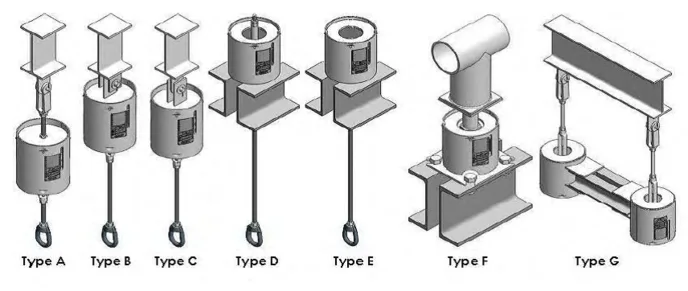
- Types of Spring Hangers

- Spring Hanger Components

- Design and Selection of Spring hangers

- Spring hanger Selection case Study using Caesar II

- Spring Supports in Piping Design

- Mechanism of variable spring hanger

- Mechanism of constant spring hanger

- How to install Spring Support at site

- How to select spring hanger - for piping engineers

Course content

The course is readily available, allowing learners to start and complete it at their own pace.

2 modules12 lectures2 hr 13 min
  1. Why to use Spring Hangers
    13 min
  2. Types of Spring Hangers
    12 min
  3. Spring Hanger Components
    8 min
  4. Design and Selection of Spring hangers
    14 min
  5. Spring hanger Selection case Study using Caesar II
    23 min
  6. Some important considerations
    13 min
  1. Spring Supports in Piping Design
    11 min
  2. Mechanism of variable spring hanger
    4 min
  3. Mechanism of constant spring hanger
    5 min
  4. How to install Spring Support at site
    7 min
  5. How to select spring hanger - for piping engineers
    14 min
  6. Internals of variable spring hanger
    9 min

Opportunities that await you!

Skills & tools you'll gain

Caesar II

Career opportunities

₹699

Access anytime

Questions and Answers

A: Governing principle: support selection is driven by allowable load variation over the full operating travel. Applied here: 210 mm travel is high but still serviceable with a variable spring if the load variation remains within acceptable limits and no sensitive equipment is involved. Tight space doesn't negate variable springs; it constrains can size. The constant spring distractor traps engineers who remember displacement thresholds without checking actual load variation or connected equipment sensitivity.

A: Governing principle: spring sizing starts from sustained load, not operating load, using simple weight per length estimates. Applied here: DN300 steel plus liquid and insulation lands near 1.6–1.8 kN/m, giving ~20 kN over 12 m. That's enough to screen spring can sizes before Caesar II refinement. The 10 kN option catches engineers who drop fluid and insulation, a common adjacent-discipline shortcut.

A: Governing principle: code intent is to limit harmful load transfer, not to enforce a universal numeric cap. Applied here: ASME piping codes allow engineering judgment; 28% is commonly tolerated on noncritical lines if stresses and nozzle loads are controlled. The hard-limit distractor appeals to engineers who confuse vendor guidelines with enforceable code rules.

A: Governing principle: spring hangers are set cold to achieve the correct hot condition after thermal growth. Applied here: confirming tag data, setting cold load, and documenting elevation before startup prevents hidden bias and overload on heat-up. The mid-travel option traps engineers who know travel matters but apply it at the wrong stage.