Skip to main contentEngineering Courses, Mentoring & Jobs | EveryEng
Instrumentation and control in Real world banner
Preview this course

Instrumentation and control in Real world

Instrumentation and control in Real world banner
Preview this course
Self-paced Beginner

Instrumentation and control in Real world

4(5)
5 enrolled
1994 views
€ 20
49 min
Anytime
English
1994 views
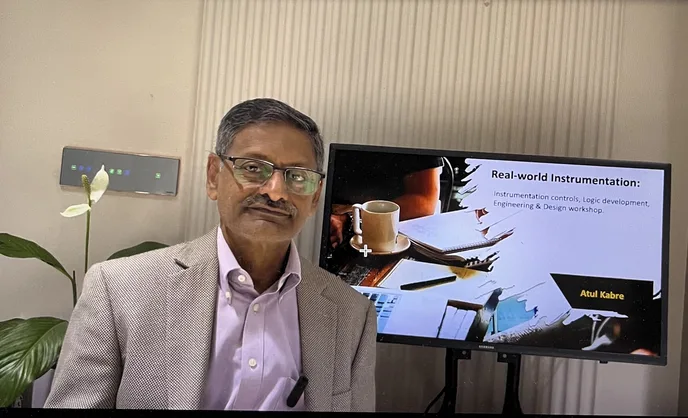
Atul Kabre
Atul KabreIndependent Consultant
  • 7-day money-back guarantee
  • Lifetime access
  • Certificate of completion

Why enroll

People enroll in the course “Instrumentation and Control in Real World” to understand how instrumentation and control systems actually work in industrial environments, not just in theory. The course helps learners gain practical knowledge of sensors, transmitters, control loops, PLC/SCADA systems, and real plant operations. It is especially useful for engineering students, technicians, and working professionals who want to build industry-relevant skills, improve troubleshooting ability, and become more confident in handling real-time process control systems in sectors such as manufacturing, oil & gas, and power plants.

What enrolled engineers say

5 verified reviews
  • May 3, 2026

    Beginner-friendly; the Module 3 PID tuning lab with the tank level loop shows how P/I/D tweaks affect overshoot and settling in the trend view. It maps to day‑to‑day plant work and obs alarms, though I wasn't sold on the math-only block diagrams and wanted more sensor calibration in prod.

    Jigna S. Verified
  • May 3, 2026

    The syllabus read heavy, but the delivery stayed lean and to the point. The Chapter 3 PID tuning walkthrough using the tank level rig and 4–20 mA loop stuck, especially the bit on why integral windup shows up in prod-like conditions. Mapping control loops to obs and infra made it click for software folks, though I wasn't sold on the brief PLC ladder section and wished for a repo or PR-sized exercise. it's become the reference I’ve been missing for the last couple years when control questions pop up.

    abdul W. Verified
  • May 3, 2026

    Nice to see a beginner course that explains why controls behave the way they do, not just knob-turning. The Chapter on PID tuning where the heater overshoot is traced to integral windup stuck with me. I've already mapped the alarm deadband example to our prod infra obs, and the checklists fit a PR review. Mostly works, though I wasn't sold on the brief k8s analogy; still, it's nudged how I think about scaling loops vs alarms as systems grow.

    Subhash S. Verified

Is this course for you?

You should take this if

  • You work in Industrial Automation
  • You're a Instrumentation Engineering / Electrical Engineering professional
  • You prefer self-paced learning you can revisit

You should skip if

  • You need a different specialisation outside Instrumentation Engineering
  • You need live interaction with an instructor

Course details

The Instrumentation and Control in the Real World course provides practical, in-depth knowledge on how instrumentation and control systems are applied in various industries. This course bridges the gap between theoretical concepts and real-world applications, focusing on the critical role of instrumentation in monitoring, controlling, and optimizing industrial processes.

Course suitable for

Key topics covered

The first session will consist of a foundation. We will take a real-world example of industry and build the control and logic requirements, from field Instrumentation to the control system. This will clear the concepts, which will help you understand and analyze control requirements for different applications.

Session 2 Once the controls and logic are developed, the next part is Detailed Engineering. What steps are involved, including the documents, drawings, and specifications? What is the purpose of each step? What method is followed? What data is required?

Session 3 To complete the system, we will examine the requirements of a PLC-based SCADA system, including engineering and other aspects. In this module, we will also learn about IT/OT integration and its requirements.

Course content

The course is readily available, allowing learners to start and complete it at their own pace.

5 lectures49 min
  1. Why Instrumentation?
    7 min
  2. Aviation & fueling system
    12 min
  3. FWS Level Control - Local
    11 min
  4. Variable Speed Control
    12 min
  5. Overall Controls
    7 min

Opportunities that await you!

Career opportunities

Certifications

PMP

Why people choose EveryEng

Industry-aligned courses, expert training, hands-on learning, recognized certifications, and job opportunities-all in a flexible and supportive environment.

€20

Access anytime

Questions and Answers

A: A: Chloride plus cyclic wetting points straight at pitting; 316L handles that without relying on coatings. B: Thicker zinc slows red rust but white rust still creeps under salt. C: Aluminium anodize hates stone chips and chloride crevice attack at fasteners. D: C3 is indoor or low salinity; coastal spray blows past it.

A: A: You don't edit GA to suit procurement guesses. B: Response time isn't stated anywhere; that's an assumption. C: 2-wire vs 3-wire hits loop power and AI sourcing immediately; that can kill the channel. D: Gland size matters later, not at the topology check.

A: A: From 60 to 20 is two 20°C steps; each step doubles IR, 45×2×2. B: Only one step applied; that's a missed decade. C: Direction is wrong; IR rises as temperature drops. D: Spec explicitly gives the coefficient; ignoring it breaks compliance.

A: A: Dissimilar metals plus electrolyte equals galvanic attack; aluminium is the anode. B: Steel will rust, but that's secondary to the couple. C: SCC needs tensile stress and specific chemistries; not here. D: No plating or acid process called up; wrong failure mode.