Skip to main contentEngineering Courses, Mentoring & Jobs | EveryEng
Modal Analysis Made Easy for Automotive Managers: A Strategic Approach banner

Modal Analysis Made Easy for Automotive Managers: A Strategic Approach

Modal Analysis Made Easy for Automotive Managers: A Strategic Approach banner
Self-paced Intermediate

Modal Analysis Made Easy for Automotive Managers: A Strategic Approach

4(115)
1 enrolled
1093 views
$ 20
206 min
Anytime
English
1093 views

MILIND AMBARDEKAR
MILIND AMBARDEKARConsultant
  • 7-day money-back guarantee
  • Lifetime access
  • Certificate of completion

Why enroll

Automotive managers often need to make strategic decisions on NVH issues with an overview of both the structural modal performance and its role highlighted in Transfer Path Analysis of vibrations and structure-borne noise inside the cabin.

This course bridges the gap between engineering details and managerial decision-making, equipping participants with a high-level yet practical understanding of modal analysis.

By the end of the course, attendees will be able to evaluate the impact of structural modifications, interpret CAE and test data effectively, and guide teams toward optimal NVH solutions in vehicle design.

Is this course for you?

You should take this if

  • You work in Automotive
  • You're a Noise & Vibration Engineering / Mechanical Engineering professional
  • You have some foundational knowledge in the subject
  • You prefer self-paced learning you can revisit

You should skip if

  • You're looking for an introductory overview course
  • You need a different specialisation outside Noise & Vibration Engineering
  • You need live interaction with an instructor

Course details

Objective:

To provide automotive Managers with a clear and strategic understanding of modal analysis, enabling them to make informed decisions for vibration control in ICE and EV vehicles.

Description:

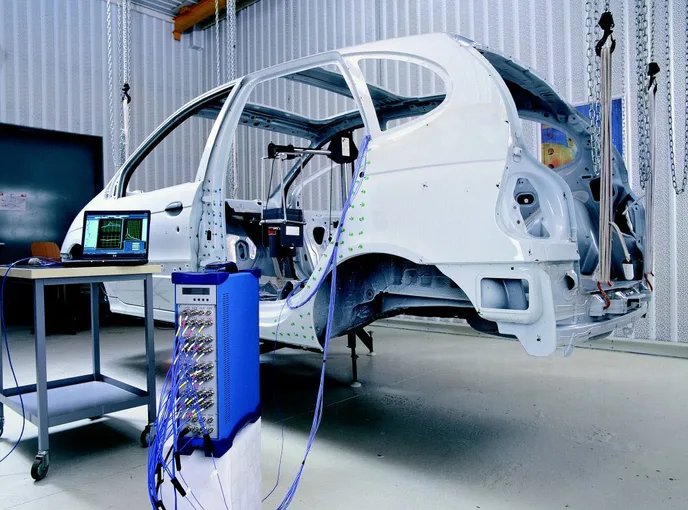
Modal analysis is a fundamental tool for controlling vibrations and refining vehicle NVH performance. This course simplifies key concepts such as eigen analysis, modal decomposition, and the hybrid TEST-CAE approach.It covers advanced techniques like Transfer Path Analysis (TPA), Panel Contribution Analysis (PCA), and Operational Modal Analysis (OMA), all crucial for diagnosing and improving structural dynamics.Real-world case studies from premium ICE and EV vehicles will highlight the role of body stiffness in NVH refinement.

Course suitable for

Key topics covered

  • Importance of Modal Analysis in Vibration Control

  • Eigen Analysis; Modal Decomposition in Structural Vibrations

  • International Experimental Set-up; Hybrid TEST & CAE approach

  • Transfer Path Analysis; Panel Contribution analysis

  • Operational Modal Analysis, Running Mode analysis

  • Practical case studies of NVH of premium cars: both ICE and EVs; Role of Body stiffness

Course content

The course is readily available, allowing learners to start and complete it at their own pace.

5 lectures3 hr 26 min
  1. Modal Analysis
    42 min
  2. Typical Modal Analysis Output Test and CAE
    64 min
  3. Classical Modal Testing VS Operational Modal Testing
    51 min
  4. Stiffness Of Body Global Beding and Twisting Modes
    40 min
  5. Relationship Between NTF and VTF Targets Acceptance
    9 min

Opportunities that await you!

Career opportunities

Why people choose EveryEng

Industry-aligned courses, expert training, hands-on learning, recognized certifications, and job opportunities-all in a flexible and supportive environment.


$20

Access anytime

Questions and Answers

A: —that's the most common mistake, mixing units before you even touch the square root. Converting 28 kN/mm to 28e6 N/m and keeping modal mass, not curb mass, keeps the eigenvalue in the right decade; the 2π matters because you're moving from rad/s to Hz.

A: —this is where people read the plot and forget to read the legend on the GA. Y is inboard, not vertical, so you're seeing lateral compliance; confusing sensor orientation sends NVH work chasing the wrong reinforcement.

A: —people jump straight to broken hardware, but the physics goes through dynamics first. Damping loss sharpens the resonance, so boom shows up well before stress ranges climb into fatigue territory.

A: —that's where reviews go sideways, adding directions that aren't asked for. Participation is directional, and it's a straight ratio; inventing an average just hides a dominant Z mode.