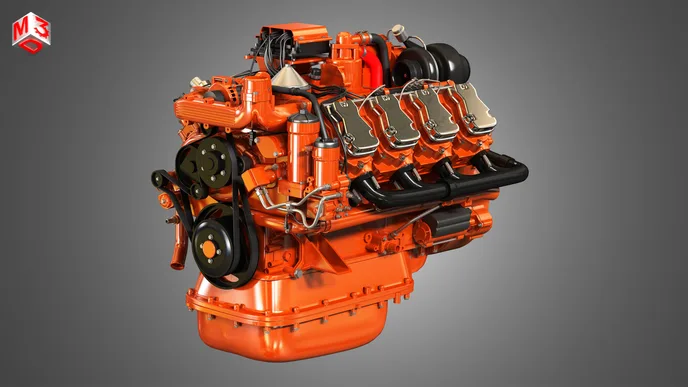
Noise Control of Internal Combustion Engines
- Lifetime access
- Certificate of completion
- Interactive Video Lessons
- Completion Certificate
Why enroll
What enrolled engineers say
.
At first glance, the topics looked familiar, but the depth surprised me. Coming from an automotive powertrain background, I’ve dealt with NVH issues before, but this course went further into combustion noise mechanisms and exhaust acoustics than what I usually see on the job. The sections on order analysis and how engine speed ties into tonal noise were especially relevant to a recent four‑cylinder calibration project I’m on. One challenge was keeping up with the acoustics math around frequency-domain analysis and FFT interpretation. It took a bit of extra time to connect the equations back to what a microphone or accelerometer actually picks up on an engine test bench. Once that clicked, it filled a real knowledge gap for me. A practical takeaway was learning how small changes in muffler geometry and transfer paths can shift dominant noise orders without hurting backpressure. I’ve already applied that thinking during an exhaust review, instead of defaulting to trial-and-error fixes. Overall, it felt grounded in real engineering practice.
Coming into this course, I had some prior exposure to the subject from working around engine test beds, but most of my understanding of noise was fairly surface-level. The material went deeper into engine NVH than I expected, especially around combustion noise versus mechanical noise sources, and how they show up differently in the frequency domain. The sections on order tracking and exhaust system acoustics were directly relevant to issues I’ve seen on production engines. One challenge was keeping up with the math behind sound power calculations and transfer paths, particularly when applying it to multi-cylinder engines with varying firing orders. It took some effort to connect the theory to what microphones and accelerometers are actually picking up during testing. That said, working through those examples helped close a gap I’ve had between test data and design decisions. A practical takeaway was learning how intake and exhaust tuning can be used as a noise control tool rather than relying solely on insulation or mufflers. That’s something I’ve already started considering in an active engine development project. Overall, it felt grounded in real engineering practice.
Is this course for you?
You should take this if
- You work in Automotive
- You're a Mechanical Engineering / Noise & Vibration Engineering professional
- You have some foundational knowledge in the subject
- You prefer self-paced learning you can revisit
You should skip if
- You're looking for an introductory overview course
- You need a different specialisation outside Mechanical Engineering
- You need live interaction with an instructor
Course details
Course suitable for
Key topics covered
Course content
The course is readily available, allowing learners to start and complete it at their own pace.
- NVH Perception in Various vehicle groups27 min
- Stiffen a Crankcase with bedplate61 min
Opportunities that await you!
Career opportunities
Why people choose EveryEng
Industry-aligned courses, expert training, hands-on learning, recognized certifications, and job opportunities-all in a flexible and supportive environment.
What learners say about this course
The Course structure was very constructive. Milind Sir has extensive experience in NVH & Acoustics domain. The way he explained NVH and acoustics concepts made even complex topics easy to understand and apply. His practical insights and structured approach added great value to the learning experience. I truly found this course to be highly informative and beneficial, and I would strongly recommend
Wasn’t thrilled that module 2 assumes you’ve already got MATLAB set up; the lab jumps straight into scripts without a quick env check. After that hiccup, the level of technical granularity was higher than expected for a beginner tag. The section in Chapter 3 where they compare FFT vs order tracking on the inline‑4 crank example stuck; the 2× order spike around 2.5k rpm finally clicked why my last NVH PR went sideways. Coverage of engine mounts and body path analysis felt grounded, not academic. I’ve seen shakier pacing in similar courses, but the quality doesn’t dip as it moves from powertrain to road noise. Consistent, which isn’t common.
Quality stayed pretty even across modules, but module 4 dragged a bit and the labs assume you’ve already got MATLAB wired up. After that, it clicked. The “Modal Testing Basics” section with the door panel resonance example at ~180 Hz stuck with me, especially how they tied frequency response back to design tradeoffs. As someone bridging legacy code and newer infra, I kept mapping the NVH flow to how we think about obs in prod: measure first, then tweak arch. The transfer path analysis chapter felt like reading a clean PR—clear inputs, fewer guesses. I’ve already borrowed the checklist style for a CI gate around RPS regressions. Not flashy, but it fits day-to-day work.
Sat through plenty of advanced NVH courses, and this one actually bites. It doesn’t float at slide level; it pushes into how decisions land in prod when targets get ugly, and that kept me engaged between meetings. The bit that stuck was the order-tracking walkthrough in the powertrain chapter, where they map 2nd order boom during a 3,200 RPM coastdown and show how a mount tweak shifts the peak; I’ve already mirrored that flow in my repo for a current PR. There’s practical glue too: tying CAE outputs to test obs, plus a quick nod to how CI can gate NVH regressions before release. I wasn't sold on the intro pacing, and I wished there was more on road-induced NVH at low RPS, but mostly it held up. I've felt the gap close between sim and test, and my day-to-day loop is shorter with fewer re-runs.