Skip to main contentEngineering Courses, Mentoring & Jobs | EveryEng
Prosper with LPG industry -- Opportunities Galore banner

Prosper with LPG industry -- Opportunities Galore

Prosper with LPG industry -- Opportunities Galore banner
Live online Basic

Prosper with LPG industry -- Opportunities Galore

4(57)
47 enrolled
2042 views
COMPLETED

Tell us and we’ll notify you when the next batch is scheduled.

1 hrs
-
2042 views
Ashok Khopkar
Ashok KhopkarConsultant
  • Session recordings included
  • Certificate of completion

Why enroll

Unlock a world of opportunities in the LPG industry by gaining expertise in its inner workings. With knowledge of LPG production, distribution, and marketing, you can propel your career into senior roles such as Operations Manager, Business Development Manager, or Supply Chain Specialist. This industry expertise can also lead to opportunities in consulting, entrepreneurship, or leadership positions. Stay ahead of the curve and capitalize on the growing demand for LPG professionals.

What enrolled engineers say

12 verified reviews
  • May 3, 2026

    Good snapshot of the LPG value chain; the Module 2 bottling-plant throughput calc and cylinder turnaround example stuck. It's mostly practical for oilgas ops, but I wasn't sold on the market sizing section and wished there was more on capex vs opex tradeoffs.

    Sonu K. Verified
  • May 3, 2026

    Came in expecting something closer to prod patterns, and it mostly met that bar for an oilgas context. The section on the LPG bottling plant walkthrough, especially the cylinder tracking flow and where audits break, stuck because it maps cleanly to arch and infra tradeoffs we argue about in PRs. I wasn't sold on the market sizing chapter; felt thin and light on obs metrics or RPS-style thinking. Still, it's given me better ammo for the conversations that actually matter with ops and product.

    Abinandh B. Verified
  • May 3, 2026

    Module 2’s bottling-plant capex spreadsheet and the propane vs butane pricing parity example stuck, since it's mapping classroom math to day-one ops in oilgas LPG. mostly useful, though I wasn't sold on the light treatment of safety regs and wished there was more on distribution infra beyond cylinders.

    Kingsly A. Verified

Is this course for you?

You should take this if

  • You work in Oil & Gas Upstream
  • You're a Mechanical Engineering / Petroleum Technology professional
  • You prefer live, instructor-led training with Q&A

You should skip if

  • You need a different specialisation outside Mechanical Engineering
  • You need fully self-paced, on-demand content

Course details

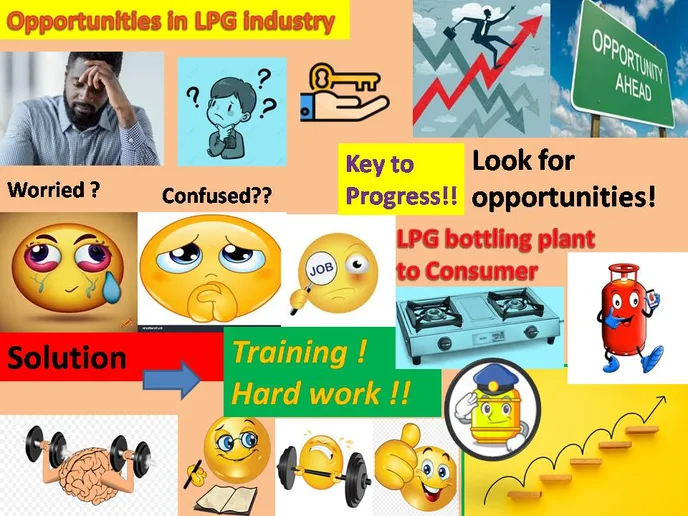
Objective: To acquaint the  participants with enormous no. of opportunities projected by LPG industry as domestic fuel, at different levels, variety of streams, and skills,

Subject description: The world has acclaimed and accepted LPG as efficient, clean and convenient fuel for domestic, industrial and automobile application. As domestic fuel, millions of household use LPG from cylinders of various sizes. Enormous number of job and business opportunities are generated for service providers and manufacturers / distributors of relevant equipment. This is for existing consumers and new connections being given. Government of India is implementing a massive program wherein LPG cylinders have reached small towns and villages, even in remote areas. All the consumers need variety of services and support in safely using this fuel.

 This free course is an effort to explain to newcomers as well as those already working with LPG related industry, about these opportunities.

Remember, "Look for opportunity, and grab it" is the key to progress.

LPG is hazardous because of its highly inflammable nature. It changes phase (state) from liquid to gas and vice versa; problems are created thereby. Hence certain fundamentals about LPG must be known to anyone working in close vicinity of LPG.

This program will explain those fundamentals, the available opportunities, and what skills are essential for jobs and business.

A series of  course are already announced and  planned subsequent to this, to impart the detailed knowledge/parameters of LPG to take care of the minimum essential knowledge for safely and effectively working in this field. It is advisable to attend those courses.

Course suitable for

Opportunities that await you!

Career opportunities

Training details

This is a live course that has a scheduled start date.

Live session

Starts

Sat, Aug 3, 2024

6:00 AM UTC· your timezone

Duration

1 hour per day

Why people choose EveryEng

Industry-aligned courses, expert training, hands-on learning, recognized certifications, and job opportunities-all in a flexible and supportive environment.

What learners say about this course

Ajay Chinthalapudi
Ajay Chinthalapudi
May 3, 2026

The module on LPG cylinder bottling economics—specifically the walk-through of distributor margin math in Chapter 3—felt practical for scoping infra spend and ops tradeoffs. It didn't go far on safety/regulatory detail, which matters in oilgas, but for team leads pressure-testing costs, it's a decent skim between meetings.

Amit Bodke
Amit Bodke
May 3, 2026

Chapter on mass vs volume at 15°C with the butane example—it's mostly useful, wished more on custody transfer math.

Ved Naik
Ved Naik Engineering
May 3, 2026

Chapter 3’s mass‑vs‑volume LPG conversion with temp correction stuck; it's practical, though I wished more on custody transfer meters.

Ashok Khopkar
Ashok Khopkar General manager at the time retirement
May 3, 2026

Most days the pain point is the async layer between policy, infra, and actual ops, and this course tackled that gap instead of hand-waving it. The Module 3 walkthrough on cylinder distribution economics stuck, especially the table where depot turnaround time and RPS-equivalent demand were mapped to headcount; I’ve used a similar sketch in prod planning for energyutilities work. It didn’t waste time selling LPG, more about where jobs cluster and where they don’t, which matters when you’re scoping arch options for a client. There’s some light repetition in the market-sizing bits, and I wasn’t sold on the short detour into retail branding, but the logistics and safety sections landed. The safety audit example tied obs metrics back to infra decisions in a way that felt practical. It’s tightened up the vocabulary we use in design sessions when LPG comes up, which saves cycles in PRs and client calls.

COMPLETED

-

Questions and Answers

A: A. This still occurs because the PSV relieves mass but doesn't control dispersion once flashing happens. B. This can still happen since the PSV doesn't limit metal temperature during expansion. C. The PSV directly protects against vessel overpressure by relieving at set pressure. D. This remains a risk because discharge direction and ignition are outside the valve's protection scope.

A: A. This would usually affect multiple arms tied to the same header, not just one. C. Cavitation would show pressure and noise fluctuations across the skid, not a single arm bias. D. Density factor errors skew all scales uniformly rather than one position. B. A leaking or worn seat causes early cutoff specific to that filling head.

A: A. Radiant heat still transmits despite fireproofing, so escalation risk remains. C. Inspectability isn't the driver for layout distances in this case. D. Logistics are secondary and not the hazard basis. B. Distance directly limits thermal radiation and missile effects during a BLEVE.

A: A. Setpoint checks assume a healthy signal path that hasn't been proven yet. B. Physical placement matters but doesn't confirm loop integrity. D. Applying gas before electrical checks can mask wiring faults. C. Signal integrity must be proven before functional testing.