Skip to main contentEngineering Courses, Mentoring & Jobs | EveryEng
Fluid Flow In Venturimeter in ANSYS 3D Simulation banner
Preview this course
Fluid Flow In Venturimeter in ANSYS 3D Simulation banner
Preview this course
Self-paced Beginner

Fluid Flow In Venturimeter in ANSYS 3D Simulation

4(8)
11 enrolled
899 views
FREE
45 min
Anytime
English
899 views
Team EveryEng
Team EveryEngMechanical Engineering
  • Lifetime access
  • Foundational Learning
  • Access to Study Materials
  • Self-Paced Learning

Why enroll

Engineers, researchers, and students involved or interested in fluid mechanics, CFD simulations, and the application of numerical methods in engineering design and analysis. By the end of this course, participants will have the skills and confidence to simulate fluid flow through a Venturi meter using ANSYS Fluent, enabling them to make informed engineering decisions and optimize device performance in various industrial and scientific applications.

Is this course for you?

You should take this if

  • You work in Aerospace or Automotive
  • You're a Mechanical Engineering professional
  • You prefer self-paced learning you can revisit

You should skip if

  • You need a different specialisation outside Mechanical Engineering
  • You need live interaction with an instructor

Course details

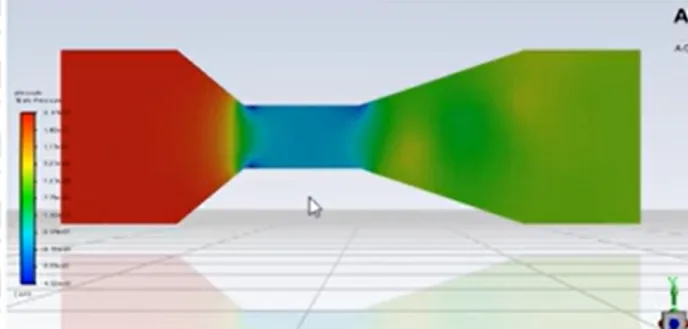
This course provides a comprehensive introduction to the simulation of fluid flow through a Venturi meter using ANSYS Fluent, a widely used computational fluid dynamics (CFD) software. Participants will learn the fundamental principles behind fluid flow measurement and the working mechanism of a Venturi meter based on pressure variation. The course explains the application of Bernoulli’s equation in analyzing velocity and pressure changes within the flow. Learners will gain hands-on experience in creating geometry, meshing, setting boundary conditions, and running simulations in ANSYS Fluent. It also covers post-processing techniques to visualize pressure and velocity contours effectively. Emphasis is placed on understanding flow behavior, pressure drops, and accuracy in measurement. Real-world engineering applications of Venturi meters in industries are also discussed. The course is suitable for beginners as well as engineering students looking to build CFD skills. By the end, participants will be able to simulate and analyze flow systems confidently. This training enhances both theoretical knowledge and practical expertise in fluid flow analysis..

Course suitable for

Key topics covered

  • Create a geometry

  • Meshing

  • Setup

  • Results & Simulation

  • Report


Course content

The course is readily available, allowing learners to start and complete it at their own pace.

5 lectures45 min
  1. Geometry
    9 min
  2. Meshing
    6 min
  3. Velocity Setup
    13 min
  4. Simulation and Results
    13 min
  5. Simulation Report
    4 min

Opportunities that await you!

Skills & tools you'll gain

Career opportunities

Why people choose EveryEng

Industry-aligned courses, expert training, hands-on learning, recognized certifications, and job opportunities-all in a flexible and supportive environment.

FREE

Access anytime

Questions and Answers

A: 0.6 is the pivot here. Below about 0.4, permanent pressure loss spikes and you start forcing turbulence modeling to do work it shouldn't in a Venturi. Above roughly 0.75, the differential pressure signal collapses and small mesh or boundary condition errors dominate the result.

A: 20% is the tell. Area-averaged pressure across expanding sections washes out the local static pressure minimum that the taps see. Turbulence model choice shifts single-digit percentages at this Reynolds number, not twenty.

A: 10D is the boundary most people forget. Swirl survives far longer than a flat velocity profile suggests, and ISO cares about repeatable Cd in the field, not whether your inlet contour plot looks pretty.

A: 3 m/s with solids is the trigger. Cavitation needs local pressure to drop below vapor pressure, which doesn't happen in clean-water Venturis at this velocity. The throat takes the particle hits, not the barrel.