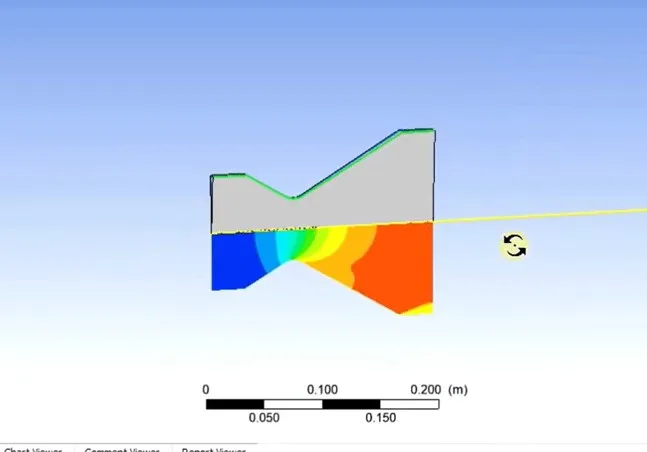
Convergent Divergent Nozzle Analysis in ANSYS
Convergent Divergent Nozzle Analysis in ANSYS

- Lifetime access
- Certificate of completion
- Foundational Learning
- Access to Study Materials
Why enroll
What enrolled engineers say
At first glance, the topics looked familiar, but the depth surprised me. The course walks through convergent-divergent nozzle behavior in ANSYS Fluent in a way that connects theory to what actually shows up in aerospace propulsion work, especially around choking, shock placement, and back-pressure sensitivity. The treatment of supersonic expansion and normal shocks felt closer to how we review nozzle performance in launch vehicle or gas turbine programs than what you usually see in a beginner course. One challenge was getting stable convergence when the shock sat near the throat or moved with small boundary condition changes. That’s a real issue in industry CFD too, and it was useful to see how mesh refinement and solver settings affect that behavior. The discussion on edge cases, like off-design pressure ratios, helped frame why nozzle performance degrades at the system level. From an automotive perspective, the parallels to exhaust flow through turbocharger nozzles and aftertreatment restrictions were clear, even if the Mach numbers differ. A practical takeaway was a more disciplined approach to setting boundary conditions and validating results against isentropic relations before trusting contours. Compared with typical industry workflows, this felt grounded and realistic. I can see this being useful in long-term project work.
At first glance, the topics looked familiar, but the depth surprised me. The course walks through convergent‑divergent nozzle behavior in a way that lines up with what’s seen in aerospace propulsion, especially around choking, shock location, and back‑pressure sensitivity. Setting this up in ANSYS Fluent felt closer to real rocket nozzle or gas turbine work than most beginner material. One challenge was getting stable convergence when the flow transitions near Mach 1 at the throat. Small changes in boundary conditions or turbulence model selection shifted the shock position, which mirrors the kind of sensitivity we deal with in industry CFD. The discussion on mesh refinement near the throat and exit helped, though it also highlighted edge cases like overexpanded versus underexpanded operation that aren’t always obvious to new users. What stood out was the system-level perspective. The same pressure loss and expansion concepts apply to automotive exhaust systems and turbocharger nozzles, where back pressure impacts engine efficiency and aftertreatment performance. A practical takeaway was routinely validating Fluent results against isentropic relations and mass flow checks before trusting contours. Overall, it felt grounded in real engineering practice.
Initially, I wasn’t sure what to expect from this course. Coming from a working background in aerospace propulsion and some crossover automotive CFD work, the basics label made me a bit skeptical. That said, it actually filled a gap around compressible flow setup in ANSYS Fluent that I hadn’t fully nailed down on the job. The walkthrough on convergent-divergent nozzle physics, especially choking conditions, Mach number transitions, and shock wave formation, tied theory to solver settings in a way that felt practical. References to gas turbine nozzles and exhaust flow behavior also translated well to automotive turbocharger applications, which was useful for current projects. One challenge was getting stable solutions during the first few runs; mesh refinement near the throat and choosing the right boundary conditions took some trial and error. A key takeaway was a repeatable workflow for setting up compressible simulations and checking results using pressure and Mach contours instead of just trusting residuals. That’s already helping on internal CFD reviews. The content felt aligned with practical engineering demands.
Your instructor
Team EveryEng
Engineer
Mechanical Engineering
Is this course for you?
You should take this if
- You work in Aerospace
- You're a Mechanical Engineering / CAD & Analysis professional
- You prefer self-paced learning you can revisit
You should skip if
- You need a different specialisation outside Mechanical Engineering
- You need live interaction with an instructor
Course details
Course suitable for
Key topics covered
Course content
The course is readily available, allowing learners to start and complete it at their own pace.
- Introduction of convergent divergent nozzle4 min
- Geometry6 min
- Meshing4 min
- Setup4 min
- Results4 min
Opportunities that await you!
Skills & tools you'll gain
Career opportunities
Why people choose EveryEng
Industry-aligned courses, expert training, hands-on learning, recognized certifications, and job opportunities-all in a flexible and supportive environment.


 Aug 29, 2026