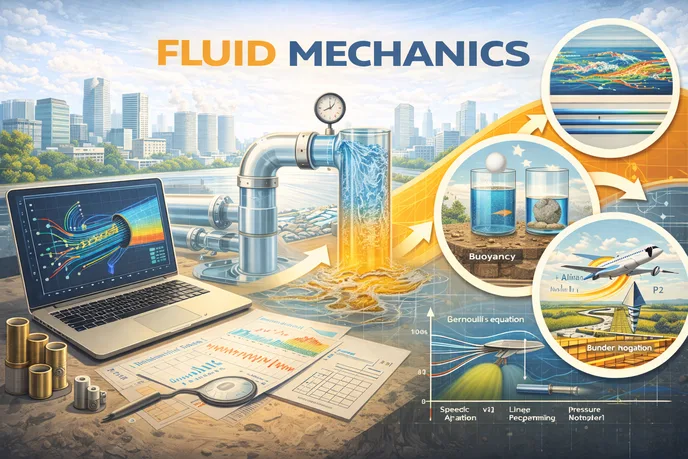
Fluid Mechanics
Fluid Mechanics

- Lifetime access
- Certificate of completion
- Anytime Learning
- Learn from Industry Expert
Why enroll
What enrolled engineers say
Advanced pace felt closer to grad fluids than day-to-day infra work; the Chapter 7 boundary-layer similarity derivation, especially the Blasius scaling step, stuck. It maps legacy hand calcs to modern CFD intuition, though I wasn't sold on the quick skip over turbulent transition and wished for more on non-Newtonian cases.
The labs had a way of exposing some bad habits, especially around treating equations as math instead of constraints on a system. In Lab 4 on internal pipe flow, the step where you nondimensionalize before touching the solver stuck; my first PR in the repo failed CI because I ignored the CFL limit and RPS blew up, which felt uncomfortably like prod. The section on boundary layers and the Blasius similarity solution was practical, tying assumptions back to arch choices rather than hand-wavy derivations. It's advanced and mostly aimed at people who already live near infra, but a bit more on turbulence modeling choices beyond k‑epsilon would’ve helped. Some labs ran long, and the obs guidance could be tighter. i don’t usually forward courses around, but this one got shared.
Is this course for you?
You should take this if
- You work in Oil & Gas Upstream
- You're a Civil & Structural / Piping & Layout Engineering professional
- You have 3+ years of hands-on experience in this field
- You prefer self-paced learning you can revisit
You should skip if
- You're new to this field with no prior experience
- You need a different specialisation outside Civil & Structural
- You need live interaction with an instructor
Course details
Course suitable for
Key topics covered
Course content
The course is readily available, allowing learners to start and complete it at their own pace.
- Lec 1: Basic Concepts of Fluid67 min
- Lec 2: Properties of Fluid72 min
- Lec 3: Fluid Flow Analysis65 min
- Lec 4: Concepts of Hydrostatic60 min
- Lec 5: Measurement of Pressure and Hydrostatic forces47 min
- Lec 6: Buoyancy, Metacentre, Stability and Rigid body motion63 min
- Lec 7: Reynolds Transport Theorem68 min
- Lec 8: Conservation of Mass62 min
- Lec 9: Conservation of Momentum59 min
- Lec 10: Conservation of Momentum Applications61 min
- Lec 11: Bernoulli’s Equation55 min
- Lec 12: Applications of Bernoulli’s Equation58 min
- Lec 13: Fluid Statics Applications: Example Problems49 min
- Lec 14: Conservation of Momentum: Example problems47 min
- Lec 15: Bernoulli’s Equation : Problems Solving on Black Board53 min
- Lec 16: Lagrangian and Eulerian Descriptions59 min
- Lec 17: Motion and deformation of fluid elements46 min
- Lec 18: Problems Solving on Black Board57 min
- Lec 19: Dimensional Homogeneity46 min
- Lec 20: Dimensional Analysis and Similarity45 min
- Lec 21: Laminar and Turbulent Flows56 min
- Lec 22: Losses in Pipe Fittings57 min
- Lec 23: Flow in Noncircular Conduits and Multiple Path Pipeflow55 min
- Lec 24: Mass Conservation Equation- I30 min
- Lec 25: Mass Conservation Equation- II54 min
- Lec 26:Stream Function64 min
- Lec 27: Cauchy's Equation55 min
- Lec 28: The Navier-Stokes Equation62 min
- Lec 29: The Navier-Stokes Equation part 261 min
- Lec 30: The Navier-Stokes Equation III56 min
- Lec 31: Approximate solutions of Navier Stokes Equation: Bounary Layer Approximation69 min
- Lec 32: Boundary Layer Approximation II60 min
- Lec 33: Boundary Layer Approximation III50 min
- Lec 34: Open Channel Flow Unlisted56 min
- Lec 35: Open Channel Flow II45 min
- Lec 36: Open Channel Flow III56 min
- Lec 37: Drag and Lift49 min
Opportunities that await you!
Career opportunities
Why people choose EveryEng
Industry-aligned courses, expert training, hands-on learning, recognized certifications, and job opportunities-all in a flexible and supportive environment.


 Aug 29, 2026