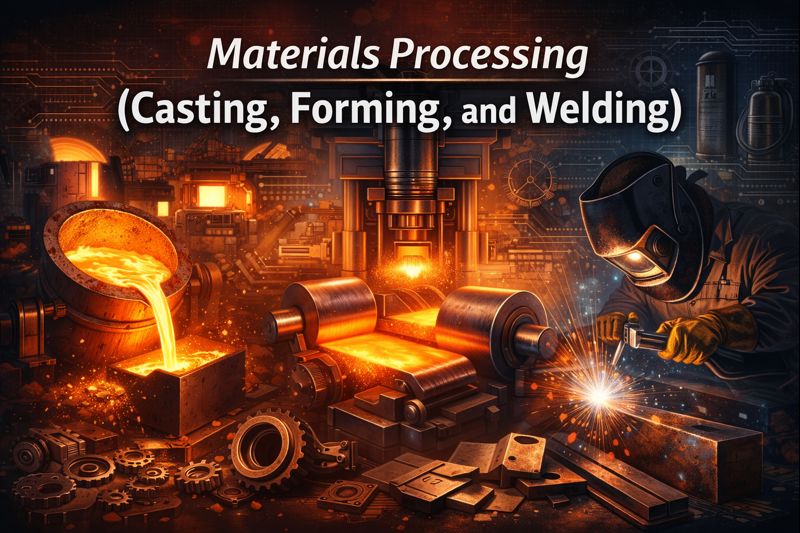
Materials processing ( casting, forming and welding)-I
Engineering Academy
Learn Without Limits: Free Engineering Courses
Pre-recorded video course. Watch anytime at your own pace.
FREE
Advanced course for professionals
Anytime Learning
Learn from Industry Expert
Career Option Guideline
Materials processing ( casting, forming and welding)-I
Why enroll
Participants join Materials Processing (Casting, Forming, and Welding) to gain a solid understanding of the core manufacturing processes that underpin most mechanical and industrial products. The course enables learners to understand how raw materials are transformed into usable components and how processing methods influence microstructure, mechanical properties, quality, and service performance.
Many participants are motivated to develop practical knowledge of casting, forming, and welding techniques that are widely used across industries such as automotive, aerospace, construction, heavy engineering, and energy. The course helps learners make informed decisions regarding process selection, material suitability, defect prevention, and cost-effective manufacturing, which are critical skills for production, design, and quality roles.
Participants also join to strengthen their technical foundation for advanced studies, research, or professional certification in manufacturing and materials engineering. By linking theoretical principles with real-world applications, the course supports career growth for students, practicing engineers, and professionals seeking to enhance their competence in materials processing, fabrication, and manufacturing technology.
Course content
The course is readily available, allowing learners to start and complete it at their own pace.
Materials processing ( casting, forming and welding)-I
26 Lectures
960 min
Materials and microcture evolutions-1
Preview
45 min
Materials and microcture evolutions-2
Preview
46 min
Materials and microcture evolutions-3
27 min
Basics of heat conduction-1
30 min
Basics of heat conduction-2
34 min
Basics of heat conduction-3
35 min
Basics of heat conduction-4
30 min
Basics of fluid flow-1
31 min
Basics of fluid flow-2
36 min
Solidification processing-1
55 min
Solidification processing-2
54 min
Casting and welding-1
63 min
Casting and welding-2
43 min
Casting and welding-3
35 min
Casting and welding-4
44 min
Material forming
68 min
Material forming: Numerical problem
29 min
Processing of metal: Casting Process- I
41 min
Processing of metal: Casting Process- II
30 min
Processing of polymer: Thermoplastic and thermosets
23 min
Processing of polymer: Extrusion
31 min
Processing of polymer: Injection molding
29 min
Processing of polymer: Blow molding
22 min
Processing of polymer: Thermosets
25 min
Processing of ceramics - I
24 min
Processing of ceramics - II
30 min
Course details
Materials Processing (Casting, Forming, and Welding) deals with the fundamental principles and practical techniques used to convert raw materials, particularly metals and alloys, into functional engineering components with desired shapes, dimensions, and properties. The course provides a comprehensive understanding of how material behavior, process parameters, and manufacturing conditions influence the quality, performance, and reliability of finished products.
The course begins with casting processes, focusing on the science of melting, pouring, solidification, and cooling of metals. Topics include sand casting, die casting, investment casting, and continuous casting, along with mold materials, gating and riser design, solidification defects, and methods for improving casting quality. Emphasis is placed on understanding microstructure evolution during solidification and its impact on mechanical properties.
Metal forming processes are then explored, covering both bulk deformation and sheet metal forming techniques such as rolling, forging, extrusion, drawing, bending, and deep drawing. The course examines material flow, stress–strain behavior, plastic deformation, forming loads, lubrication, and formability limits. Process design considerations, defect prevention, and the role of temperature in hot and cold working are also discussed.
The welding and joining section focuses on permanent joining processes used in manufacturing and fabrication. Various welding techniques, including arc welding, resistance welding, gas welding, and advanced welding processes, are introduced. Topics include weld metallurgy, heat-affected zones, residual stresses, welding defects, and quality inspection methods. The course highlights the relationship between welding parameters, joint design, and structural integrity.
Overall, the course integrates theoretical concepts with practical insights to help participants understand the selection, design, and optimization of casting, forming, and welding processes. It prepares learners to address real-world manufacturing challenges, improve product quality, and make informed decisions in materials processing and fabrication applications.
source: NPTEL [youtube]
Course suitable for
Mechanics & Turbomachinery Mechanical Production
Key topics covered
materials and microcture evolution
basics of heat conduction
basics of fluid flow
solidification processing
casting and welding
material forming
FREE
Access anytime