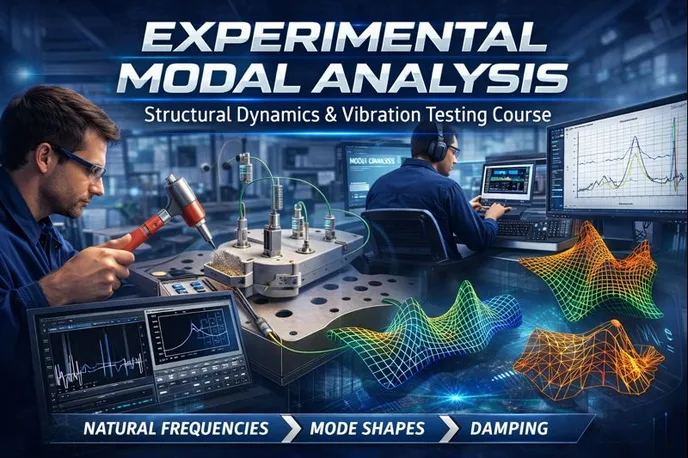
Experimental Modal Analysis (EMA) is a systematic and widely used vibration analysis technique employed to determine the dynamic characteristics of a physical structure through experimental testing. The primary objective of EMA is to identify a structure’s modal parameters—namely natural frequencies, mode shapes, and damping ratios—by measuring its response to controlled external excitation. These parameters are fundamental for understanding how a structure behaves under dynamic loading and for predicting its vibration and noise performance.
In experimental modal analysis, the test structure is excited using known input forces, typically applied through impact hammers, electrodynamic shakers, or hydraulic actuators. The resulting vibration response is measured at selected locations using sensors such as accelerometers, velocity transducers, or laser vibrometers. The input–output data are then processed using signal analysis techniques, including Fast Fourier Transform (FFT) and frequency response functions (FRFs), to extract the modal parameters of the system.
EMA is particularly valuable for validating analytical and numerical models, such as finite element models, by comparing experimentally obtained modal data with predicted results. It helps engineers identify discrepancies caused by modeling assumptions, boundary conditions, or material property variations. The technique is also extensively used in design optimization, structural modification, fault detection, and troubleshooting of vibration-related issues.
Applications of experimental modal analysis span a wide range of engineering fields, including mechanical, aerospace, civil, and automotive engineering. It is commonly applied to structures such as machine tools, automotive components, aircraft structures, bridges, and electronic assemblies. By providing accurate insight into real-world dynamic behavior, experimental modal analysis plays a critical role in improving structural reliability, performance, and durability under dynamic operating conditions.
source: NPTEL[youtube]