Skip to main contentEveryEng | Everything for Engineering
Search icon
Search icon

Technical Courses

Soft-Skills Trainings

Seminar & Conferences

Articles & Blogs

Jobs / Hiring

Internship Options

Project Based Freelancing

Communities & Consultation

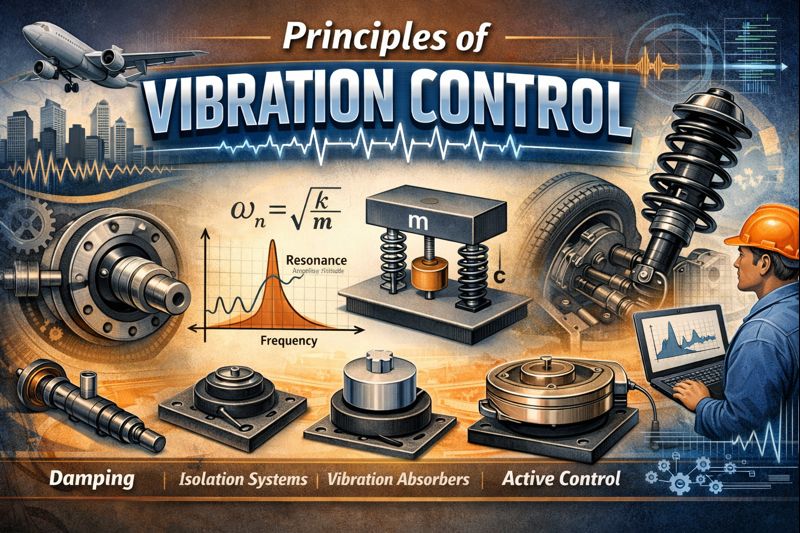
Principles of Vibration Control banner
Preview this course

Principles of Vibration Control

Engineering Academy

Engineering Academy

Learn Without Limits: Free Engineering Courses

Rating 4 (7)
Course typeWatch to learn anytime
Duration 630 Min
Start Access anytime
Language English
Views47

FREE

Principles of Vibration Control banner
Preview this course

Principles of Vibration Control

Why enroll

Participants join Principles of Vibration Control to gain a strong conceptual and practical understanding of how unwanted vibrations can be analyzed, controlled, and mitigated in engineering systems. The course equips learners with essential skills to improve system performance, reduce noise and structural damage, and enhance safety and reliability across mechanical, civil, aerospace, and automotive applications.

This course is particularly valuable for students and professionals who want to bridge theory with real-world engineering practice. By learning industry-relevant vibration control techniques—such as damping, isolation, and absorber design—participants enhance their problem-solving capabilities and technical competence, making them better prepared for advanced studies, research, and vibration-related challenges in modern engineering environments.

Opportunities that awaits you!

Certificate thumbnail

Earn a course completion certificate

Add this credential to your LinkedIn profile, resume, or CV. Share it on social media and in your performance review

Career opportunities

Course content

The course is readily available, allowing learners to start and complete it at their own pace.

Video info icon

Principle of vibration control

21 Lectures

630 min

  • Introduction to Vibration control

    Preview icon

    Preview

    36 min

  • Strategies & Steps in Vibration Control

    Preview icon

    Preview

    32 min

  • Strategies, Active control, Detuning & Decoupling

    30 min

  • Viscous damping model

    38 min

  • Coulomb & Hysteretic damping model

    32 min

  • Energy Dissipation in Structural Materials

    32 min

  • Material Selection Criterion against Damping

    25 min

  • Design for Enhanced Material Damping

    24 min

  • Linear Viscoelastic Materials & Models

    35 min

  • Maxwell & 3-Parameter Models

    37 min

  • Complex modulus & Applications of VEM

    30 min

  • Proof mass Actuator

    30 min

  • Springs for Vibration Isolation

    28 min

  • Basics of Dynamic Vibration Absorber

    26 min

  • Modelling of Dynamic Vibration Absorber

    34 min

  • Introduction to Active Vibration Control

    32 min

  • Basics of Classical Control System

    42 min

  • Basics of State Space Control

    31 min

  • Controllability & Observability of System

    29 min

  • Full State Feedback Control

    18 min

  • SMSS Laboratory Demonstration

    9 min

Course details

Principles of Vibration Control is a foundational subject that focuses on understanding, analyzing, and mitigating unwanted vibrations in mechanical and structural systems. The course introduces the physical origins of vibration, dynamic system behavior, and the adverse effects of excessive vibration on performance, safety, comfort, and service life. Emphasis is placed on the theoretical principles that govern vibration suppression and isolation, supported by practical engineering considerations.

Participants learn key vibration control strategies such as passive, active, and semi-active control methods, including damping techniques, vibration absorbers, isolation systems, and feedback-based control approaches. The course integrates mathematical modeling, frequency-domain analysis, and real-world case studies from mechanical, aerospace, civil, and automotive engineering applications. By the end of the course, learners gain the ability to select and design appropriate vibration control solutions to enhance system reliability, efficiency, and structural integrity in engineering practice.

Course suitable for

  • Mechanics & Turbomachinery
  • Mechanical
  • Production

Key topics covered

  • introduction to vibration control

  • strategies, active control, detuning & decoupling

  • coulomb & hysteretic damping model

  • energy dissipation in structural materials

  • basic dynamic vibration absorber

  • introduction to active vibration control

FREE

Access anytime