Search icon
Search icon

Technical Courses

Soft-Skills Trainings

Seminar & Conferences

Articles & Blogs

Jobs / Hiring

Internship Options

Project Based Freelancing

Communities & Consultation

Product image
Preview this course

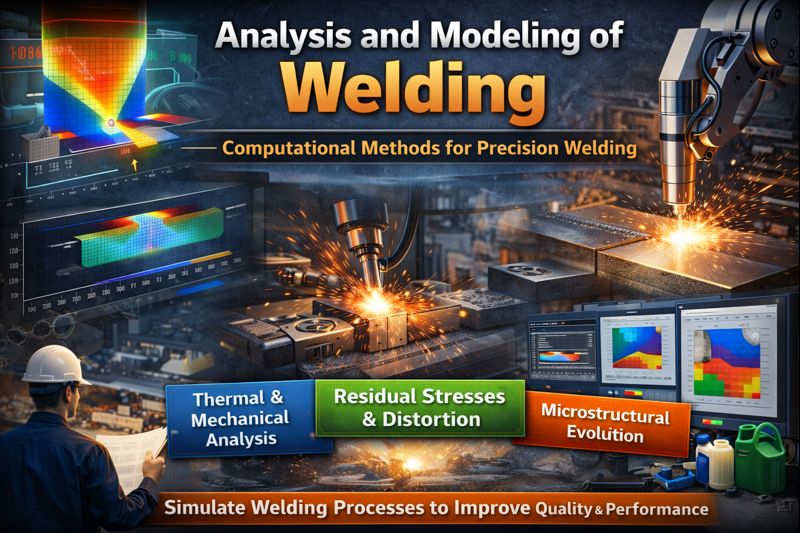
Analysis and Modeling of Welding

Engineering Academy

Engineering Academy

Learn Without Limits: Free Engineering Courses

FREE

Product image
Preview this course

Analysis and Modeling of Welding

  • Trainers feedback

    5

    (2 reviews)

    Engineering Academy

    Engineering Academy

    Learn Without Limits: Free Engineering Courses

  • Course type

    Watch to learn anytime

  • Course duration

    726 Min

  • Course start date & time

    Access anytime

  • Language

    English

Why enroll

Participants join this course to develop a deep, analytical understanding of welding processes through scientific and computational modeling techniques. The course enables learners to move beyond empirical approaches and gain the ability to predict temperature distribution, residual stresses, distortion, and microstructural evolution during welding.

This program is particularly valuable for postgraduate students, researchers, and practicing engineers involved in welding design, simulation, and process optimization. By learning analytical and numerical modeling methods, participants enhance their capability to solve complex welding problems, reduce trial-and-error in process development, and support data-driven decision-making in industries such as aerospace, automotive, shipbuilding, and energy.

Opportunities that awaits you!

Certificate thumbnail

Earn a course completion certificate

Add this credential to your LinkedIn profile, resume, or CV. Share it on social media and in your performance review

Course content

The course is readily available, allowing learners to start and complete it at their own pace.

Video info icon

Analysis and modeling of welding

20 Lectures

726 min

  • Lesson icon

    Introduction to fusion welding processes: part 1/2

    Preview icon

    Preview

    32 min

  • Lesson icon

    Introduction to fusion welding processes: part 2/2

    Preview icon

    Preview

    31 min

  • Lesson icon

    Heat sources part 1/2

    30 min

  • Lesson icon

    Heat sources part 2/2

    40 min

  • Lesson icon

    Heat removal

    29 min

  • Lesson icon

    Thermal Modeling Part 1/2

    43 min

  • Lesson icon

    Thermal Modelling - Part 2/2

    46 min

  • Lesson icon

    Zones in a weldment

    42 min

  • Lesson icon

    Analytical Solutions to Weld Thermal Field

    29 min

  • Lesson icon

    Conduction to Keyhole mode

    27 min

  • Lesson icon

    Fluid flow modelling - part 1/2

    41 min

  • Lesson icon

    Fluid flow modelling - part 2/2

    37 min

  • Lesson icon

    Solute transfer modelling - part 1/2

    24 min

  • Lesson icon

    Solute transfer modelling - part 2/2

    37 min

  • Lesson icon

    Solute segregation profile - part 1/2

    25 min

  • Lesson icon

    Solute segregation profile - part 2/2

    21 min

  • Lesson icon

    Microstructure Formation in Fusion Welds

    39 min

  • Lesson icon

    Numerical Solutions to Thermal Field and Fluid Flow in Welding - Part 1

    44 min

  • Lesson icon

    Numerical Solutions to Thermal Field and Fluid Flow in Welding - Part 2

    52 min

  • Lesson icon

    Dissimilar Welding

    57 min

Course details

Analysis and Modeling of Welding focuses on the scientific and computational approaches used to understand, predict, and optimize welding processes. The course introduces the fundamentals of welding physics, including heat transfer, fluid flow in the molten pool, metallurgical transformations, and residual stress and distortion development. Emphasis is placed on developing analytical and numerical models that describe the complex thermal–mechanical–metallurgical interactions occurring during welding.

The course covers analytical heat source models, temperature field prediction, cooling rate estimation, and their influence on microstructure and mechanical properties. It also introduces numerical techniques such as finite element and finite difference methods for simulating welding processes, residual stresses, and deformation. By integrating theoretical concepts with practical modeling approaches and industrial case studies, the course equips participants with the skills required to analyze welding behavior, improve joint design, and support process optimization and quality assurance in advanced manufacturing applications.

Source : NPTEL [Youtube]

Course suitable for

  • Mechanics & Turbomachinery
  • Mechanical
  • Production

Key topics covered

  • introduction to fusion welding processes

  • heat sources and heat removal

  • thermal modelling

  • zones in a weldment

  • conduction to keyhole mode

  • solute transfer modelling

  • dissimilar welding

Why people choose EveryEng

Industry-aligned courses, expert training, hands-on learning, recognized certifications, and job opportunities—all in a flexible and supportive environment.

Engineering Academy

Engineering Academy

Learn Without Limits: Free Engineering Courses

Questions and Answers

Empty state icon

No questions yet - Be the first one to ask!