Skip to main contentEveryEng | Everything for Engineering
Search icon
Search icon

Technical Courses

Soft-Skills Trainings

Seminar & Conferences

Articles & Blogs

Jobs / Hiring

Internship Options

Project Based Freelancing

Communities & Consultation

Subsurface Exploration :Importance And Techniques Involved banner
Preview this course

Subsurface Exploration :Importance And Techniques Involved

Engineering Academy

Engineering Academy

Learn Without Limits: Free Engineering Courses

Rating 4 (7)
Course typeWatch to learn anytime
Duration 1206 Min
Start Access anytime
Language English
Views40

FREE

Subsurface Exploration :Importance And Techniques Involved banner
Preview this course

Subsurface Exploration :Importance And Techniques Involved

Why enroll

This course is highly valuable for civil and geotechnical engineering students, design engineers, and site professionals involved in foundation and earthwork projects. It helps learners understand how to plan subsurface investigations, select appropriate exploration techniques, interpret test results, and reduce the risk of failures due to unforeseen ground conditions. The knowledge gained is crucial for making informed design decisions and improving project safety, reliability, and cost efficiency.

Opportunities that awaits you!

Certificate thumbnail

Earn a course completion certificate

Add this credential to your LinkedIn profile, resume, or CV. Share it on social media and in your performance review

Career opportunities

Course content

The course is readily available, allowing learners to start and complete it at their own pace.

Video info icon

Subsurface Exploration :Importance And Techniques Involved

21 Lectures

1206 min

  • Introduction

    Preview icon

    Preview

    43 min

  • Phases and classification of subsurface Investigation

    60 min

  • Test Pits+ Borings

    59 min

  • Ground water table and rock drilling

    57 min

  • Standard Penetration Test

    52 min

  • Cone Penetration Test

    58 min

  • Dilatometer Test

    63 min

  • Pressuremeter Test

    62 min

  • Seismic reflection method

    60 min

  • Seismic refraction method

    57 min

  • Electrical Resistivity Survey

    59 min

  • Magnetic Survey

    66 min

  • Surface wave method

    66 min

  • Gravity Survey

    59 min

  • Offshore Investigation

    49 min

  • Geophysical Investigation in Offshore Environment

    44 min

  • Sampling and Geotechnical Investigations in Offshore Environment

    68 min

  • Important Terminologies in Offshore Environment

    70 min

  • Dynamic Testing in Pile Driving

    54 min

  • Dynamic Testing in Pile ( Low Strain)

    66 min

  • Conclusion

    34 min

Course details

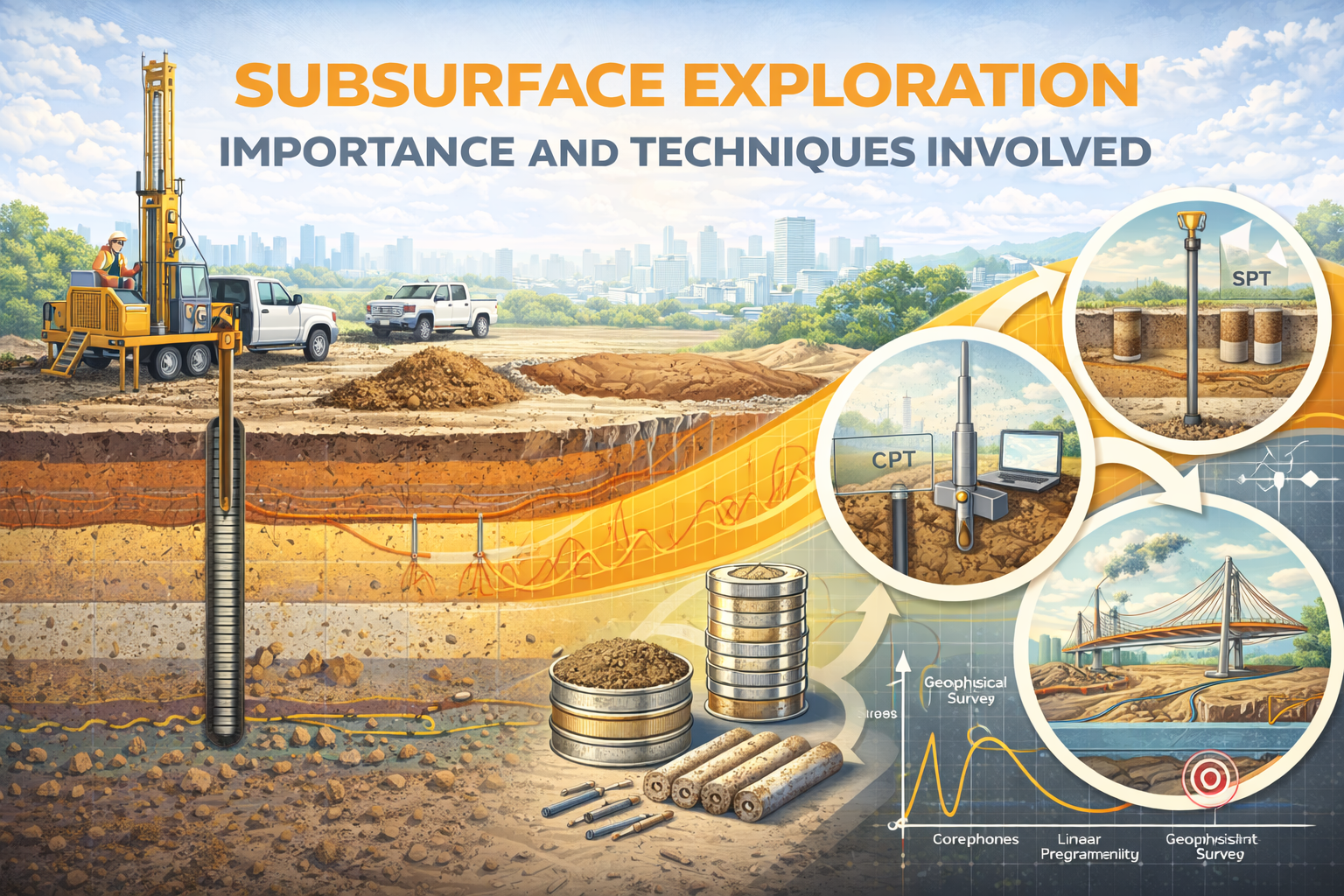
The Subsurface Exploration: Importance and Techniques Involved course provides a clear understanding of soil and rock conditions beneath the ground surface and their role in civil engineering projects. It explains why subsurface investigation is a critical step before the design and construction of foundations, embankments, tunnels, and other infrastructure works, helping to minimize structural risks and unexpected ground failures.

The course covers the planning and execution of site investigation programs, including direct and indirect exploration methods, drilling and boring techniques, in-situ testing, geophysical surveys, and groundwater assessment. It also emphasizes the interpretation of field and laboratory test results, development of soil profiles, and preparation of geotechnical investigation reports used for safe and economical engineering design.

SOURCE-YouTube[ NPTEL IIT Guwahati]

Course suitable for

  • Oil & Gas
  • Agriculture
  • Civil & Structural
  • Chemical & Process

Key topics covered

  1. Importance of subsurface exploration in civil engineering

  2. Objectives and scope of soil and rock investigations

  3. Planning of site investigation programs

  4. Geological and geotechnical considerations

  5. Direct methods of exploration (trial pits, trenches)

  6. Boring techniques and sampling methods

  7. In-situ testing methods (SPT, CPT, vane shear test)

  8. Geophysical methods of subsurface exploration

  9. Groundwater investigation and measurement

  10. Laboratory testing of soil and rock samples

  11. Interpretation of subsurface data and soil profiles

  12. Preparation of geotechnical investigation reports

FREE

Access anytime