
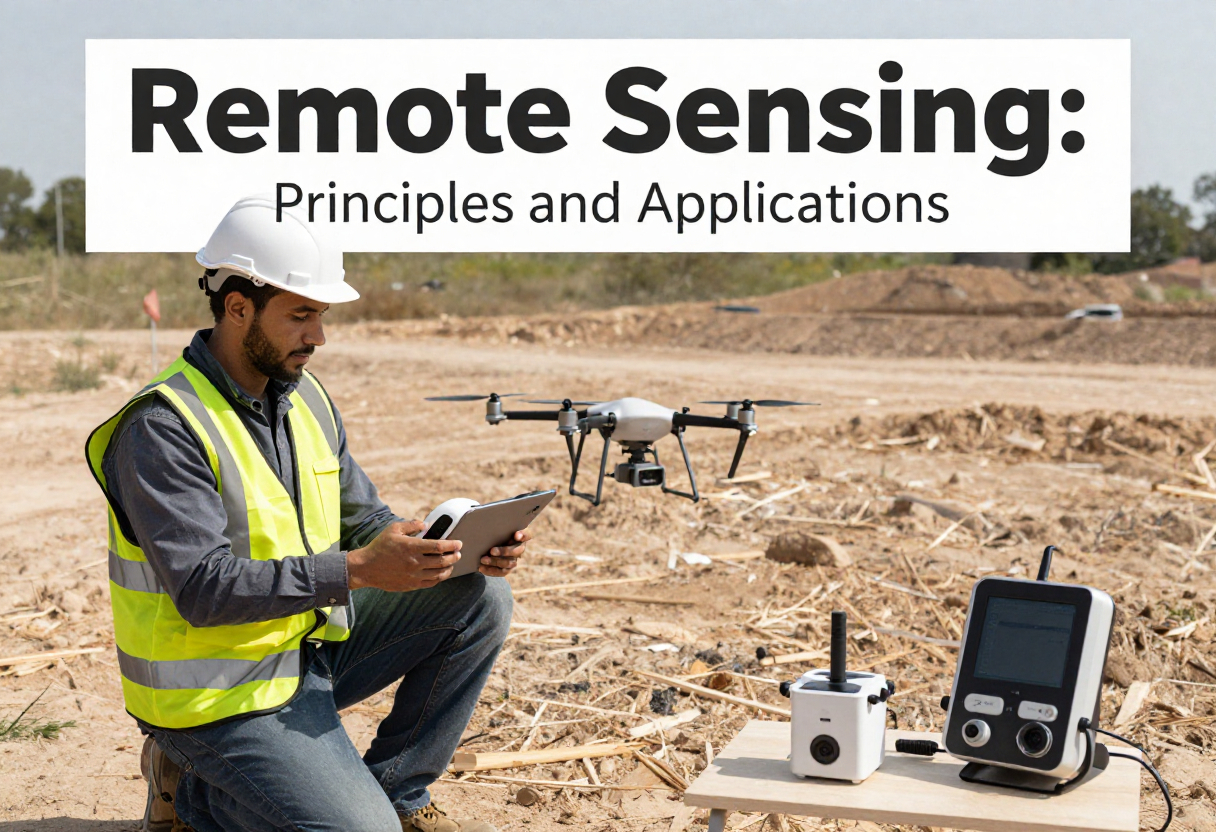
Remote Sensing: Principles and Applications

Engineering Academy
Learn Without Limits: Free Engineering Courses
FREE
Advanced course for professionals

Anytime Learning

Learn from Industry Expert

Career Option Guideline
Remote Sensing: Principles and Applications
Why enroll

Course content
The course is readily available, allowing learners to start and complete it at their own pace.

Remote Sensing: Principles and Applications
30 Lectures
873 min
Lecture 1: Introduction to RS and EMR
Preview
19 min
Lecture 2: Introduction to EMR
25 min
Lecture 3: Basic Laws of RS
23 min
Lecture 4: Properties of EMR – Part 1
27 min
Lecture 5: Properties of EMR – Part 2
21 min
Lecture 6: Interaction of EMR with atmosphere
28 min
Lecture 7: Radiometry – Part 1
34 min
Lecture 8: Radiometry – Part 2
32 min
Lecture 9: Radiometry – Part 3
32 min
Lecture 10: Reflectance, albedo and related quantities
26 min
Lecture 11: Interaction of EMR with terrain features – Part 1
29 min
Lecture 12: Interaction of EMR with terrain features – Part 2
20 min
Lecture 13: Radiation reaching sensor – Part 1
29 min
Lecture 14: Radiation reaching sensor – Part 2
28 min
Lecture 15: RS data: From Radiance to reflectance – Part 1
33 min
Lecture 16: RS data: From Radiance to reflectance – Part 2
28 min
Lecture 17: RS data: From Radiance to reflectance – Part 3
33 min
Lecture 18: RS image acquisition and RS systems – Part 1
20 min
Lecture 19: RS image acquisition and RS systems – Part 2
33 min
Lecture 20: RS image acquisition and RS systems – Part 3
26 min
Lecture 21: RS image acquisition and RS systems – Part 4
36 min
Lecture 22: RS image acquisition and RS systems – Part 5
24 min
Lecture 23: RS image acquisition and RS systems – Part 6
39 min
Lecture 24: RS image acquisition and RS systems – Part 7
36 min
Lecture 25: RS image acquisition and RS systems – Part 8
36 min
Lecture 26: RS image acquisition and RS systems – Part 9
34 min
Lecture 27: Spectral Properties of few common earth features in the Visible, NIR and SWIR bands- 1
33 min
Lecture 28: Spectral Properties of few common earth features in the Visible, NIR and SWIR bands– 2
30 min
Lecture 29: Spectral Properties of few common earth features in the Visible, NIR and SWIR bands– P 3
31 min
Lecture 30: Spectral Properties of few common earth features in the Visible, NIR and SWIR bands– P 4
28 min