Search icon
Search icon

Technical Courses

Soft-Skills Trainings

Seminar & Conferences

Articles & Blogs

Jobs / Hiring

Internship Options

Project Based Freelancing

Communities & Consultation

Product image

First Law of Thermodynamics in Closed System by PK NAG (Chapter 04)

Saurabh Kumar Gupta

Saurabh Kumar Gupta

Mechanical Engineer

$ 10

32 already enrolled!

Product image

First Law of Thermodynamics in Closed System by PK NAG (Chapter 04)

  • Trainers feedback

    3

    (7 reviews)

    Saurabh Kumar Gupta

    Saurabh Kumar Gupta

    Mechanical Engineer

  • Course type

    Watch to learn anytime

  • Course duration

    273 Min

  • Course start date & time

    Access anytime

  • Language

    Hindi

Why enroll

This course is based on PK Nag's Book Chapter 04, to excel in the GATE (Graduate Aptitude Test in Engineering) examination and to secure good marks in other engineering exams. Thermodynamics is a crucial subject in the engineering syllabus, and mastering the concepts and applications presented in Chapter 04 is essential to achieving a high score. By taking this course, individuals can gain a comprehensive understanding of thermodynamic principles, practice solving problems, and develop strategies to tackle complex questions. With a strong foundation in thermodynamics, students can confidently approach the GATE exam and improve their chances of securing admission to top engineering programs or landing coveted jobs at top PSUs.

Master the fundamentals of thermodynamics and unlock the secrets of energy conversion, efficiency, and optimization—enroll now and become a thermal energy expert!

Opportunities that awaits you!

Certificate thumbnail

Earn a course completion certificate

Add this credential to your LinkedIn profile, resume, or CV. Share it on social media and in your performance review

Career opportunities

Course content

The course is readily available, allowing learners to start and complete it at their own pace.

Video info icon

First Law of Thermodynamics in Closed System by PK NAG (Chapter 04)

11 Lectures

273 min

  • Lesson icon

    Introduction to the first law of thermodynamics for closed system

    27 min

  • Lesson icon

    Numerical-1

    24 min

  • Lesson icon

    Numerical-2

    25 min

  • Lesson icon

    Heat Transfer For Various Process

    34 min

  • Lesson icon

    Perpetual Motion Machine of First Kind

    3 min

  • Lesson icon

    Free Expansion of Gases

    14 min

  • Lesson icon

    Solved Example PK NAG Book

    34 min

  • Lesson icon

    Problems with Hint PK Nag Chapter -4

    26 min

  • Lesson icon

    Pk Nag Problems Chapter-4

    27 min

  • Lesson icon

    Pk Nag Problems Chapter-4

    42 min

  • Lesson icon

    Numerical

    17 min

Course details

Course suitable for

  • Aerospace
  • HVAC
  • Mechanical

Key topics covered

  • Introduction to the first law of thermodynamics for closed system

  • Numerical

  • Heat transfer in various process

  • Perpetual Motion of Machine of First Kind

  • Free expansion of gas

  • PK Nag Problem Chapter 4

Course Attachments

lec-19.pdf

lec-20.pdf

lec-21.pdf

lec-22.pdf

lec-23.pdf

lec-24.pdf

lec-25--.pdf

lec-26.pdf

lec-27.pdf

lec-28.pdf

lec-29.pdf

Why people choose EveryEng

Industry-aligned courses, expert training, hands-on learning, recognized certifications, and job opportunities—all in a flexible and supportive environment.

Saurabh Kumar Gupta

Saurabh Kumar Gupta

Mechanical Engineer

Questions and Answers

Q: How is the First Law applied to cyclic processes in closed systems?

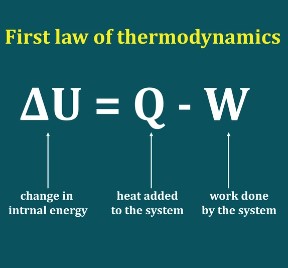
A: In a cyclic process, the system returns to its initial state at the end of the cycle, so the net change in internal energy over one complete cycle is zero (\( \Delta U = 0 \)). According to the First Law, \( 0 = Q - W \) or \( Q = W \). This means the net heat added to the system equals the net work done by the system during the cycle. This principle is fundamental in thermodynamic cycles such as engines and refrigerators. PK NAG’s chapter on the First Law covers cyclic processes and their importance in practical thermodynamics.