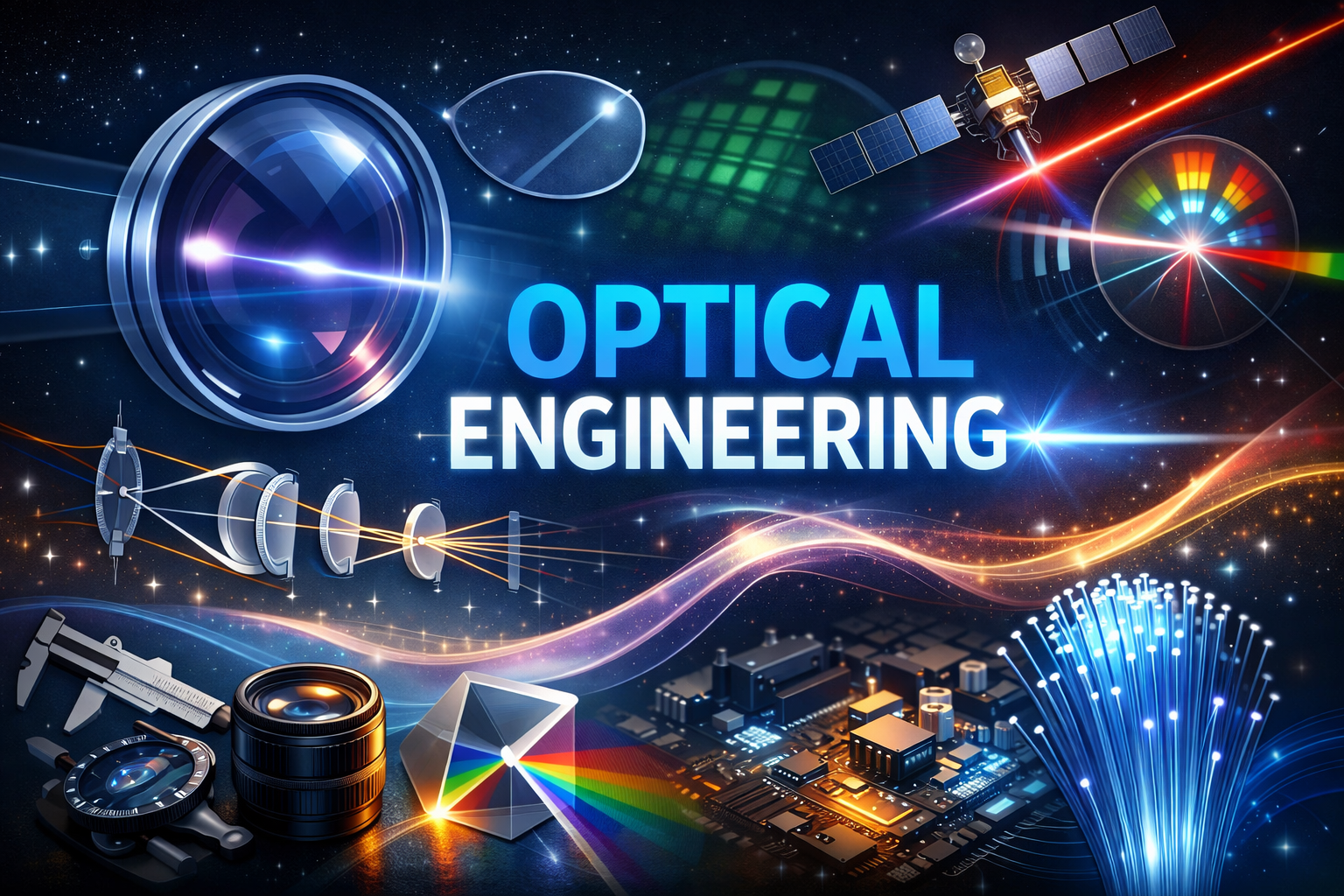

Optical Engineering
Engineering Academy
Learn Without Limits: Free Engineering Courses
Pre-recorded video course. Watch anytime at your own pace.
FREE
Advanced course for professionals
Anytime Learning
Learn from Industry Expert
Career Option Guideline
Optical Engineering
Why enroll
Participants should join this course because it helps them understand how optics is used in real engineering applications. The course explains optics in a simple and practical way, making it easy to connect theory with real devices and systems. Through hands-on labs and software tools, learners gain useful skills in optical design and analysis. This course is especially helpful for students who want to work in areas like opto-electronics, photonics, imaging, or measurement systems, and who want a strong foundation in optics for their future careers.
Opportunities that awaits you!
Earn a course completion certificate
Add this credential to your LinkedIn profile, resume, or CV. Share it on social media and in your performance review

Course content
The course is readily available, allowing learners to start and complete it at their own pace.
Optical Engineering
30 Lectures
1002 min
Introduction to Optical Engineering
Preview
53 min
Geometric Optics Basics | Optical Engineering
42 min
Refraction at a single surface | Optical Engineering
43 min
Lab 1 Introduction to OSLO | Optical Engineering
26 min
Stops and Rays | Optical Engineering
53 min
Aperture Stop | Part 1 | Optical Engineering
19 min
Aperture Stop | Part 2 | Optical Engineering
27 min
Lab 2 | OSLO | Optical Engineering
26 min
Tracing Rays through Optical Pupils | Part 1 | Optical Engineering
23 min
Tracing Rays through Optical Pupils | Part 2 | Optical Engineering
15 min
Ray Tracing Matrix | Part 1 | Optical Engineering
32 min
Ray Tracing Matrix | Part 2 | Optical Engineering
23 min
Principal Planes | Optical Engineering
36 min
Lab 3 OSLO | Optical Engineering
25 min
Imaging Equation for Thick Lens with ABCD Matrix | Optical Engineering
12 min
Aberrations | Optical Engineering
38 min
Monochromatic Aberrations | Part 1 | Optical Engineering
48 min
Monochromatic Aberrations | Part 2 | Optical Engineering
45 min
Lab 4 - OSLO | Optical Engineering
16 min
Chromatic Aberrations | Aberration Correction | Optical Engineering
48 min
Aberration Correction | Optical Engineering
26 min
Revisiting Ray Intercept Curves | Optical Engineering
17 min
Lab 5 - OSLO | Optical Engineering
5 min
Interesting Geometric Phenomena & Applications | Optical Engineering
29 min
Gaussian Beams Introduction | Optical Engineering
62 min
Gaussian Beams | Optical Engineering
35 min
Lab 6 - OSLO | Optical Engineering
33 min
Transformation of a Gaussian Beam | Optical Engineering
48 min
Gaussian Beam Transformation by Lens & Mirror | Optical Engineering
52 min
Application of Gaussian Beam Equations | Optical Engineering
45 min
Course details
Optics is used in many modern technologies, from everyday devices to precise measurement systems. Today, optics is not limited to research labs—it is widely applied in areas like opto-electronics, metrology, and engineering systems that combine optics with electronics and mechanical design.This course introduces the basic ideas of optics in a simple and practical way, suitable for engineering students. It begins with geometric optics, then covers Gaussian optics and wave optics. Real engineering examples are discussed to show how these concepts are used in practice.Along with theory, the course includes a lab component. Students will use optical design software (OSLO) to learn geometric optics through hands-on exercises, and tools like Python or MATLAB to understand wave optics through simulations.
Source - NPTEL NOC IITM
Course suitable for
Automotive Electrical Engineering & Design Research & Developmnet Project Management
Key topics covered
Introduction to the course and optical engineering basics
Understanding light as rays in geometric optics
Refraction of light at a single surface
Lab: getting started with OSLO optical design software
Stops and apertures and their role in optical systems
Clear understanding of aperture stop and field stop
Lab: hands-on practice using OSLO software
Image formation using thick lenses
Ray tracing using matrix method – part 1
Ray tracing using matrix method – part 2
Principal planes and focal points in optical systems
Image formation by lenses and basic formulas
Lens maker’s formula and its applications
Paraxial approximation to simplify ray optics
Fermat’s principle and light path behavior
Refraction at curved surfaces like lenses and mirrors
Multiple lens systems and combined optical setups
Introduction to optical aberrations
Types of aberrations and their effect on image quality
Basics of Gaussian optics and beam behavior
Wave nature of light and wave optics basics
Interference of light waves
Diffraction and spreading of light
Polarization and orientation of light waves
Engineering applications of interference and diffraction
Optical instruments such as microscopes and telescopes
Practical examples of optical instruments
Basics of lasers and coherent light
Gaussian laser beams and their properties
Lab: wave optics demonstrations using Python or MATLAB
FREE
Access anytime