
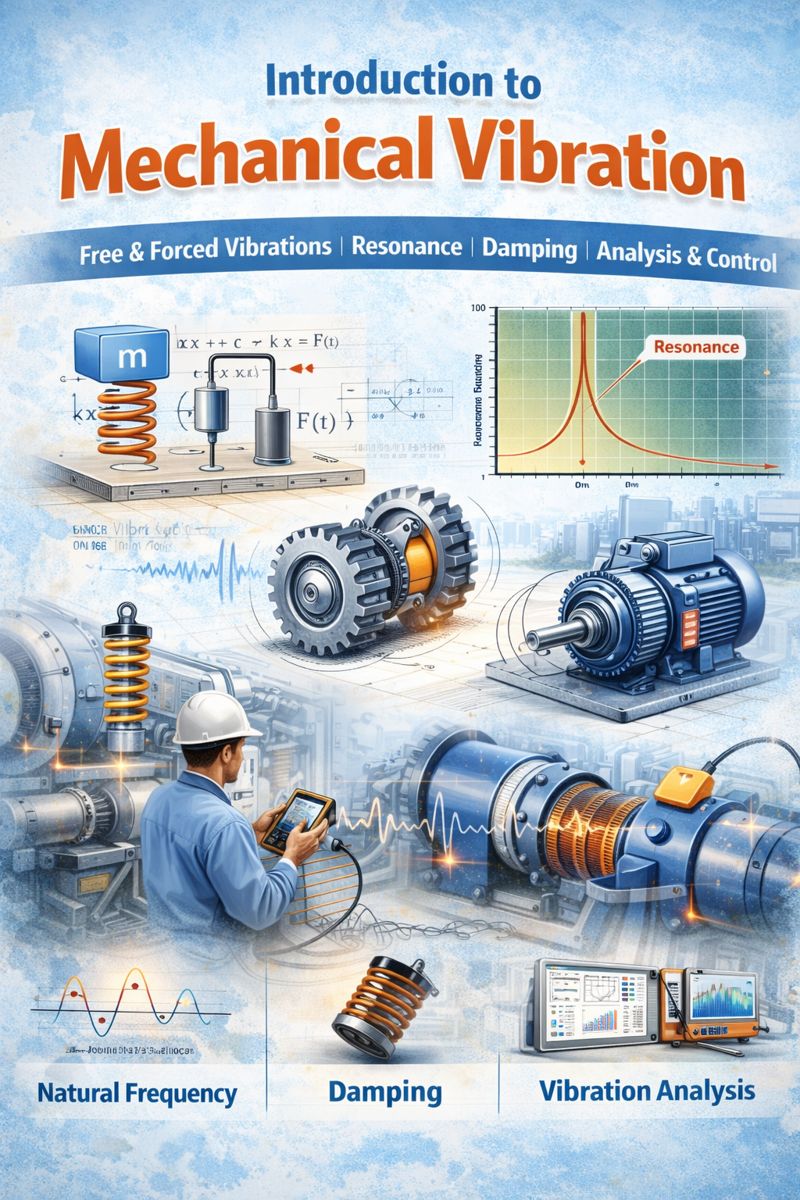
Introduction to Mechanical Vibration

Engineering Academy
Learn Without Limits: Free Engineering Courses
FREE
1 already enrolled!
Advanced course for professionals

Anytime Learning

Learn from Industry Expert

Career Option Guideline
Introduction to Mechanical Vibration
Why enroll

Course content
The course is readily available, allowing learners to start and complete it at their own pace.

Introduction to mechanical vibration
40 Lectures
1261 min
Introduction_old
Preview
33 min
Addition of two harmonic motions and beat phenomenon
Preview
27 min
Fourier series and harmonic analysis
41 min
Vibration analysis procedure
37 min
Numerical problems-1
32 min
Undamped free vibration-1
31 min
Energy method
31 min
Damped free vibration
33 min
Viscous damped systems and logarithmic decrement
34 min
Coulomb damping
34 min
Harmonic excitations
32 min
Magnification factor and frequency response curve
32 min
Rotating unbalance
35 min
Excitation of the support
37 min
Energy input and dissipation by viscous damping
32 min
Coulomb damping and equivalent viscous damping
31 min
Structural damping and equivalent viscous damping
32 min
Vibration isolation and force transmissibility
35 min
Motion transmissibility
29 min
Numerical problems-2
27 min
Transducers and vibration pickup
30 min
Vibrometer
26 min
Accelerometer
30 min
Velocity pickup or Velometer
26 min
Phase distortion and frequency measurement
28 min
Undamped free vibration-2
28 min
Principal modes of vibration
26 min
Combined rectilinear and angular modes
30 min
Damped free vibration-2
30 min
Undamped forced vibration with harmonic excitation
27 min
Undamped dynamic vibration absorber
32 min
Tuned absorber
30 min
Numerical problems-3
30 min
Damped dynamic vibration absorber
56 min
Optimally tuned vibration absorber_old
32 min
Undamped free vibration-3
30 min
Eigen values and eigen vectors
31 min
Flexibility influence coefficients
29 min
Stiffness influence coefficients
26 min
Static and dynamic coupling
29 min