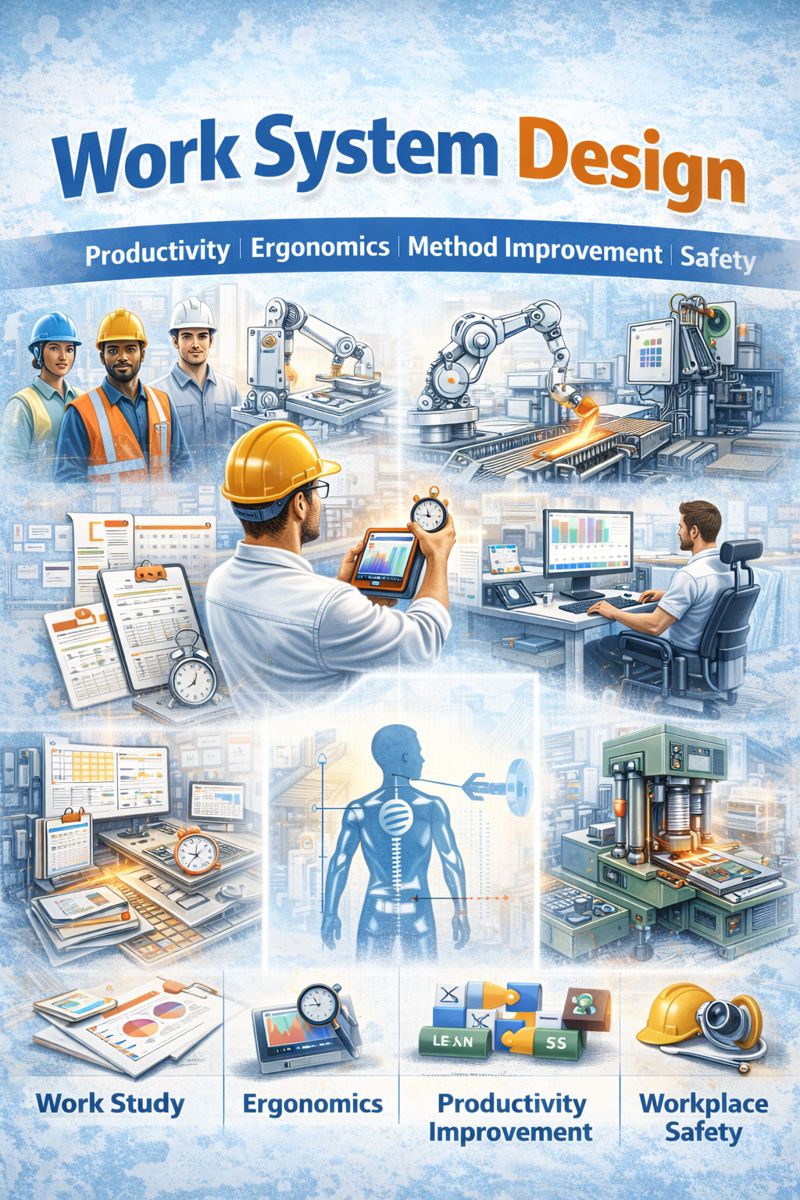

Work system design
Engineering Academy
Learn Without Limits: Free Engineering Courses
Pre-recorded video course. Watch anytime at your own pace.
FREE
Advanced course for professionals
Anytime Learning
Learn from Industry Expert
Career Option Guideline
Work system design
Why enroll
Participants join this course to learn how to design and improve work systems that balance productivity, efficiency, safety, and human well-being. The course equips learners with practical and analytical tools to study work methods, measure performance, and develop optimized workflows that reduce waste, fatigue, and operational inefficiencies.
The program is especially valuable for students and professionals interested in industrial engineering, production management, ergonomics, and operations. Participants gain the ability to analyze real-world work environments, apply ergonomic principles, and design jobs and workplaces that enhance both employee comfort and organizational performance.
By joining this course, learners strengthen their problem-solving and decision-making skills and gain industry-relevant knowledge applicable to manufacturing and service sectors. The course also provides a strong foundation for advanced studies and professional roles in productivity improvement, lean systems, and human-centered system design.
Course content
The course is readily available, allowing learners to start and complete it at their own pace.
Work system design
29 Lectures
930 min
Work System Design
Preview
5 min
Work System Design: Introduction
Preview
30 min
Work Study: Basic Concept
31 min
Techniques of Work Study
38 min
Flow Process Charts
36 min
Flow Process Charts: Examples
32 min
Two-Handed-Process Charts
36 min
Multiple Activity Charts
34 min
Operation Process Charts: Examples
34 min
Operation Process Charts
35 min
Method Study: Recording Techniques
39 min
Method Study: Steps
33 min
Method Study: Basic Concept
38 min
Human Aspects of Work Study
36 min
Concept of Work Content
34 min
Steps Involved in Work Study
34 min
Case Study on Productivity
35 min
Numerical Problems on Productivity
28 min
Productivity Improvement Technique
35 min
Causes of Low Productivity
31 min
Factors Influencing Productivity
25 min
Productivity Measurement Models
28 min
Productivity Measures
26 min
Measurement of Productivity
35 min
Introduction and Concept of Productivity
33 min
Development and Selection of New Method
31 min
Critical Examination Techniques
38 min
Installation and Maintenance of Improved Methods
30 min
Memo-Motion Study
30 min
Course details
Work System Design is a fundamental course in industrial and production engineering that focuses on the systematic design, analysis, and improvement of work systems to achieve high productivity, efficiency, safety, and worker well-being. The course integrates principles of ergonomics, work study, human factors, and operations management to develop optimized methods for performing tasks in manufacturing and service environments.
The course begins with an introduction to work systems and their components, including workers, machines, materials, methods, and the working environment. It emphasizes the importance of understanding human capabilities and limitations in designing effective work systems. Concepts such as anthropometry, biomechanics, physiological factors, and workplace ergonomics are covered to ensure safe, comfortable, and efficient job design.
Key topics include method study, work measurement, time study, standard time determination, and productivity analysis. Students learn to analyze existing work methods, eliminate unnecessary motions, and develop improved processes using tools such as process charts, motion study, and principles of motion economy. The course also addresses job design, work layout planning, and material handling systems to enhance workflow and reduce fatigue and delays.
In addition, Work System Design covers workplace safety, environmental factors, and quality of work life, highlighting their impact on employee performance and organizational effectiveness. Modern approaches such as lean manufacturing, work system optimization, and the use of digital tools for work analysis are introduced to align the course with current industrial practices.
By the end of the course, learners gain the skills required to design and evaluate efficient, safe, and human-centered work systems. The knowledge acquired is highly relevant for careers in manufacturing, operations management, ergonomics, industrial engineering, and productivity improvement initiatives.
source : NPTEL [youtube]
Course suitable for
Mechanics & Turbomachinery Mechanical Production
Key topics covered
introduction to work system design
flow process charts
operation process charts
human aspects of work study
case study on productivity
productivity measures
FREE
Access anytime