Search icon
Search icon

Technical Courses

Soft-Skills Trainings

Seminar & Conferences

Articles & Blogs

Jobs / Hiring

Internship Options

Project Based Freelancing

Communities & Consultation

Product image
Preview this course

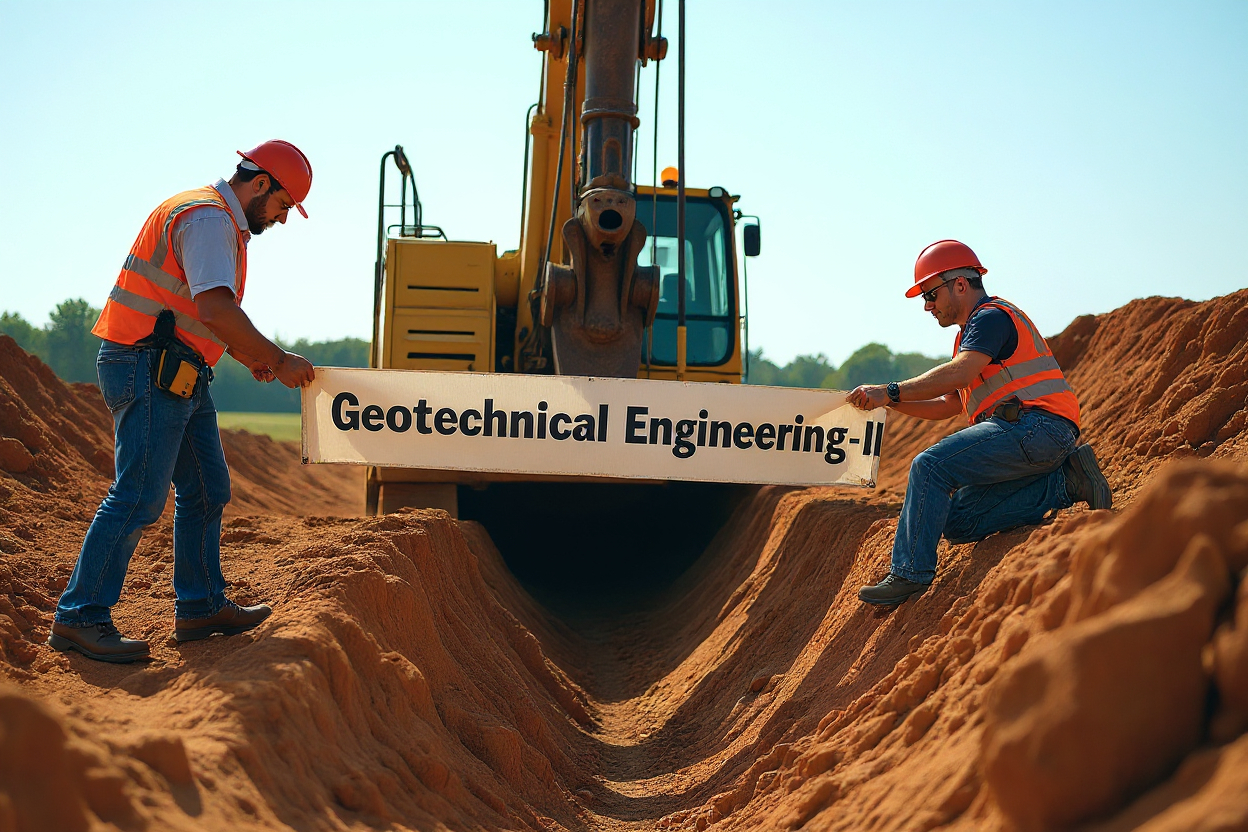
Geotechnical Engineering - II

Engineering Academy

Engineering Academy

Learn Without Limits: Free Engineering Courses

FREE

Product image
Preview this course

Geotechnical Engineering - II

  • Trainers feedback

    5

    (2 reviews)

    Engineering Academy

    Engineering Academy

    Learn Without Limits: Free Engineering Courses

  • Course type

    Watch to learn anytime

  • Course duration

    714 Min

  • Course start date & time

    Access anytime

  • Language

    English

Why enroll

This course is essential for civil engineering students and professionals aiming to specialize in geotechnical engineering and foundation design. It provides the technical foundation required for designing safe foundations and earth-retaining systems and is highly relevant for construction projects, infrastructure development, and geotechnical consultancy. The course is also important for competitive exams, higher studies, and research in geotechnical and earthquake engineering.

Opportunities that awaits you!

Certificate thumbnail

Earn a course completion certificate

Add this credential to your LinkedIn profile, resume, or CV. Share it on social media and in your performance review

Course content

The course is readily available, allowing learners to start and complete it at their own pace.

Video info icon

Geotechnical Engineering - II

28 Lectures

714 min

  • Lesson icon

    Introduction

    Preview icon

    Preview

    28 min

  • Lesson icon

    Shear Strength of Soils – I

    32 min

  • Lesson icon

    Shear Strength of Soils – II

    12 min

  • Lesson icon

    Shear Strength of Soils – III

    28 min

  • Lesson icon

    Shear Strength of Soils – IV

    19 min

  • Lesson icon

    Testing for Shear Strength Parameters: Introduction

    23 min

  • Lesson icon

    Direct Shear Box Test

    25 min

  • Lesson icon

    Direct Shear Interpretation of Test Results – I

    29 min

  • Lesson icon

    Direct Shear Interpretation of Test Results – II

    32 min

  • Lesson icon

    Selection of Parameter (Shear Strength, SS) – I

    28 min

  • Lesson icon

    Selection of Parameter (Shear Strength, SS) – II

    26 min

  • Lesson icon

    Shear Strength of Cohesive Soils – I

    26 min

  • Lesson icon

    Shear Strength of Cohesive Soils – II

    15 min

  • Lesson icon

    Triaxial Test – I

    36 min

  • Lesson icon

    Triaxial Test – II

    17 min

  • Lesson icon

    Triaxial Test – III

    22 min

  • Lesson icon

    Interpretation of Triaxial Test Results – I

    25 min

  • Lesson icon

    Interpretation of Triaxial Test Results – II

    25 min

  • Lesson icon

    Interpretation of Triaxial Test Results – III

    25 min

  • Lesson icon

    Pore Pressure Parameters – I

    28 min

  • Lesson icon

    Pore Pressure Parameters – II

    26 min

  • Lesson icon

    Stress Paths – I

    25 min

  • Lesson icon

    Stress Paths – II

    22 min

  • Lesson icon

    Plastic Equilibrium in Soils

    43 min

  • Lesson icon

    Mechanisms of Development of Plastic Equilibrium in Soils – I

    27 min

  • Lesson icon

    Mechanisms of Development of Plastic Equilibrium in Soils – II

    24 min

  • Lesson icon

    Earth Pressure Analysis (Trial Wedge) – I

    20 min

  • Lesson icon

    Earth Pressure Analysis (Trial Wedge) – II

    26 min

Course details

The Geotechnical Engineering – II course provides an in-depth understanding of soil behavior and its application in the analysis and design of geotechnical structures. Building upon basic soil mechanics concepts, the course focuses on how soils respond to external loads and environmental conditions and how this behavior influences the safety and performance of civil engineering structures.

The course begins with stress distribution in soils due to surface and subsurface loads and examines consolidation and settlement behavior of soils under long-term loading. Learners study primary and secondary consolidation, rate of settlement, and methods for predicting total and differential settlements. The course further explores shear strength characteristics of soils, including Mohr–Coulomb failure theory, drained and undrained conditions, and factors affecting soil strength.

Significant emphasis is placed on foundation engineering, covering the bearing capacity of shallow foundations and the analysis and design of deep foundations such as piles and well foundations. The course also addresses lateral earth pressure theories and the design of retaining walls, as well as the stability analysis of natural and man-made slopes. Practical considerations such as soil–structure interaction, ground improvement concepts, and real-world design challenges are integrated throughout the course to bridge theory with practice.

By the end of the course, learners develop the ability to analyze geotechnical problems, interpret soil investigation data, and apply design principles to ensure safe and economical geotechnical solutions.

SOURCE- youtube [NPTEL IIT Bombay]

Course suitable for

  • Oil & Gas
  • Rail & Transport
  • Geoscience
  • Civil & Structural

Key topics covered

  1. Stress distribution in soil mass

  2. Consolidation and settlement of soils

  3. Shear strength of soils and failure criteria

  4. Bearing capacity of shallow foundations

  5. Design of deep foundations (piles and well foundations)

  6. Earth pressure theories and retaining walls

  7. Stability of slopes and embankments

  8. Ground improvement basics

  9. Soil–structure interaction

  10. Case studies and design applications

Why people choose EveryEng

Industry-aligned courses, expert training, hands-on learning, recognized certifications, and job opportunities—all in a flexible and supportive environment.

Engineering Academy

Engineering Academy

Learn Without Limits: Free Engineering Courses

Questions and Answers

Empty state icon

No questions yet - Be the first one to ask!