Skip to main contentEveryEng | Everything for Engineering
Search icon
Search icon

Technical Courses

Soft-Skills Trainings

Seminar & Conferences

Articles & Blogs

Jobs / Hiring

Internship Options

Project Based Freelancing

Communities & Consultation

Fundamentals of Acoustics-II banner
Preview this course

Fundamentals of Acoustics-II

Engineering Academy

Engineering Academy

Learn Without Limits: Free Engineering Courses

Rating 4 (7)
Course typeWatch to learn anytime
Duration 1098 Min
Start Access anytime
Language English
Views153

FREE

Fundamentals of Acoustics-II banner
Preview this course

Fundamentals of Acoustics-II

Why enroll

Participants join Fundamentals of Acoustics to build a strong conceptual understanding of sound and vibration phenomena that are essential in many engineering and scientific applications. The course helps learners grasp how sound is generated, propagates, and interacts with materials and structures, providing a solid foundation for addressing noise and vibration issues in real-world systems.

Many participants are motivated to acquire practical knowledge of acoustic measurement techniques, noise evaluation, and basic control methods used in industries such as automotive, aerospace, construction, manufacturing, and environmental engineering. The course supports the development of skills needed to analyze sound quality, comply with noise regulations, and improve acoustic performance of products and spaces.

Participants also join to strengthen their academic base for advanced courses, research, or specialization in acoustics, noise and vibration engineering, or related fields. By connecting theory with practical applications, the course benefits students, researchers, and professionals seeking to enhance their technical competence and career opportunities in acoustics and noise control.

Opportunities that awaits you!

Certificate thumbnail

Earn a course completion certificate

Add this credential to your LinkedIn profile, resume, or CV. Share it on social media and in your performance review

Career opportunities

Course content

The course is readily available, allowing learners to start and complete it at their own pace.

Video info icon

Fundamentals of acoustics -II

31 Lectures

1098 min

  • Sound from a pulsating sphere using boundary matching technique.

    Preview icon

    Preview

    32 min

  • Sound from a pulsating sphere using boundary matching technique contd.

    Preview icon

    Preview

    37 min

  • Sound radiation from a spherical cap on a rigid sphere using the Neumann Green function.

    38 min

  • Scattering of a plane acoustic wave from a rigid sphere

    32 min

  • Example to show that the surface in the KHIE is notional (not actual)

    52 min

  • The Rayleigh Integral

    40 min

  • Sound field of an oscillating piston in a rigid baffle

    32 min

  • Sound field of an oscillating piston in a rigid baffle contd.

    30 min

  • Physics of the sound field of an oscillating piston in a rigid baffle.

    26 min

  • Physics of the sound field of an oscillating piston in a rigid baffle contd.

    27 min

  • Physics of the sound field of the oscillating piston (cap) on a rigid sphere.

    34 min

  • The Sommerfeld radiation condition

    48 min

  • Sound field inside a rigid walled box due to initial conditions.

    37 min

  • Sound field inside a rigid walled box due to a harmonic source

    47 min

  • Sound field inside a rigid walled hollow cylinder due to initial conditions

    39 min

  • Modeshape visualization inside a rigid walled cylinder

    21 min

  • Sound field inside a rigid walled hollow cylinder due to initial conditions contd.

    43 min

  • Green function inside a rigid walled cylinder.

    38 min

  • Measures of sound

    37 min

  • Measures of sound contd.

    34 min

  • Average mean square value of different frequency sinusoids

    30 min

  • Frequency analysis of sounds in terms of third octave bands

    42 min

  • Transient solution of the wave equation using Fourier series

    37 min

  • Total soln of harmonically forced wave equation with initial conditions using Fourier series

    44 min

  • Total soln of forced wave eqn with initial conditns using Laplace transform and Fourierseries

    30 min

  • Branched systems, Helmholtz resonator

    29 min

  • The radiation impedance and acoustic power

    39 min

  • Acoustic potential, combined systems, special techniques for solving acoustic wave equation

    40 min

  • Why do we take the real value of the solution in acoustic wave problems

    24 min

  • Course summary part 1

    30 min

  • Course summary part 2.

    29 min

Course details

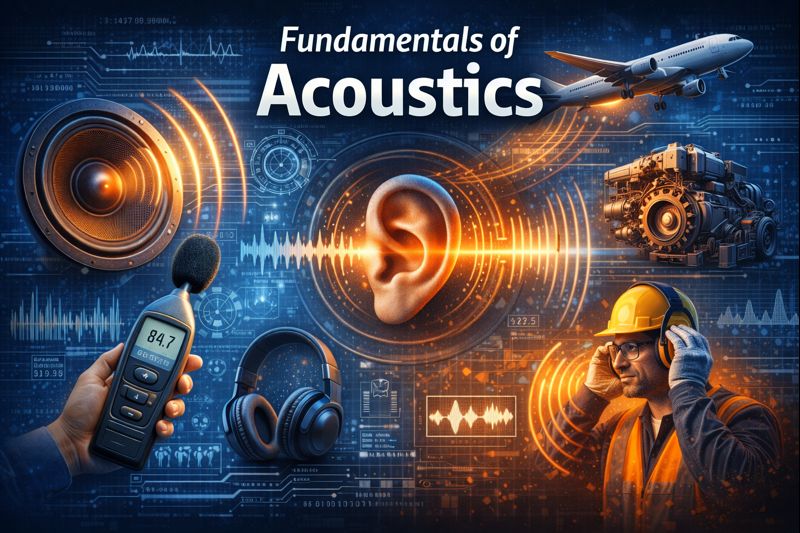
Fundamentals of Acoustics is a core course that introduces the principles governing the generation, propagation, measurement, and control of sound and vibration. The course provides a strong theoretical foundation in acoustics while linking fundamental concepts to practical engineering and real-world applications across mechanical, civil, aerospace, and environmental domains.

The course begins with the basic physics of sound, covering wave motion, frequency, wavelength, sound speed, and sound pressure levels. Participants learn how sound propagates in different media such as air, liquids, and solids, and how boundary conditions and material properties influence acoustic behavior. Topics such as reflection, refraction, diffraction, and interference are discussed to explain sound behavior in enclosed and open environments.

Further, the course explores acoustic measurement techniques and instrumentation, including microphones, sound level meters, frequency analysis, and octave band analysis. Human hearing, psychoacoustics, and noise perception are also introduced to help participants understand how sound is perceived and evaluated. The principles of noise generation, transmission, and control are examined, with emphasis on practical noise reduction methods using absorption, insulation, and damping.

The course also introduces vibration fundamentals and their relationship to acoustics, along with basic room acoustics and environmental acoustics. Applications in noise control engineering, building acoustics, automotive and industrial noise, and product sound quality are highlighted through examples and case studies. By the end of the course, participants gain a clear understanding of acoustic principles and are equipped to analyze, measure, and control sound in engineering systems and environments.

source : NPTEL[youtube]

Course suitable for

  • Mechanics & Turbomachinery
  • Mechanical
  • Production

Key topics covered

  • boundary matching technique

  • the rayleigh integral

  • the sommerfeld radiation condition

  • green function inside a rigid walled cylinder

  • measures of sound

  • course summary

FREE

Access anytime