
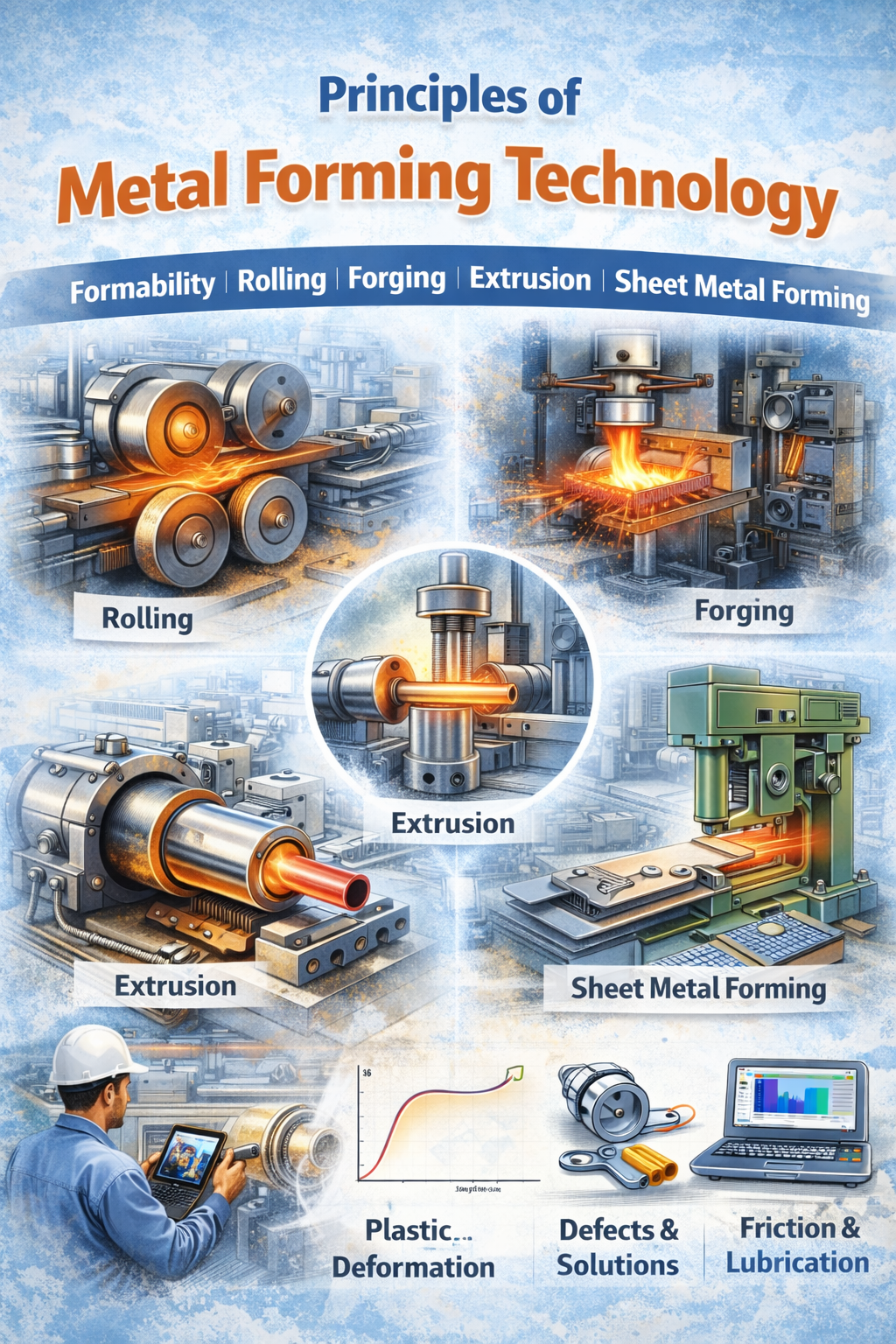
Principles of Metal Forming Technology
Engineering Academy
Learn Without Limits: Free Engineering Courses
Pre-recorded video course. Watch anytime at your own pace.
FREE
Advanced course for professionals
Anytime Learning
Learn from Industry Expert
Career Option Guideline
Principles of Metal Forming Technology

Why enroll
Participants join this course to gain a clear understanding of how metals are shaped through plastic deformation and how forming processes are applied in modern manufacturing. The course builds strong fundamentals in material behavior, metal flow, and formability, enabling learners to analyze and understand the mechanics behind various metal forming operations.
The program is highly beneficial for students and professionals aiming to work in manufacturing, production, automotive, aerospace, and heavy engineering industries. It enhances the ability to select appropriate forming processes, materials, and process parameters while addressing common forming defects and quality issues. Exposure to both conventional and modern forming techniques strengthens practical and analytical skills relevant to industrial applications.
By joining this course, participants develop a solid foundation for advanced studies in manufacturing technology and gain industry-relevant knowledge that supports careers in process design, tooling, production planning, and manufacturing optimization.
Course content
The course is readily available, allowing learners to start and complete it at their own pace.
Principles of Metal Forming Technology
39 Lectures
1221 min
Introduction to Metal Forming Technology
Preview
31 min
Classification of Metal Working Processes
Preview
30 min
Behavior of Materials
33 min
Failure of Materials
31 min
Concept of stress and strain
29 min
Description of stress
30 min
State of stress in three dimension
30 min
Hydrostatic and deviator components of stress and strain
30 min
Elastic stress strain relationships
30 min
Introduction to theory of plasticity and flow curve
31 min
True stress and true strain
30 min
Yield criteria for ductile materials
30 min
Yield locus, Octahedral shear stress and strain
31 min
Plastic stress strain relationships
32 min
Measures of yielding and ductility in tensile testing
32 min
Instability in tension
34 min
Strain rate effects on flow properties
31 min
Temperature effects on flow properties
30 min
Influence of various parameters on flow properties
32 min
Classification of metal working processes-2
32 min
Mechanics of metalworking and analysis methods
33 min
Determination of flow stresses in metal working
29 min
Hot working and cold working
31 min
Metallurgical considerations in metal forming
35 min
Introduction and classification of forging processes
31 min
Equipments used in forging
30 min
Forging in plane strain
31 min
Introduction and classification of rolling processes
32 min
Analysis of rolling load calculations
33 min
Defects in rolled and forged products
28 min
Introduction and classification of extrusion processes
32 min
Analysis of extrusion processes
30 min
Extrusion of tubes and pipes, extrusion defect
33 min
Introduction to rod and wire drawing
32 min
Analysis of wire drawing and tube drawing processes
32 min
Sheet metal operations-I
33 min
Sheet metal operations-II
32 min
Powder metallurgy forming-I
34 min
Powder metallurgy forming-II
31 min
Course details
Principles of Metal Forming Technology is a core manufacturing engineering course that focuses on the science and engineering principles involved in shaping metals through plastic deformation. The course provides a comprehensive understanding of how metals behave under applied stresses beyond their elastic limit and how this behavior is utilized in industrial forming processes to produce components with desired shapes, dimensions, and mechanical properties.
The course begins with an introduction to the fundamentals of plastic deformation, including stress–strain behavior, yield criteria, flow rules, strain hardening, and the effects of temperature and strain rate on metal flow. Concepts of metal flow, formability, and workability are explained to help students understand the limits and capabilities of different materials during forming operations.
Various metal forming processes are studied in detail, including rolling, forging, extrusion, drawing, and sheet metal forming operations such as bending, deep drawing, and stretch forming. The working principles, process parameters, tooling, and equipment used in each process are discussed along with advantages, limitations, and typical industrial applications. The course also introduces defects in metal forming, such as cracking, wrinkling, and residual stresses, and methods for their prevention and control.
In addition, the course covers analytical and empirical approaches to metal forming analysis, including force and power requirements, friction and lubrication, and basic process modeling. Modern developments such as computer-aided metal forming, finite element analysis, and advanced forming techniques are introduced to provide exposure to current industrial practices.
By the end of the course, learners gain a strong theoretical foundation and practical insight into metal forming technologies, enabling them to analyze forming processes, select appropriate methods and materials, and contribute effectively to manufacturing process design, optimization, and quality improvement in metalworking industries.
source : NPTEL[youtube]
Course suitable for
Mechanics & Turbomachinery Mechanical Production
Key topics covered
introduction to principles of metal forming technology
concept of stress & strain
state of stress in three dimension
introduction to theory of plasticity and flow curve
instability in tension
classification of metal working processes
FREE
Access anytime