
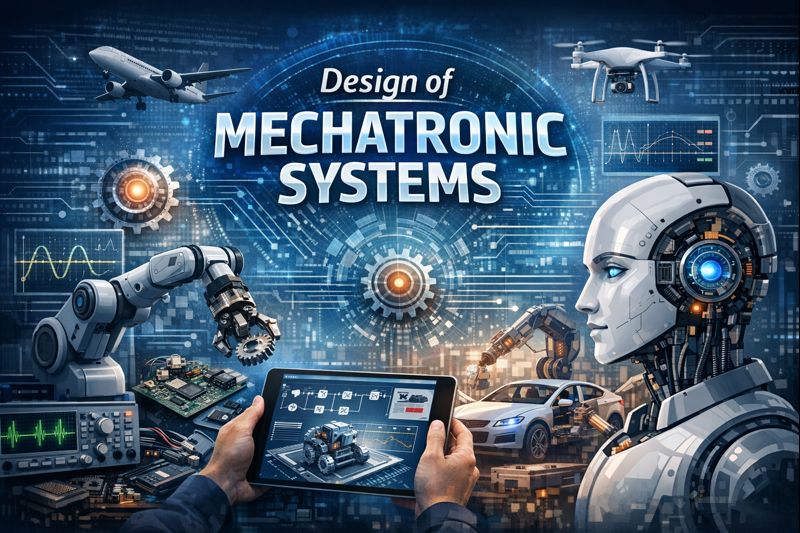
Design of Mechatronic Systems - I

Engineering Academy
Learn Without Limits: Free Engineering Courses
FREE
Advanced course for professionals

Anytime Learning

Learn from Industry Expert

Career Option Guideline
Design of Mechatronic Systems - I
Why enroll
Opportunities that awaits you!

Earn a course completion certificate
Add this credential to your LinkedIn profile, resume, or CV. Share it on social media and in your performance review
Career opportunities
Course content
The course is readily available, allowing learners to start and complete it at their own pace.

Design of Mechatronic Systems
30 Lectures
950 min
Course Introduction - Design of Mechatronic Systems
Preview
7 min
Introduction
Preview
43 min
Elements of Mechatronic Systems – Part I
28 min
Elements of Mechatronic Systems - Part II
36 min
Elements of Mechatronic Systems - Part III
25 min
CD-ROM Part I
36 min
CD-ROM Part II
21 min
Scanner
32 min
Integrated Mechanical-Electronics Philosophy – Part I
38 min
Integrated Mechanical-Electronics Philosophy – Part II
26 min
Smart Sensors Concept
22 min
Compliant Mechanisms
27 min
Microprocessor Building Blocks I- Combinational Circuits
31 min
Microprocessor Building Blocks II - Sequential Circuits
40 min
Microprocessor Memory and Addressing
33 min
Timing and control unit: Primitive Microprocessor
42 min
Microcontroller Architecture I
35 min
Microcontroller Architecture II
29 min
Microcontroller Programming Philosophy
25 min
Hardware Interfaces
41 min
Interfacing Actuator using PWM in Tiva Microcontroller
43 min
Interfacing Encoder using QEI in Tiva Launchpad + ISR
51 min
Mathematical Modelling: Overview and Context
36 min
Modelling Friction in a System
31 min
Modelling DC Motor with loads
39 min
Lagrange formulation fundamentals
29 min
Lagrange formulation examples
39 min
Dynamics: 2-R Manipulator
29 min
Control formulation: Regulation and Tracking
14 min
Fundamentals of Simulation of dynamics using MATLAB
22 min
Course details
Course suitable for
Key topics covered
Why people choose EveryEng
Industry-aligned courses, expert training, hands-on learning, recognized certifications, and job opportunities—all in a flexible and supportive environment.
- Industry Veteran
- Trainer Review

Technip
The content quality on EveryEng is outstanding! Every lesson is well-organized, and the instructors explain everything so clearly. This platform can help every engineer grow professionally in ways I never imagined.

Mulkita Sabharwal
Lead Engineer
Frankfrut, Germany

Heelium
EveryEng is my go-to platform for engineering education. The courses are easy to follow, and the instructors are very knowledgeable. The platform has helped my team gain confidence and expertise in our field.

Siddharth Jain
Co-Founder
Pune, India

Worley
I’ve had an amazing experience with EveryEng! The courses are well-structured, insightful, and practical. The platform is perfect for anyone looking to advance their engineering career with industry-relevant skills.

Arghyapratim Haldar
Sr Process Engineer
Bangalore, India

Lummus
I love how EveryEng makes complex engineering concepts easy to understand. The platform offers valuable insights, great mentors, and a supportive community. It's truly a one-stop solution for engineers worldwide.

Siddharth Mishra
Project Manager
Frankfrut, Germany

KPMG
From learning new technologies to getting hired, this platform changed engineer's career trajectory! It's a great work by Engineer's behind the EveryEng brain.

Rahul Dalal
Senior Resourc Manager
Dallas, USA