Remote Sensing and GIS
Engineering Academy
Learn Without Limits: Free Engineering Courses
Pre-recorded video course. Watch anytime at your own pace.
FREE
1 already enrolled!
Advanced course for professionals
Anytime Learning
Learn from Industry Expert
Career Option Guideline
Remote Sensing and GIS

Why enroll
This course is highly valuable for civil engineers, planners, and environmental professionals seeking to develop modern, data-driven skills. It helps learners analyze spatial patterns, monitor large areas efficiently, and support informed decision-making in projects related to smart cities, transportation networks, water resources, and environmental protection. The skills gained also enhance career opportunities in GIS, remote sensing, and geospatial analytics.
Course content
The course is readily available, allowing learners to start and complete it at their own pace.
Remote Sensing and GIS
24 Lectures
1345 min
Lec 01: Overview and Introduction
Preview
60 min
Lec 02: Basics of Remote Sensing
50 min
Lec 03: Error corrections in satellite image
64 min
Lec 04: Error Identification and Correction - I
61 min
Lec 05: Error Identification and Correction - II
51 min
Lec 06: Error Identification and Correction - III
60 min
Lec 7: DIP-I
54 min
Lec 8: DIP-II
65 min
Lec 9: DIP-III
54 min
Lec 10: DIP-IV
53 min
Lec 11: Image Classification-I
77 min
Lec 12: Image Classification-II
53 min
Lec 13: Photogrammetry
60 min
Lec 14: Thermal Remote Sensing
67 min
Lec 15: Microwave Remote Sensing
62 min
Lec 16: HRS-I
72 min
Lec 17: HRS-II
55 min
Lec 18: HRS-III
49 min
Lec 19: HRS-IV
54 min
Lec 20: HRS-V
33 min
Lec 21: GIS-I
55 min
Lec 22: GIS-II
58 min
Lec 23: Applications of Remote Sensing & GIS-I
35 min
Lec 24: Applications of Remote Sensing & GIS-II
43 min
Course details
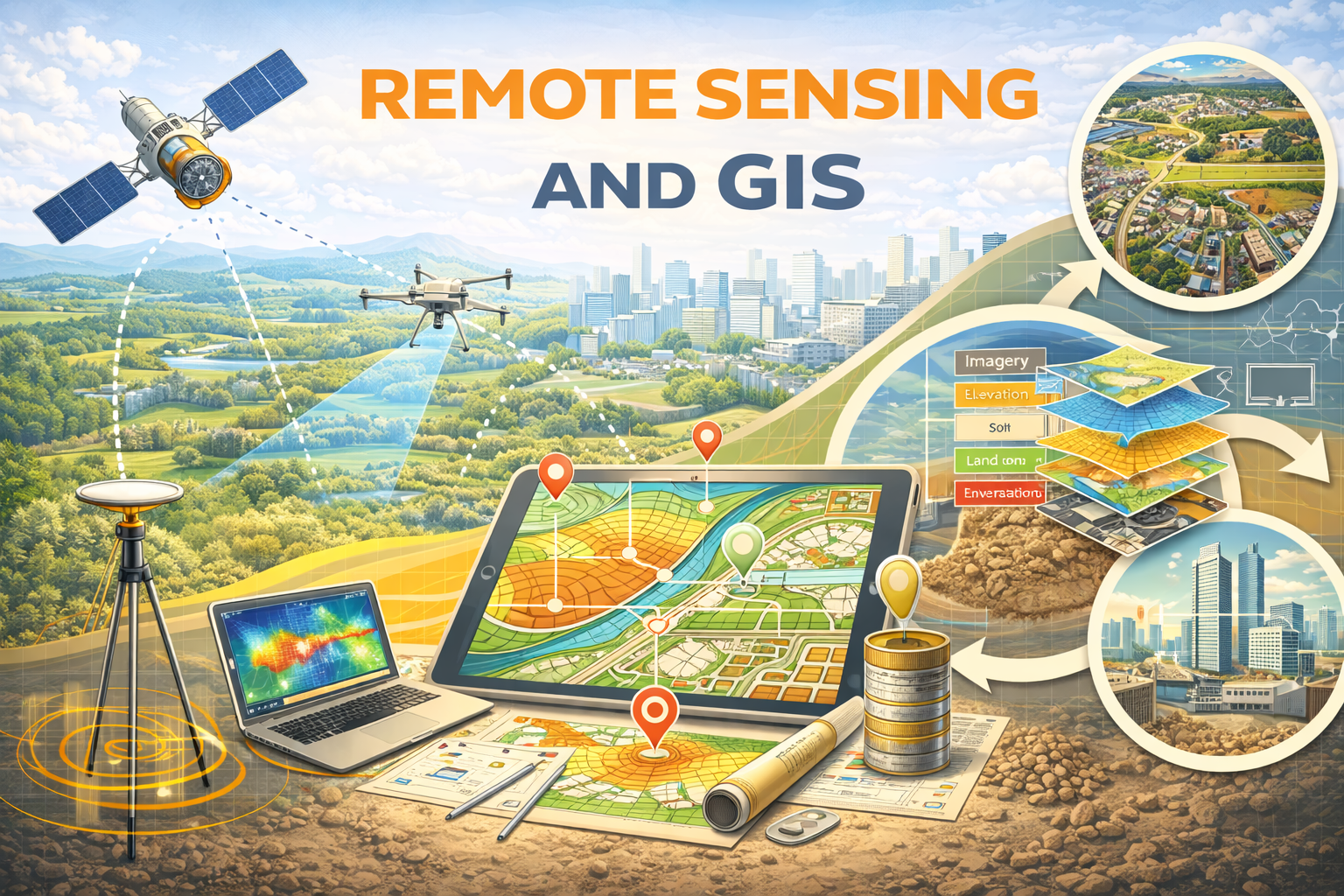
The Remote Sensing and GIS course introduces the principles of acquiring, processing, and analyzing spatial data for engineering and planning applications. It explains how satellite and aerial imagery are used alongside Geographic Information Systems (GIS) to capture, manage, analyze, and visualize geographic information. The course builds a strong foundation in spatial data concepts and their role in modern infrastructure and environmental projects.
The course covers the fundamentals of remote sensing, including sensors, platforms, and image interpretation, along with core GIS concepts such as spatial data models, map projections, and spatial analysis techniques. Emphasis is placed on practical applications in urban planning, transportation, water resources, environmental monitoring, and disaster management, enabling learners to understand how geospatial technologies support data-driven decision-making.
SOURCE- youtube[ NPTEL IIT Guwahati]
Course suitable for
Telecommunication Aerospace Civil & Structural
Key topics covered
Basics of remote sensing and electromagnetic spectrum
Satellite platforms, sensors, and image acquisition
Image preprocessing and enhancement techniques
Image interpretation and classification
Fundamentals of Geographic Information Systems (GIS)
Spatial data models and map projections
Spatial analysis and GIS tools
Integration of remote sensing and GIS
Applications in urban planning and transportation
Environmental monitoring and disaster management
FREE
Access anytime