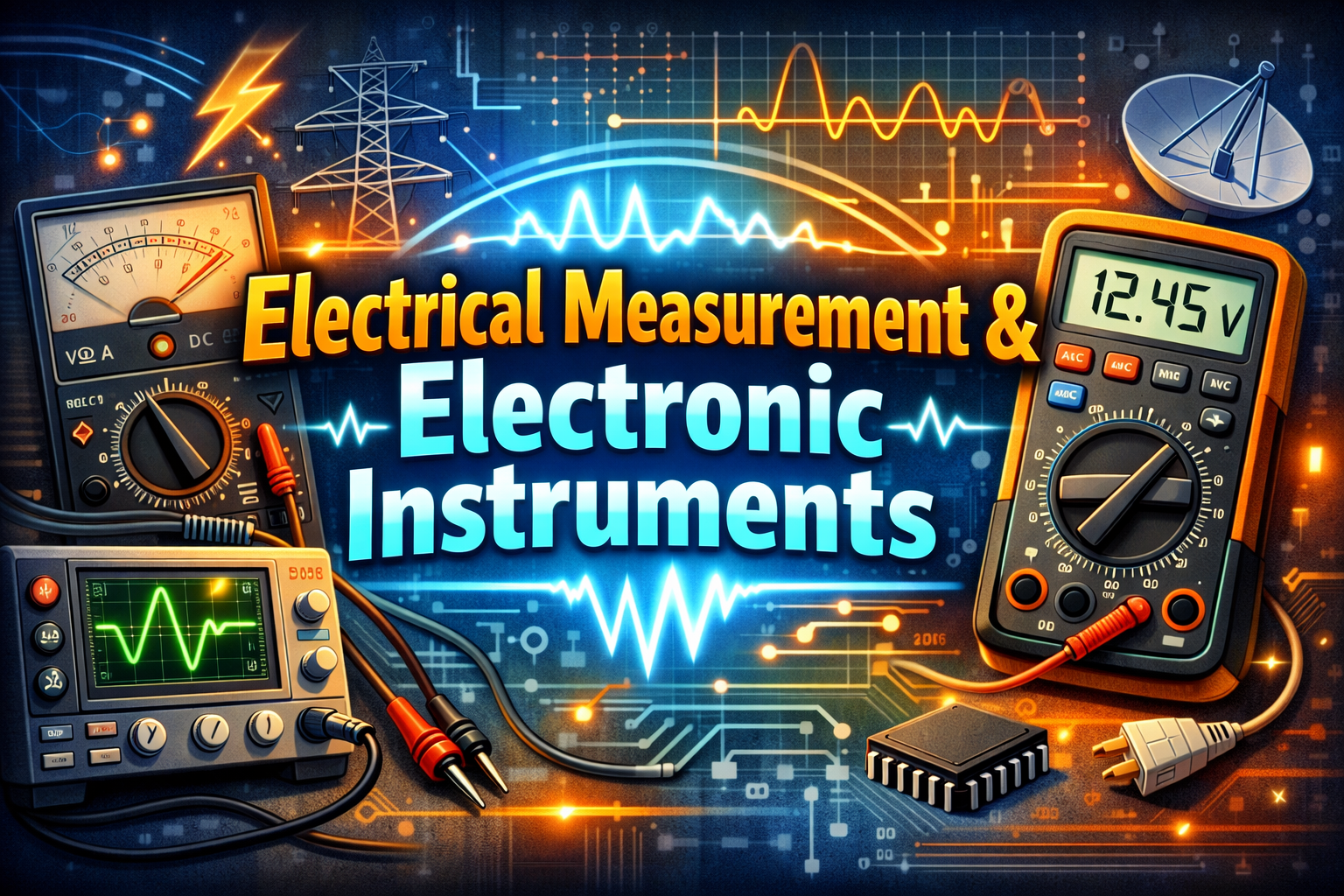
Electrical Measurement and Electronic Instruments
Engineering Academy
Learn Without Limits: Free Engineering Courses
FREE
Advanced course for professionals

Anytime Learning

Learn from Industry Expert

Career Option Guideline
Electrical Measurement and Electronic Instruments
Why enroll
Opportunities that awaits you!

Earn a course completion certificate
Add this credential to your LinkedIn profile, resume, or CV. Share it on social media and in your performance review
Career opportunities
Course content
The course is readily available, allowing learners to start and complete it at their own pace.

Electrical Measurement and Electronic Instruments
30 Lectures
1082 min
Electrical Measurement and Electronic Instruments
Preview
17 min
PMMC Instrument
34 min
Electrodynamic Instrument
40 min
Demonstration of PMMC and Electrodynamic Instrument
12 min
Features of PMMC and Electrodynamic Instrument
27 min
Moving Iron Instruments
27 min
Demonstration of Moving Iron Instrument
24 min
Electrostatic Instrument
19 min
Derivation of Deflecting Torque in Electrodynamic,Electrostatic & Moving Iron Instrument
62 min
Damping and Eddy Current Damping
46 min
Dynamics of the Moving Coil and Damping
28 min
Dynamics of the Moving Coil and Damping (Contd.)
33 min
Ballistic Galvanometer
24 min
Ammeter- I
22 min
Voltmeter
35 min
Ohmmeters- I
40 min
Ohmmeters- II
33 min
Rectifier based Voltmeters and Ammeter- I
35 min
Rectifier based Voltmeters and Ammeter- II
28 min
Resistance measurement with a Voltmeter and an Ammeter
33 min
Four-Terminal Resistance
34 min
Problems: Four Terminal Resistance
64 min
Error Calculation
49 min
Sensitivity, Accuracy, and Resolution of Wheatstone Bridge
50 min
Kelvin Double Bridge
52 min
High Resistance Measurement
53 min
Wattmeter Connection and Compensated Wattmeter
46 min
Single Phase Energy Meter
47 min
Demonstration : Eddy current Braking, creation of magnetic field without moving object
22 min
Single Phase Energy Meter (Contd....)
46 min
Course details
Course suitable for
Key topics covered
Why people choose EveryEng
Industry-aligned courses, expert training, hands-on learning, recognized certifications, and job opportunities—all in a flexible and supportive environment.
- Industry Veteran
- Trainer Review
Technip
The content quality on EveryEng is outstanding! Every lesson is well-organized, and the instructors explain everything so clearly. This platform can help every engineer grow professionally in ways I never imagined.

Mulkita Sabharwal
Lead Engineer
Frankfrut, Germany

SaiDeepa
I’m amazed by the depth of knowledge available on EveryEng. The platform covers various engineering topics in detail, making learning both exciting and rewarding. I would highly recommend it to everyone!

Kranthi Bolineni
COO
Hydrabad, India

Lamprell
EveryEng provides everything an aspiring engineer needs. The courses are relevant, engaging, and easy to follow. It's the best investment an engineer can make in his/her career!

Parth Desai
Offshore Construction Manager
Dubai, UAE

SaiDeepa
EveryEng has completely transformed the learning experience. The platform is easy to navigate, offers high-quality content, and provides great support. I highly recommend it to anyone looking to upskill in engineering.

Sunil Nukatti
CEO
Hydrabad, India

KPMG
From learning new technologies to getting hired, this platform changed engineer's career trajectory! It's a great work by Engineer's behind the EveryEng brain.
Rahul Dalal
Senior Resourc Manager
Dallas, USA