
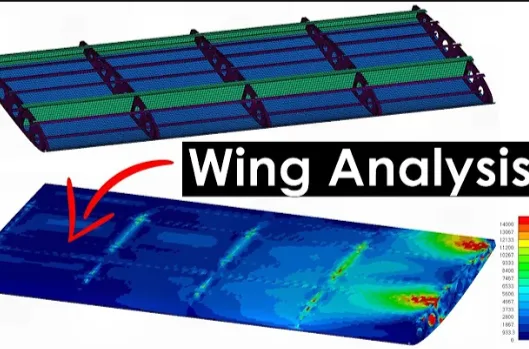
Modal Analysis of Airplane Wing in ANSYS
Modal Analysis of Airplane Wing in ANSYS

- 7-day money-back guarantee
- Lifetime access
- Certificate of completion
Why enroll
What enrolled engineers say
Coming into this course, I had some prior exposure to the subject, mostly from doing hand calcs around vibration issues, but modal analysis in ANSYS was a gap for me. The focus on airplane wing structures made it easier to connect theory to aerospace work, especially when looking at natural frequencies and mode shapes in a realistic geometry. Seeing how boundary conditions and material properties affect results was directly relevant to a wing bracket project I’m currently supporting. One challenge was getting comfortable with the ANSYS workflow at the start. Setting up the mesh and constraints correctly took a few tries, and early results didn’t make sense until I slowed down and checked assumptions. That struggle was useful though, because it mirrors what happens on real programs. A practical takeaway was learning how to interpret modal results beyond just reading frequency values. Understanding which modes are bending versus torsion ties directly into aeroelasticity concerns and early flutter screening. This filled a knowledge gap between theory and actual FEM execution. The content felt aligned with practical engineering demands.
Initially, I wasn’t sure what to expect from this course. Coming from industry, modal analysis of an airplane wing is something usually buried inside larger aeroelastic or flutter studies, not treated on its own. The walkthrough in ANSYS did a decent job of grounding the basics, especially around extracting natural frequencies and interpreting mode shapes. One challenge was getting the boundary conditions right. A fixed-root wing is fine for learning, but in practice the difference between fixed-free and free-free assumptions can shift modes enough to matter, especially when you start thinking about flutter margins. The course briefly touches this, but it took some trial and error to see how sensitive the results are. Meshing was another sticking point; coarse meshes gave misleading higher-order modes, which is an easy beginner trap. Compared to industry workflows, damping and mass participation were simplified, but that’s acceptable at this level. A useful takeaway was building a repeatable setup process in ANSYS that can be extended later to aeroelastic coupling or composite wings. From a system-level view, understanding how wing modes interact with control surfaces is critical. I can see this being useful in long-term project work.
Initially, I wasn’t sure what to expect from this course. Coming from a structures background in aerospace, modal analysis was something I’d seen on the job, but never fully set up end‑to‑end myself in ANSYS. The focus on airplane wing structures made it relevant right away, especially when discussing natural frequencies and mode shapes rather than abstract examples. The walkthrough of building the FEM model, applying realistic boundary conditions at the wing root, and extracting modes helped fill a gap I’ve had for a while. One challenge was interpreting whether the higher-order modes were physical or just artifacts of mesh density, which took some trial and error. The course didn’t completely hand-hold there, but that felt realistic. A practical takeaway was learning a repeatable workflow for modal analysis that I could apply to preliminary flutter screening and vibration checks before detailed aeroelastic work. That’s already been useful on a small UAV wing study at work, where quick confidence in dynamic behavior matters. It’s clearly beginner-level, but grounded enough to connect with real aerospace problems. The content felt aligned with practical engineering demands.
Your instructor
Team EveryEng
Engineer
Mechanical Engineering
Is this course for you?
You should take this if
- You work in Aerospace
- You're a CAD & Analysis / Mechanical Engineering professional
- You prefer self-paced learning you can revisit
You should skip if
- You need a different specialisation outside CAD & Analysis
- You need live interaction with an instructor
Course details
Course suitable for
Key topics covered
Course content
The course is readily available, allowing learners to start and complete it at their own pace.
- Geomtry And Modelling5 min
- Meshing and Nodal Analysis5 min
Opportunities that await you!
Skills & tools you'll gain
Career opportunities
Why people choose EveryEng
Industry-aligned courses, expert training, hands-on learning, recognized certifications, and job opportunities-all in a flexible and supportive environment.


 Oct 2, 2026