

Article details
Introduction
Electric motors are essential components in industrial machinery, manufacturing equipment, pumps, compressors, conveyors, and HVAC systems. Their performance depends on three important parameters: power, torque, and speed. These parameters determine how effectively a motor can drive a machine, handle a load, and operate under different working conditions.
Understanding the relationship between motor power, torque, and speed is important for selecting the right motor for an application. It also helps engineers improve energy efficiency, prevent overloading, and achieve reliable equipment performance.
What Is Electric Motor Power?
Electric motor power refers to the rate at which a motor converts electrical energy into mechanical energy. It indicates how much work the motor can perform over a specific period.
Motor output power is commonly measured in watts (W) or kilowatts (kW). In some applications, horsepower (HP) is also used.
A motor with a higher power rating can generally perform more work per unit of time, provided that it operates within its designed limits. However, power alone does not determine whether a motor is suitable for a particular application. Torque requirements, operating speed, load characteristics, and efficiency must also be considered.
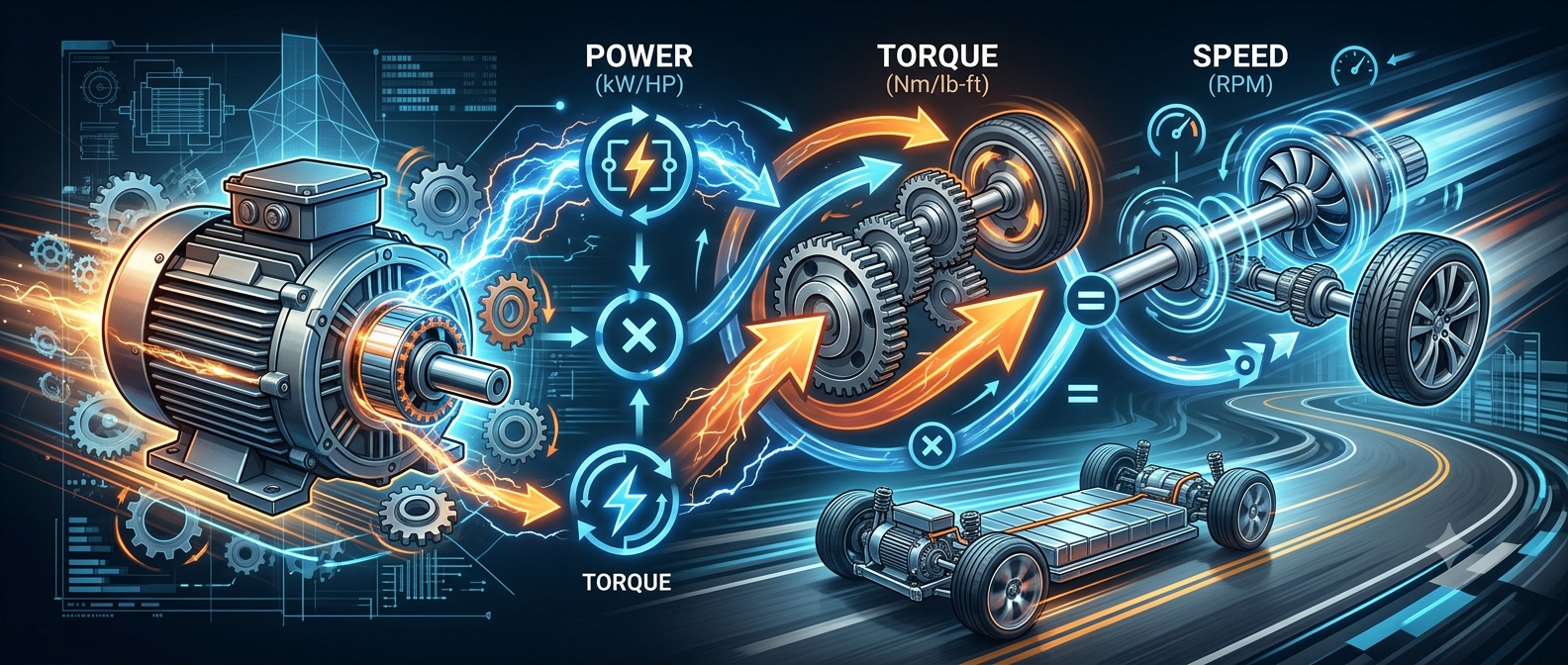
The relationship between power, torque, and rotational speed helps engineers evaluate the performance of an electric motor.
What Is Motor Torque?
Torque is the rotational force produced by a motor. It determines the motor's ability to turn a shaft and overcome the resistance of a connected load.
Torque is measured in newton-metres (N·m) in the International System of Units. In some countries and industries, pound-feet (lb-ft) is also used.
A motor with high torque can drive loads that require significant rotational force, such as heavy conveyors, industrial mixers, lifting equipment, and loaded machinery.
Starting torque is particularly important when a motor must begin rotating a stationary load. Running torque refers to the torque required to keep the motor and its connected equipment operating under normal conditions.
The torque requirement varies depending on the application. For example, a centrifugal pump may require different starting and operating torque characteristics compared with a conveyor carrying heavy materials.
What Is Motor Speed?
Motor speed describes how quickly the motor shaft rotates. It is generally measured in revolutions per minute (RPM).
Motor speed affects how quickly a machine operates and how much torque is available at a given power level. Applications such as fans, pumps, compressors, and machine tools often require specific operating speeds to achieve the desired performance.
The speed of an electric motor depends on its design, supply frequency, number of poles, load, and control method.
For example, the synchronous speed of an AC motor can be calculated using the following formula:
Synchronous Speed (RPM) = (120 × Frequency) / Number of Poles
Here, frequency is measured in hertz (Hz), and the number of poles refers to the motor's magnetic poles.
For a four-pole motor operating at 50 Hz, the synchronous speed is:
Synchronous Speed = (120 × 50) / 4 = 1,500 RPM
An induction motor normally operates slightly below its synchronous speed because of slip. The actual operating speed also depends on the motor design and load.
Relationship Between Power, Torque, and Speed
Power, torque, and speed are closely connected. For a rotating motor shaft, mechanical power depends on both the torque produced and the rotational speed.
The relationship is expressed as:
Power (kW) = Torque (N·m) × Speed (RPM) / 9,550
This formula is commonly used to calculate mechanical shaft power when torque and rotational speed are known.
Alternatively, torque can be calculated using:
Torque (N·m) = 9,550 × Power (kW) / Speed (RPM)
These equations show that, at a constant power level, torque decreases as rotational speed increases. Similarly, a lower rotational speed can provide higher torque when the power output remains constant.
For example, consider a motor producing 5 kW of mechanical power at 1,000 RPM.
Torque = (9,550 × 5) / 1,000
Torque = 47.75 N·m
If the same power is delivered at 500 RPM, the calculated torque becomes 95.5 N·m. This illustrates how lower speed corresponds to higher torque at the same mechanical power.
However, actual motor performance depends on its torque-speed characteristics, rated operating conditions, and control system.
How Torque and Speed Affect Motor Performance
Torque and speed influence how a motor responds to different loads. Their relationship is especially important during starting, acceleration, and continuous operation.
High Torque at Low Speed
Some applications require high torque at relatively low speeds. Examples include lifting systems, heavy-duty conveyors, industrial mixers, and material-handling equipment.
Gearboxes are often used to reduce output speed while increasing available torque. This allows a motor to drive heavy loads without requiring the motor itself to operate at an unnecessarily low speed.
High Speed with Lower Torque
Other applications require high rotational speeds, such as certain machine tools, fans, and high-speed processing equipment.
At a constant power level, increasing speed reduces the available torque. Therefore, engineers must verify that the motor can still provide sufficient torque to overcome the load resistance.
Torque During Motor Starting
When a motor starts, it must generate enough torque to overcome static resistance and accelerate the connected equipment.
If the starting torque is insufficient, the motor may fail to start, accelerate slowly, or draw excessive current for an extended period. This can increase heating and place additional stress on the motor and electrical supply.
Selecting a motor with suitable starting characteristics is essential for applications involving heavy loads or frequent starts.
Understanding the Motor Torque-Speed Curve
A torque-speed curve shows how the torque produced by a motor changes with rotational speed. It helps engineers understand the motor's operating limits and identify suitable applications.
The curve differs according to the motor type and design. Induction motors, synchronous motors, and permanent-magnet motors can have different torque-speed characteristics.
Important operating points may include starting torque, breakdown torque, rated torque, and rated speed. For variable-speed motors, the curve also depends on the drive and control settings.
The operating point is established where the torque supplied by the motor balances the torque demanded by the driven equipment. If the load requires more torque than the motor can deliver at that speed, the motor may slow down or stall.
Studying the torque-speed curve is therefore useful when selecting motors for pumps, compressors, conveyors, and other industrial machines.
Factors Affecting Motor Power, Torque, and Speed
Several factors influence motor performance.
Electrical supply: Voltage, frequency, and supply quality affect motor operation.
Motor design: The motor type, winding arrangement, pole count, and construction influence its torque-speed characteristics.
Load conditions: The weight, friction, inertia, and operating requirements of the driven machine determine the torque demand.
Efficiency: Electrical input power is not entirely converted into mechanical output because of copper, magnetic, friction, and other losses.
Motor control: Variable-frequency drives and other control systems can regulate speed and influence torque availability.
Temperature: Excessive heat can affect insulation life and may require the motor to operate below its full rated capacity.
Engineers must consider these factors together rather than relying on a single motor rating.
Applications in Industrial Engineering
The relationship between power, torque, and speed is important across several engineering applications.
Pumps and compressors: Motor selection must account for the required flow, pressure, starting conditions, and operating speed.
Conveyor systems: Sufficient torque is necessary to move materials, overcome friction, and handle changes in load.
HVAC equipment: Fans and pumps require suitable speed and torque characteristics to maintain system performance and control energy consumption.
Machine tools: Cutting and machining operations require appropriate combinations of speed and torque to maintain productivity and product quality.
Material-handling systems: Hoists and lifting equipment require suitable torque during starting, lifting, lowering, and controlled stopping.
Correct motor selection helps these systems operate safely, reliably, and efficiently.
How to Select the Right Electric Motor
Selecting a suitable motor requires a clear understanding of the driven equipment and its operating conditions.
First, determine the required mechanical power, operating speed, and torque. Consider both continuous operating requirements and peak demands during starting or acceleration.
Next, evaluate the load type, duty cycle, ambient temperature, mounting arrangement, and environmental conditions. Applications involving frequent starts, variable loads, or heavy inertia may require special motor characteristics or a suitable drive system.
Engineers should also check rated voltage, supply frequency, efficiency, protection requirements, and service conditions. Where a gearbox is used, its ratio and efficiency must be included when calculating the required motor performance.
Finally, compare the motor's torque-speed curve with the load characteristics to confirm that the motor can start, accelerate, and operate reliably throughout the required range.
