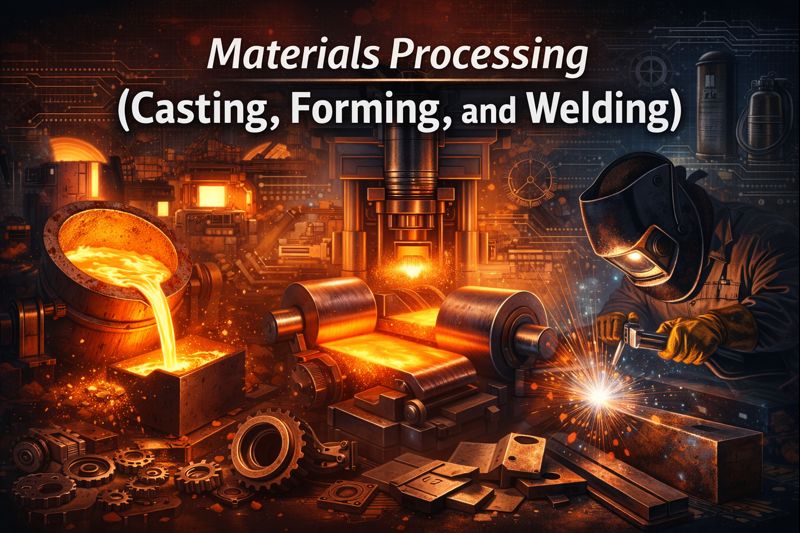
Materials processing ( casting, forming and welding)-II

Engineering Academy
Learn Without Limits: Free Engineering Courses
FREE
Advanced course for professionals

Anytime Learning

Learn from Industry Expert

Career Option Guideline
Materials processing ( casting, forming and welding)-II
Trainers feedback
Engineering Academy
Learn Without Limits: Free Engineering Courses
Course type
Watch to learn anytime
Course duration
1209 Min
Course start date & time
Access anytime
Language
English
Opportunities that awaits you!

Earn a course completion certificate
Add this credential to your LinkedIn profile, resume, or CV. Share it on social media and in your performance review
Course content
The course is readily available, allowing learners to start and complete it at their own pace.

Materials processing ( casting, forming and welding)-II
24 Lectures
1209 min

Processing of glass and fused depostion modeling
Preview
38 min
Arc welding processes
Preview
28 min
Welding of polymers
46 min
Laser and electron beam welding processes
38 min
Advanced welding processes
48 min
Welding solidification
51 min
Metallic wire additive manufacturing
53 min
Mechanical responses of metals and polymers
52 min
Hot working and cold working
29 min
Types of metal forming processes
20 min
Types of metal forming processes-II
29 min
Types of metal forming processes-III and Hot rolling of steel
34 min
Solid state deformation-1
69 min
Solid state deformation -2
72 min
Powder processing-1
60 min
Powder processing-2
73 min
Powder processing -3
58 min
Ceramic processing: Dry pressing & plastic forming methods
57 min
Ceramic processing: Colloidal processing, casting, and coating techniques
66 min
Introduction to steel making and single crystal production
62 min
Integrated Analysis of Steel Solidification, Fluid Flow, and Prodder Processing Technologies
69 min
Processing of electronics Materials, A case Study: semiconductor measurements
61 min
Processing of magnetic materials & Processing of magnetic materials for advanced materials
61 min
Processing of optics materials and pertaining case study
35 min
Why people choose EveryEng
Industry-aligned courses, expert training, hands-on learning, recognized certifications, and job opportunities—all in a flexible and supportive environment.
- Industry Veteran
- Trainer Review

Subsea7
I was searching for a reliable platform to expand my engineering knowledge, and EveryEng exceeded my expectations. The content and courses are well-structured, informative, and taught by experienced professionals. A great platform for Engineers!


SLB
EveryEng stands out with its exceptional learning materials, expert guidance, and real-world applications. It can truly help to enhance skills and knowledge, making more confident professional.


Lockwood
The real-world projects gave my team the hands-on experience they needed to stand out to our clients! A special thanks to EveryEng team.


KPMG
From learning new technologies to getting hired, this platform changed engineer's career trajectory! It's a great work by Engineer's behind the EveryEng brain.


Halliburton
I had been looking for a reliable online platform for engineering courses, and EveryEng delivered beyond my expectations. The content is top-notch, the instructors are excellent, and the learning experience is seamless.

Engineering Academy
Learn Without Limits: Free Engineering Courses
Questions and Answers

No questions yet - Be the first one to ask!
More from Same Author
- Technical Courses
- Articles



17
E-Learning
Unlimited access
Advanced
E-Learning
Unlimited access
Pre-recorded videos

18
E-Learning
Unlimited access
Advanced
E-Learning
Unlimited access
Pre-recorded videos

39
E-Learning
Unlimited access
Advanced
E-Learning
Unlimited access
Pre-recorded videos
Earning and Growth option in same Industry Domain
- Pre-recorded
- Online live session
- Offline
- Articles

628
E-Learning
Unlimited access
Beginner
E-Learning
Unlimited access
Pre-recorded videos


330
E-Learning
Unlimited access
Intermediate
E-Learning
Unlimited access
Pre-recorded videos


505

2
E-Learning
Unlimited access
Intermediate
E-Learning
Unlimited access
Pre-recorded videos
More Training & Development option to expand your reach
- Technical courses
- Soft-skills courses
- Seminars
- Articles & Blogs

1555
5
Online
Live courses

December 31

160 Hrs
Advanced
Online
Live courses
Interacting with trainer

72
Online
Live courses
February 1
3 Hrs
Beginner
Online
Live courses
Interacting with trainer

590
Online
Live courses
February 21
30 Hrs
Advanced
Online
Live courses
Interacting with trainer