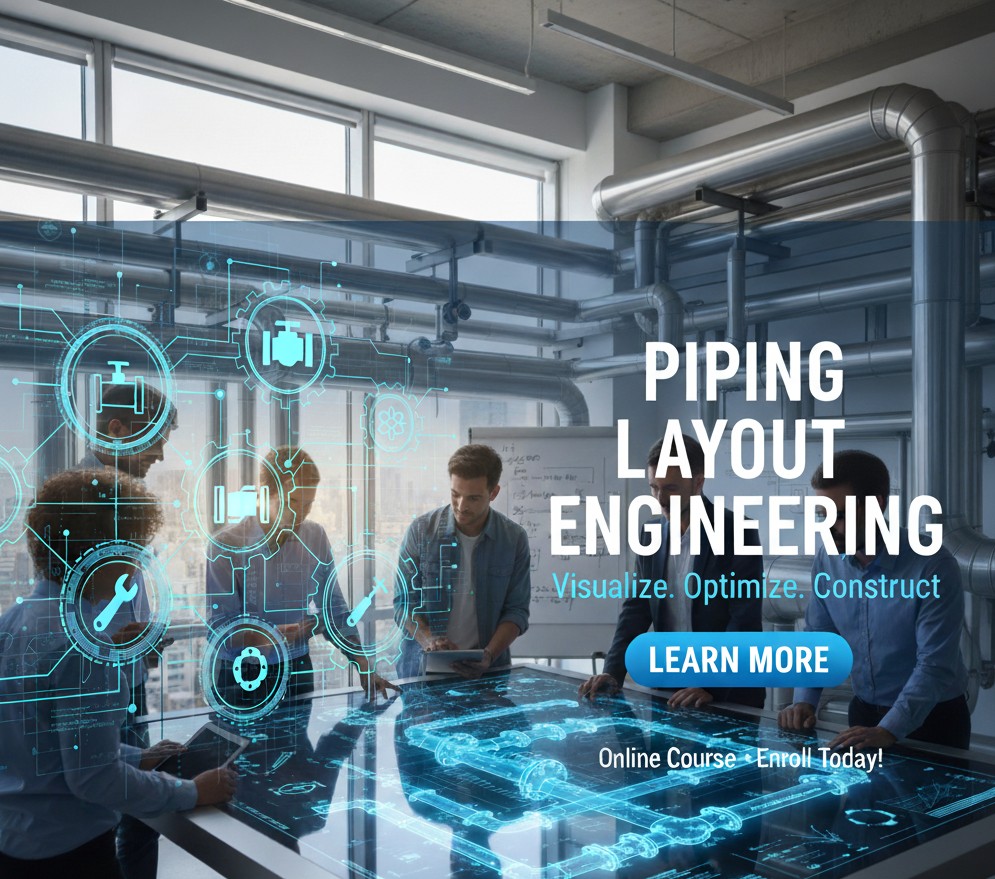
Industrial Piping Layout Engineering
$ 100
Advanced course for professionals
Anytime Learning
Learn from Industry Expert
Career Option Guideline
Industrial Piping Layout Engineering
Trainers feedback
4
(16 reviews)
Course type
Watch to learn anytime
Course duration
1156 Min
Course start date & time
Access anytime
Language
English
This course format through pre-recorded video. You can buy and watch it to learn at any time.
Why enroll
Participants join this course to gain practical, job-ready skills in converting P&IDs into real piping layouts used in industry.It helps them build confidence in plot plans, pipe racks, and equipment layouts while boosting their career growth with industry-relevant expertise.
Course content
The course is readily available, allowing learners to start and complete it at their own pace.
Industrial Piping Layout Engineering
14 Lectures
1156 min
Introduction
Preview
60 min
Introduction to Piping
100 min
Pipe Fitting
96 min
Equal Tee and Reducing Tee
98 min
Flanges and Valves
95 min
General Design Guidelines
94 min
Pipe Support
72 min
Pipe Support I
84 min
Pipe Rack
66 min
Nozzle Orientation
83 min
Isometric Drive
76 min
Overall Plot Plan
76 min
Overall Plot Plan I
78 min
Wall Thickness Calculation
78 min
Course details
The course “PIPING LAYOUT ENGINEERING: Converting P&ID into Piping Layouts” is designed to provide participants with in-depth knowledge and practical skills to effectively translate Piping and Instrumentation Diagrams (P&IDs) into efficient, safe, and standards-compliant piping layouts. The program covers critical aspects of piping layout engineering, including understanding the installation and piping requirements of both process and utility equipment, ensuring smooth and reliable plant operation. Participants will learn how to develop comprehensive overall plot plans by integrating unit requirements, industry standards, and statutory regulations. The course also offers detailed training in pipe rack design, focusing on line placement, width and height calculations, layout development, and preparation of isometric drawings. In addition, it provides comprehensive exposure to storage terminal and tank farm design, covering equipment and piping layouts, support design, nozzle orientation, and isometric construction for both greenfield and brownfield projects. Overall, the course equips participants with industry-relevant, hands-on expertise to confidently handle real-world industrial piping layout projects.
Course suitable for
Oil & Gas Energy & Utilities Pharmaceutical & Healthcare Chemical & Process Piping & Layout Onshore Pipeline Engineering & Design
Key topics covered
Introduction
Introduction to Piping
Pipe Fitting
Equal Tee and Reducing Tee
Flanges and Valves
General Design Guidelines
Pipe Support
Pipe Support I
Pipe Rack
Nozzle Orientation
Isometric Drive
Overall Plot Plan
Overall Plot Plan I
Wall Thickness Calculation
Our Alumni Work At
Why people choose EveryEng
Industry-aligned courses, expert training, hands-on learning, recognized certifications, and job opportunities—all in a flexible and supportive environment.
- Industry Veteran
- Trainer Review

Petrofac
I was skeptical at first, but EveryEng's training programs really delivered. I gained the skills and confidence to take on challenging projects and advance my career. Highly recommended!

Nainesh Desai
Principal Project engineer
Sharjah, UAE

ITER
The user experience on EveryEng is fantastic! The platform is simple, efficient, and provides excellent educational content. It helps developing new skills and gain confidence in engineering career.

Nirbhay Naik
Engineer
France

Subsea7
I was searching for a reliable platform to expand my engineering knowledge, and EveryEng exceeded my expectations. The content and courses are well-structured, informative, and taught by experienced professionals. A great platform for Engineers!

C P Sharma
Principal Engineer
London

Technip
The content quality on EveryEng is outstanding! Every lesson is well-organized, and the instructors explain everything so clearly. This platform can help every engineer grow professionally in ways I never imagined.

Mulkita Sabharwal
Lead Engineer
Frankfrut, Germany

SLB
I never imagined an online learning platform could be this effective! EveryEng’s courses are top-notch, the mentors are industry experts, and the skills my team gained have made a real difference in the performance!"

Vishal Kokate
Engineering Team Lead
Pune, India
Trinergy Engineering
Questions and Answers
A: 150 mm. That's the typical minimum vapor space margin above the normal liquid level for a horizontal separator of this class, and the symptom set hinges on it. Stable indicated level and rising demister DP rule out gross level control issues. Fouled demisters and eroded inlet devices explain DP or efficiency loss, but not why the problem appeared only after a layout revision. A lowered gas outlet nozzle steals disengagement height without touching controls or internals, so carryover climbs while instruments look calm.
A: 610 mm OD drives this. Six large lines at roughly 0.6 m each plus one diameter spacing already lands near 4.2 m. Add edge clearance both sides and a realistic 900–1000 mm walkway and you're near 6 m before utilities. Anything under 4 m collapses spacing rules; anything near 9 m assumes access requirements that don't apply to a single-tier offshore rack.
A: 0.03 bar CO2 equivalent is the trigger. At 55°C with free water, CO2 corrosion rates jump when you create stagnant holdup. H2S at 50 ppmv is below thresholds for SSC in carbon steel under normal stress, and oxygen pitting needs a different exposure pattern. Velocity effects matter at restrictions, but the step change after adding a low point points straight at sweet corrosion.

A: 1.0% per 10°C is the number people miss. A 25°C rise can drive pressures well past MAWP in a fully blocked liquid line long before a high-set PSV reacts. Cracking valves creates uncontrolled flow and risk. Dedicated thermal relief sized for liquid expansion is the safe path offshore where response time is constrained.
A: 20 Hz is the tell. AIV typically sits in the 15–60 Hz band and scales hard with gas velocity and pressure drop across valves. Slugging shows low-frequency, high-amplitude movement. Pump pulsation doesn't exist in a gas-only overhead, and wind effects don't track with flow rate.
A: 1% is the working rule. Over 30 m that clears minor construction tolerances and keeps pockets from forming. 0.1% disappears once supports settle, and 1:20 is overkill that drives support and tie-in issues without benefit for clean water service.
A: 0.6 beta changes everything. An unaccounted reducer upstream of an orifice or venturi skews velocity profile and indicated flow without a matching DP increase. Acting on the transmitter or P&ID alone risks choking the system. As-built geometry governs until proven otherwise.
A: Chlorides above 15,000 ppm kill 316L by pitting and crevice attack, especially in stagnant sections. Lined carbon steel fails when coatings holiday, and repair offshore is painful. GRE, when fire-rated and UV-protected, avoids electrochemical corrosion altogether and matches firewater pressure classes.
A: API 610 nozzle load limits are low. A stiff suction line acts like a lever during heat-up, relaxing gasket stress even when alignment looks fine cold. Material and torque errors leak immediately; cavitation leaves different damage patterns.
A: 12 mm per 10 m per 100°C sets the scale. Over 60 m and 80°C you're near 58 mm growth. Standard flexibility charts put loop legs around 6 m for a 10-in line to stay within allowable stress without exotic supports. Short legs don't bend enough; relying on sliding alone ignores anchor reality.
More from Same Author
- Technical Courses
- Articles
4 (16)
1918
6
Online
Live courses
December 31
160 Hrs
Advanced
Online
Live courses
Interacting with trainer
4 (16)
616
E-Learning
Unlimited access
Advanced
E-Learning
Unlimited access
Pre-recorded videos
4 (16)
764
E-Learning
Unlimited access
Advanced
E-Learning
Unlimited access
Pre-recorded videos
Earning and Growth option in same Industry Domain
- Pre-recorded
- Online live session
- Offline
- Articles
4 (14)
2865
4
E-Learning
Unlimited access
Advanced
E-Learning
Unlimited access
Pre-recorded videos

4 (12)
334
4
E-Learning
Unlimited access
Intermediate
E-Learning
Unlimited access
Pre-recorded videos
4 (316)
5744
1
E-Learning
Unlimited access
Beginner
E-Learning
Unlimited access
Pre-recorded videos

More Training & Development option to expand your reach
- Technical courses
- Soft-skills courses
- Seminars
- Articles & Blogs
4 (16)
1918
6
Online
Live courses
December 31
160 Hrs
Advanced
Online
Live courses
Interacting with trainer
4
156
Online
Live courses
February 21
25 Hrs
Advanced
Online
Live courses
Interacting with trainer
4 (16)
784
Online
Live courses
February 21
30 Hrs
Advanced
Online
Live courses
Interacting with trainer