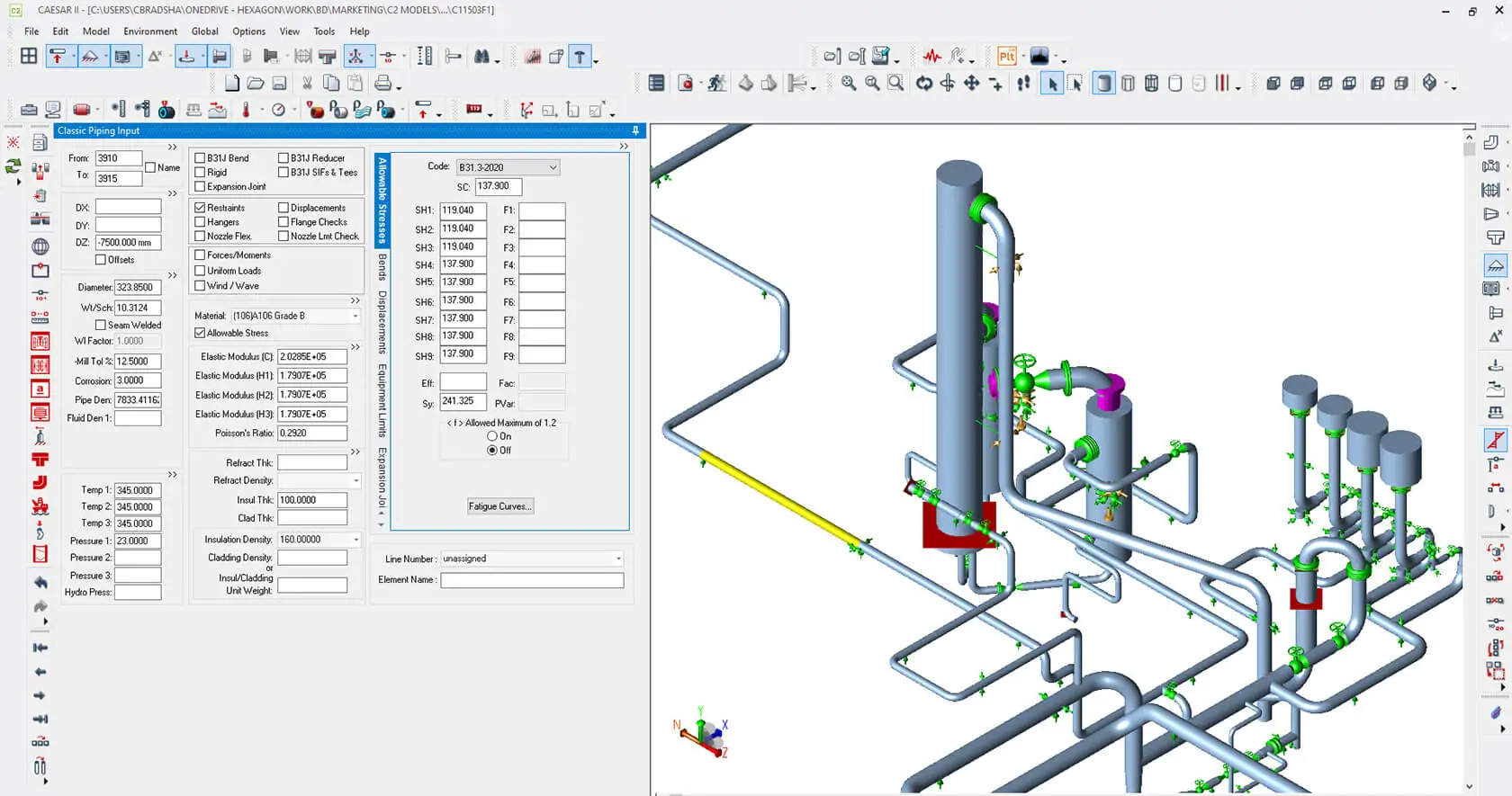
Caesar II Pipe Stress Analysis Basic Course for Beginners and Students
Anup Kumar Dey
Owner of https://whatispiping.com/
$ 50
12 already enrolled!
Beginner course for learners
Foundational Learning
Access to Study Materials
Self-Paced Learning
Caesar II Pipe Stress Analysis Basic Course for Beginners and Students
Trainers feedback
4
(384 reviews)
Anup Kumar Dey
Owner of https://whatispiping.com/
Course type
Watch to learn anytime
Course duration
978 Min
Course start date & time
Access anytime
Language
English
This course format through pre-recorded video. You can buy and watch it to learn at any time.
Course content
The course is readily available, allowing learners to start and complete it at their own pace.
Online Course on Caesar II Pipe Stress Analysis- Basic Course for Beginners
18 Lectures
978 min
Introduction
17 min
What is Pipe Stress Analysis
30 min
Stress Critical Line List
31 min
Inputs Required for Pipe Stress Analysis
12 min
Getting Started with Caesar II
21 min
Modeling and Analysis of Typical Pump System
80 min
Creating Analysis Load Cases
41 min
Wind and Seismic Analysis
25 min
Generating Stress Analysis Report
11 min
Use of Spring Hanger
37 min
Editing Caesar II Model
13 min
Bonus Lecture: Fundamentals of Pipe Stress Analysis in Piping Design
32 min
Bonus Lecture: STATIC Equipment modelling in CAESAR II
33 min
Bonus: PIPING MODELING/ INPUTS/ BREAK/INSERT/PIPE SUPPORT/ OFFSET/ SKEWED LINES /ISOMETRIC
85 min
Bonus: CAESAR-2 PIPING MODELING/ REDUCER/MEASURE THE DISTANCE /PIPE BENDS- PSV LINES (INLET/OUTLET)
102 min
Bonus: CAESAR-2 PIPING MODEL-PSV REACTION FORCE CALC, ASME B 31.8 ,UNDERGROUND/BURIED PIPING
90 min
Bonus: HOW TO MODEL THE TRUNNION PIPE SUPPORT/ DUMMY PIPE SUPPORT IN CAESAR II & TRUNNION STRENGTH CALCN
68 min
Bonus-Pipe Stress Analysis - Detailed Study
250 min
Course details
Pipe stress analysis is one of the most critical activities in piping engineering. Critical piping routes must be studied with proper details to ensure the piping systems perform their intended work throughout their design life without failure.
This course is perfect for any engineer interested in starting a career in piping stress analysis. Even piping layout engineers can learn the basics of pipe stress analysis using these step-by-step lectures. Most of the information related to piping stress analysis is organized in this course.
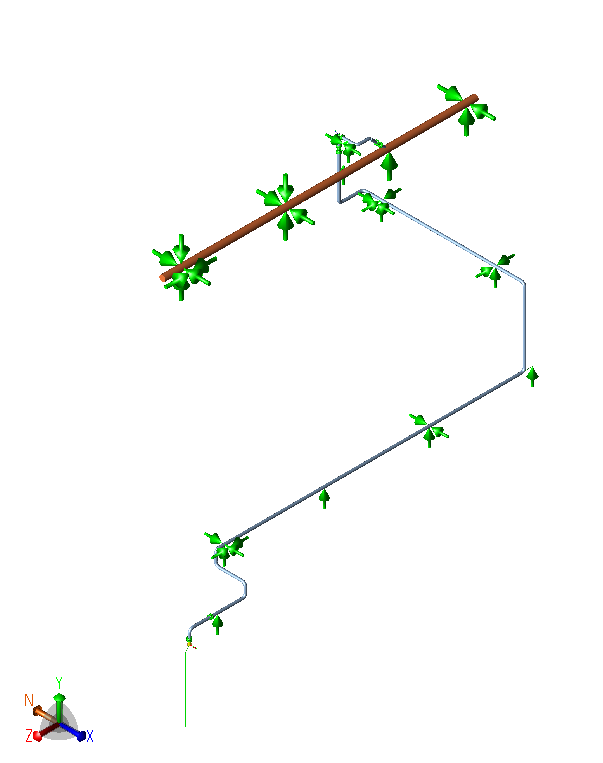
This course is designed to guide you through the pipe stress analysis process - using CAESAR II software developed by Hexagon. One practical problem is taken as an example to help the users learn the complete process of Caesar II pipe stress analysis. Some of the theoretical backgrounds are also covered in the online course. The major subjects that are touched upon are:
What is Pipe Stress Analysis
Which Line Needs Pipe Stress Analysis
Preparing Critical Line List
Common Pipe Support in Caesar II
Pipe Stress Analysis Workflow
Pipe Stress Analysis Software Packages
Creating New Model
Inputs Required for Analysis
Modeling pipes, elbows, tees, reducers, flanges, valves
Adding Supports (Rests, guides, line stops)
Adding Trunnion Support
Adding Spring Hangers
Adding Wind and Seismic
Modeling Equipment Nozzles
Running Error Checker
Creating Load Cases for Stress Analysis
Reviewing Output Results
Code Compliance Check
Checking Sagging
Checking Support Forces
Checking Thermal Movements
Checking Occasional Movements
Optimizing Supports
Optimizing Pipe Routes
Checking Nozzle Loads
Caesar II pipe stress analysis course is indispensable for ensuring the integrity and safety of piping systems. Caesar II, a leading software tool used for pipe stress analysis, enables engineers to evaluate the structural performance of piping under various operating conditions. This kind of analysis is crucial because it helps in identifying potential issues such as excessive stress, vibration, and thermal expansion, which can lead to catastrophic failures if left unaddressed. The course provides a comprehensive understanding of how to effectively use the software to simulate and analyze the behavior of piping systems, ensuring that they meet industry standards and regulations. Without such training, engineers may struggle to interpret complex results, leading to flawed designs or overlooked critical issues that could jeopardize the safety and functionality of the entire system.
Furthermore, the complexity of modern industrial processes and the stringent regulations governing them make it essential for engineers to be proficient in Caesar II pipe stress analysis. The course covers a range of topics, including load calculations, support design, and dynamic analysis, equipping professionals with the skills to handle intricate piping layouts and varying operational scenarios. By mastering these concepts, engineers can prevent costly design mistakes and maintenance issues, ultimately saving time and resources. The course also emphasizes best practices for documentation and reporting, which are vital for compliance with regulatory standards and for maintaining clear communication among project stakeholders. In an industry where precision and reliability are paramount, a thorough understanding of Caesar II through specialized training is not just beneficial but necessary for ensuring successful project outcomes and the longevity of piping systems.
Course suitable for
Oil & Gas Energy & Utilities Chemical & Process Mechanical Piping & Layout
Our Alumni Work At

Why people choose EveryEng
Industry-aligned courses, expert training, hands-on learning, recognized certifications, and job opportunities—all in a flexible and supportive environment.
- Industry Veteran
- Trainer Review

L&T
EveryEng is a game-changer in engineering education. The platform provides high-quality courses, interactive learning experiences, and excellent mentor support. It has significantly helped me grow in my engineering career.


Omkar Zolekar
Ass Manager, Projects
Mumbai, India

Electric Hydrogen
EveryEng is more than just a training platform - it's a career catalyst! Their expert instructors, real-world projects, and job assistance helped engineers transition into a successful engineering professional.

Nirdesh Patel
Director of Engineering
Austin, USA

Lummus
I love how EveryEng makes complex engineering concepts easy to understand. The platform offers valuable insights, great mentors, and a supportive community. It's truly a one-stop solution for engineers worldwide.

Siddharth Mishra
Project Manager
Frankfrut, Germany

Worley
I’ve had an amazing experience with EveryEng! The courses are well-structured, insightful, and practical. The platform is perfect for anyone looking to advance their engineering career with industry-relevant skills.

Arghyapratim Haldar
Sr Process Engineer
Bangalore, India

Lockwood
The real-world projects gave my team the hands-on experience they needed to stand out to our clients! A special thanks to EveryEng team.

Poonam Dalal
Senior Project Manager
Dallas, USA
Anup Kumar Dey
Owner of https://whatispiping.com/
Questions and Answers
A: For sustained stress evaluation per ASME B31.3, Caesar II checks the longitudinal stress from weight (W) and internal pressure (P) against the allowable stress Sh. Thermal expansion is excluded because it is displacement-driven and evaluated separately under expansion stress range criteria.
A: Buried piping develops axial resistance from soil friction rather than full fixity. Caesar II axial soil springs, derived from soil properties and pipe OD, provide a closer representation of load transfer and prevent non-physical anchor loads.
A: Expansion stress is checked against the allowable stress range Sa, which is derived from material properties and cyclic service assumptions. Caesar II automatically calculates Sa based on code inputs and operating conditions.
A: Guides restrain lateral displacement while permitting axial movement, controlling buckling and sway without locking thermal growth. Line stops restrain axial movement and significantly alter expansion load distribution.
A: Occasional loads such as wind or seismic are combined with sustained loads and evaluated against an increased allowable, commonly 1.33 × Sh, subject to the governing code and service category.
A: Including pump stiffness allows Caesar II to distribute loads between piping and equipment realistically, avoiding unconservative nozzle load predictions that can exceed vendor limits such as API 610.
A: A stable model shows global equilibrium where summed support reactions balance applied loads. Large imbalances typically point to missing restraints, bad directions, or data entry errors.
A: Friction models capture stick-slip behavior at supports, resisting initial thermal movement until friction limits are exceeded. This nonlinearity affects load redistribution and displacement patterns.
A: Thermal expansion force is driven by the coefficient of thermal expansion in combination with temperature change and system restraint. Incorrect values skew displacement and load predictions.
A: Using guides with conservative gaps provides restraint without over-constraining the system, allowing validation against observed behavior while avoiding artificial anchor loads common in brownfield rework.
More from Same Author
- Technical Courses
- Articles
4 (384)
3595
38
E-Learning
Unlimited access
Advanced
E-Learning
Unlimited access
Pre-recorded videos
4 (384)
14991
12
E-Learning
Unlimited access
Beginner
E-Learning
Unlimited access
Pre-recorded videos
4 (384)
6961
12
E-Learning
Unlimited access
Beginner
E-Learning
Unlimited access
Pre-recorded videos
Earning and Growth option in same Industry Domain
- Pre-recorded
- Online live session
- Offline
- Articles
4 (384)
238
1
E-Learning
Unlimited access
Beginner
E-Learning
Unlimited access
Pre-recorded videos
4 (384)
3579
2
E-Learning
Unlimited access
Beginner
E-Learning
Unlimited access
Pre-recorded videos
4 (12)
370
2
E-Learning
Unlimited access
Beginner
E-Learning
Unlimited access
Pre-recorded videos

More Training & Development option to expand your reach
- Technical courses
- Soft-skills courses
- Seminars
- Articles & Blogs

4 (16)
1941
6
Online
Live courses
December 31
160 Hrs
Advanced
Online
Live courses
Interacting with trainer

4
163
Online
Live courses
February 21
25 Hrs
Advanced
Online
Live courses
Interacting with trainer

4 (16)
792
Online
Live courses
February 21
30 Hrs
Advanced
Online
Live courses
Interacting with trainer