
An Overview of Drilling fluids
Dr Surekha Prabhu
Researcher/ Consultant
$ 20
Beginner course for learners
An Overview of Drilling fluids

Trainers feedback
0
(0 reviews)
Dr Surekha Prabhu
Researcher/ Consultant
Course type
Instructor led live training
Course duration
2 Hrs
Course start date & time
Coming in Next Month
Language
English
This course format is where trainer will explain you the subject via online live session. Date and time are not decided yet but it will be planned within next 2 weeks after you enroll & pay for this course?. Get in touch with our team if any clarification is required.
Why enroll
This course will give insight of all applications and importance of drilling fluid technology and an overview of future courses to be delivered by instructor.
Its useful for:
Drilling engineers and fluid specialists.
Geologists and geoscientists involved in well planning and execution.
Environmental engineers focused on oil and gas.
Researchers and innovators in fluid technology.
Course details
The Drilling Fluid Technology course is a comprehensive program designed for oil and gas industry professionals seeking to enhance their knowledge and skills in drilling fluid management.
This course covers the fundamental principles and advanced technologies used in drilling fluid systems, including fluid properties, rheology, and hydraulics.
Participants will learn about various drilling fluid types, such as water-based, oil-based, and synthetic-based muds, and their applications in different drilling environments.
The course also delves into drilling fluid optimization, waste management, and environmental considerations.
Through case studies, simulations, and hands-on exercises, attendees will gain practical experience in designing and implementing effective drilling fluid programs to improve drilling efficiency, reduce costs, and minimize environmental impact.
Upon completion, participants will receive a certificate and be equipped to make informed decisions on drilling fluid selection, design, and operations.
Course suitable for
Oil & Gas Petroleum Geoscience Chemical & Process
Key topics covered
Introduction to Drilling Fluids: Overview of the role and importance of drilling fluids.
Types of drilling fluids:
Composition and properties of drilling fluids.
Rheology and Flow Characteristics:
Functions of Drilling Fluids:
Wellbore stability.
Environmental Considerations:
New Developments in Drilling Fluid Formulation:
Challenges and Solutions in Drilling Fluid Management:
Case Studies and Practical Applications:
Future Trends in Drilling Fluids:
Training details
This is a live course that has a scheduled start date.
Live session
Why people choose EveryEng
Industry-aligned courses, expert training, hands-on learning, recognized certifications, and job opportunities—all in a flexible and supportive environment.
- Industry Veteran
- Trainer Review
$ 20
- $ 0 Early bird discount
Coming in Next Month
Questions and Answers
A: Drilling fluids, commonly known as drilling muds, are specially engineered fluids used during the drilling of boreholes into the earth. Their primary functions include lubricating and cooling the drill bit, carrying rock cuttings to the surface, maintaining hydrostatic pressure to prevent formation fluids from entering the wellbore, and stabilizing the wellbore walls. Without proper drilling fluids, efficient drilling and well integrity cannot be maintained. For detailed information, you can refer to the Schlumberger Oilfield Glossary: https://www.glossary.oilfield.slb.com/Terms/d/drilling_fluid.aspx
A: The main types of drilling fluids include water-based muds (WBMs), oil-based muds (OBMs), and synthetic-based muds (SBMs). Water-based muds are the most common and environmentally friendly, consisting primarily of water with various additives. Oil-based muds use oil as the continuous phase, providing excellent lubrication and wellbore stability but with environmental concerns. Synthetic-based muds use synthetic oils that combine the benefits of OBMs while reducing environmental impact. Each type is chosen based on well conditions and environmental regulations. More details can be found here: https://www.drillingfluid.org/types-of-drilling-fluids/
A: Viscosity and density are critical properties of drilling fluids. Viscosity measures the fluid's resistance to flow, affecting its ability to carry rock cuttings to the surface. Higher viscosity improves cuttings suspension but may increase pumping requirements. Density affects hydrostatic pressure; it must be carefully controlled to balance formation pressures and avoid influxes or wellbore collapse. Maintaining optimal viscosity and density is essential for efficient drilling and well control. For more insights, see: https://www.iadc.org/en/drilling-fluid-properties/
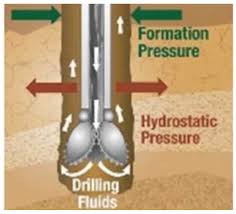
A: Drilling fluids help maintain wellbore stability through hydrostatic pressure, which counterbalances formation pressure and prevents the collapse or influx of fluids. Additionally, certain additives in the fluid can strengthen the borehole walls by forming a thin filter cake on the formation surfaces, reducing fluid loss and stabilizing shale formations. Proper formulation and maintenance of drilling fluids are crucial for preventing wellbore instability issues such as caving or stuck pipe. Refer to this detailed explanation: https://www.spe.org/en/print-issue/?art=1039
A: Environmental concerns related to drilling fluids include contamination of soil and water due to spills, toxicity of oil-based or synthetic-based muds, and disposal of used fluids. Mitigation strategies involve using environmentally friendly fluids where possible, proper containment and handling practices, treatment of used drilling muds, and compliance with environmental regulations. Advances in drilling fluid technology also aim to produce biodegradable and less toxic formulations. For guidelines, visit: https://www.epa.gov/oil-spills/what-drilling-mud-and-their-environmental-impact
A: Additives in drilling fluids serve various purposes such as controlling viscosity (e.g., bentonite, polymers), adjusting density (e.g., barite, hematite), preventing fluid loss (e.g., starch, gilsonite), inhibiting shale swelling (e.g., potassium chloride), and controlling pH (e.g., lime). The selection and concentration of additives depend on the drilling environment and objectives to optimize performance and minimize problems in the wellbore. Detailed additive functions can be found here: https://www.drillingfluid.org/drilling-fluid-additives/
A: Rheology, which describes the flow behavior of drilling fluids, is measured using instruments like viscometers that provide parameters such as plastic viscosity and yield point. Understanding the rheology helps in optimizing the fluid's ability to transport cuttings, manage pressure losses, and maintain wellbore stability. Proper rheological properties ensure efficient drilling and reduce operational issues. For an in-depth explanation, this resource is helpful: https://www.iadc.org/en/drilling-fluid-rheology/
A: Weighting materials like barite or hematite are added to drilling fluids to increase their density. Increasing fluid density is essential to balance formation pressures and avoid influxes (kicks) or blowouts, while also providing wellbore stability. The amount and type of weighting material are selected based on the required mud weight and the compatibility with other fluid components. More information can be found here: https://www.energysolutionsonline.com/weighting-materials-in-drilling-muds/
A: Drilling fluids suspend and carry rock cuttings generated by the drill bit up to the surface. The fluid’s viscosity and flow rate are crucial factors that enable efficient cuttings transport. Properly balanced drilling fluids avoid cuttings from settling in the wellbore, which can cause stuck pipe and other problems. The fluid’s rheological properties ensure the suspension of particles in the annulus during both circulation and static conditions. Learn more about cuttings transport here: https://www.spe.org/en/jpt/jpt-article-detail/?art=3908
A: Yes, drilling fluids are usually recycled and reused multiple times during drilling operations to reduce costs and environmental impact. This involves cleaning the fluid of cuttings and contaminants through solids control equipment like shale shakers, desanders, and centrifuges. Parameters such as mud weight, viscosity, and chemical balance are monitored and adjusted to maintain fluid performance. Proper fluid management extends mud life and improves operational efficiency. For fluid recycling methods, see: https://www.drillingfluid.org/mud-recycling/
More from Same Author
- Technical Courses
- Articles
4
553
11
E-Learning
Unlimited access
Beginner
E-Learning
Unlimited access
Pre-recorded videos
5
747
29
E-Learning
Unlimited access
Beginner
E-Learning
Unlimited access
Pre-recorded videos
4 (20)
928
71
E-Learning
Unlimited access
Beginner
E-Learning
Unlimited access
Pre-recorded videos
Earning and Growth option in same Industry Domain
- Pre-recorded
- Online live session
- Offline
- Articles
4 (23)
5004
6
E-Learning
Unlimited access
Beginner
E-Learning
Unlimited access
Pre-recorded videos
1062
E-Learning
Unlimited access
Beginner
E-Learning
Unlimited access
Pre-recorded videos
4 (43)
7799
387
E-Learning
Unlimited access
Beginner
E-Learning
Unlimited access
Pre-recorded videos
More Training & Development option to expand your reach
- Technical courses
- Soft-skills courses
- Seminars
- Articles & Blogs
4
403
Online
Live courses
December 21
1.5 Hrs
Beginner
Online
Live courses
Interacting with trainer
998
3
Online
Live courses
December 31
160 Hrs
Advanced
Online
Live courses
Interacting with trainer
254
Online
Live courses
January 8
9 Hrs
Beginner
Online
Live courses
Interacting with trainer


