Complete Basics to Advance of Materials Science and Engineering
$ 100
4 already enrolled!
Advanced course for professionals
Anytime Learning
Learn from Industry Expert
Career Option Guideline
Complete Basics to Advance of Materials Science and Engineering
Trainers feedback
4
(6 reviews)
Course type
Watch to learn anytime
Course duration
618 Min
Course start date & time
Access anytime
Language
English
This course format through pre-recorded video. You can buy and watch it to learn at any time.
Why enroll
Participants should take this 20 hour course to build a strong foundation in materials science, a critical field for numerous engineering disciplines. The knowledge and skills gained will be invaluable for developing and optimizing materials in high-demand industries like aerospace, automotive, electronics, and energy. By learning how to evaluate, manipulate, and improve material properties, participants will be better prepared for careers in research, development, and design where innovative materials are key to advancing technology and solving real-world challenges. This course will help learners stand out as competitive and forward-thinking engineers capable of driving material innovations.
Course content
The course is readily available, allowing learners to start and complete it at their own pace.
Complete Basics to Advance of Materials Science and Engineering
12 Lectures
164 min
Introduction to Course, its Objectives, and its Modules
Preview
8 min
Difference between Materials Science and Materials Engineering
Preview
7 min
Classification of Materials (Metals, Alloys, Ceramics, Polymers, Composites)
Preview
9 min
Classification of Materials (Based on Structure)
7 min
Science behind Bond Formations
7 min
Primary Atomic Bonds
11 min
Secondary Atomic Bonds
12 min
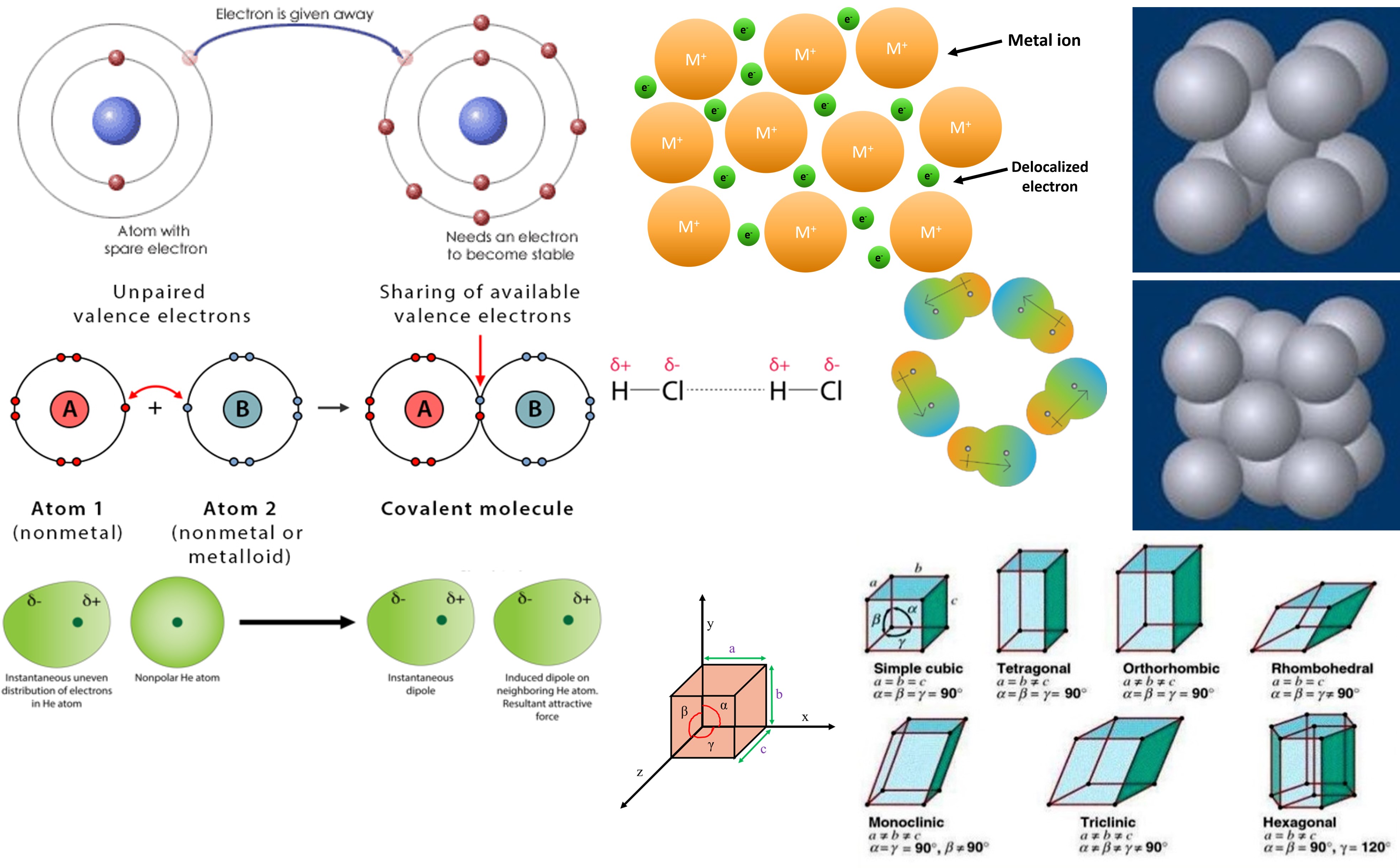
Concept and Visualization of Crystal Structures
11 min
BCC, FCC, and HCP Crystal Systems
11 min
Difference between Metal and Ceramic Crystal Structures
5 min
Crystal Stoichiometry
16 min
Fatigue Testing | SN Curve
60 min
Module 2 : Materials Characterization
3 Lectures
140 min
Optical Microscopy and Scanning Electron Microscopy
60 min
Transmission Electron Microscopy and X-ray Diffraction
60 min
Raman Spectroscopy
20 min
Module 3: Testing of Materials
3 Lectures
145 min
Hardness Testing: Rockwell, Brinell, Vickers, Knoop, Nanoindentation
40 min
Tensile Testing
60 min
Compression Testing
45 min
Course details
This 20 hour crash course is designed to understand the processing-structure-property-applications co-relationships in different materials. It offers an in-depth exploration of essential topics in materials science covering atomic structure and bonding, material characterization methods, mechanical testing, diffusion, and phase transformations. Participants will gain a solid understanding of different engineering materials and how their properties can be manipulated to obtain high quality and more reliable advanced materials needed to maximize part performance, application regime, and customer satisfaction.
Course Modules
📌 Module 1: Atomic Structure and Bonding in Materials
This module introduces various types of engineering materials (metals, alloys, ceramics, polymers, and composites). It explores ionic, covalent, metallic, and Van der Waals bonding and crystal structures in metals and ceramics.
A solid understanding of atomic structure and bonding principles is essential for predicting material properties and behaviors. This knowledge is key to designing and developing new materials with tailored properties required for synthesis and fabrication of more efficient, durable, and innovative products.
📌 Module 2: Materials Characterization
This module will cover a variety of material characterization techniques, including optical microscopy, scanning electron microscopy, transmission electron microscopy, and X-ray diffraction. Material characterization provides critical insights into the chemical, physical, mechanical, and electrical properties of materials.
By employing these techniques, one can visualize structures and perform more precise material analysis. This deeper understanding helps in identifying defects, optimizing material performance, and improving manufacturing processes. The ability to characterize materials accurately is crucial for advancing innovations in different fields such as nano engineering, mechanical engineering, materials engineering, and structural engineering.
📌 Module 3: Testing of Materials
This module will cover a variety of mechanical testing methods, including hardness testing, tensile testing, compression testing, fatigue testing, and impact testing. These techniques are essential for evaluating and predicting the mechanical properties of materials such as strength, ductility, toughness, and resistance to wear or failure. Understanding these properties is critical for determining how materials will perform under different conditions such as stress, load, and temperatures.
By accurately assessing the mechanical behavior of materials, one can ensure their suitability for specific applications, optimize designs for durability and safety, and enhance overall product performance. These testing methods also help in identifying material limitations and guiding improvements for materials development and quality control.
📌 Module 4: Diffusion and Phase Transformations in Materials
This module will explore the fundamentals of diffusion processes, driving forces behind them, key influencing factors, diffusion types, and their underlying mechanisms. Fick's Laws of diffusion will be discussed with their mathematical formulations and practical applications.
In addition, the module will delve into the Iron-Carbon phase diagram, a critical tool for understanding phase transformations in steels, including the formation of different microstructures like austenite, ferrite, and pearlite. Heat treatment processes, such as annealing, quenching, and tempering, will be examined in the context of their impact on the mechanical properties and microstructures of steels and metallic alloys. By understanding these concepts, students will gain insights into controlling material properties for engineering applications, such as enhancing strength, toughness, and wear resistance in industrial components.
Course suitable for
Pharmaceutical & Healthcare Chemical & Process Metallurgy & Material Science
Our Alumni Work At
Why people choose EveryEng
Industry-aligned courses, expert training, hands-on learning, recognized certifications, and job opportunities—all in a flexible and supportive environment.
- Industry Veteran
- Trainer Review

Technip
The content quality on EveryEng is outstanding! Every lesson is well-organized, and the instructors explain everything so clearly. This platform can help every engineer grow professionally in ways I never imagined.

Mulkita Sabharwal
Lead Engineer
Frankfrut, Germany

SaiDeepa
EveryEng has completely transformed the learning experience. The platform is easy to navigate, offers high-quality content, and provides great support. I highly recommend it to anyone looking to upskill in engineering.

Sunil Nukatti
CEO
Hydrabad, India

Lamprell
EveryEng provides everything an aspiring engineer needs. The courses are relevant, engaging, and easy to follow. It's the best investment an engineer can make in his/her career!

Parth Desai
Offshore Construction Manager
Dubai, UAE

Petrofac
I was skeptical at first, but EveryEng's training programs really delivered. I gained the skills and confidence to take on challenging projects and advance my career. Highly recommended!


Nainesh Desai
Principal Project engineer
Sharjah, UAE

Subsea7
I was searching for a reliable platform to expand my engineering knowledge, and EveryEng exceeded my expectations. The content and courses are well-structured, informative, and taught by experienced professionals. A great platform for Engineers!

C P Sharma
Principal Engineer
London
Jay Desai
Questions and Answers
A: Pick the wrong alloy and you invite pitting after repeated SIP cycles, leading to extractables and a rejected validation run. 316L with controlled sulfur and electropolish handles ethanol, tolerates steam, and manages chlorides at these temperatures while meeting hygienic design expectations. The other options work in different duty envelopes but bring joining, inspection, or contamination risks here.
A: Misconverting hardness drives an under‑ or over‑designed shaft, either bending in service or forcing an unnecessary redesign. The standard empirical relation for carbon and low‑alloy steels ties ultimate strength to Brinell hardness with a factor near 3.45. The other numbers come from mixing heat treatment assumptions or dropping the correlation entirely.
A: Skip the wrong step and you may sign off a vessel that never met code soak conditions, forcing a shutdown when the auditor asks for proof. Temperature history and thermocouple coverage show whether PWHT was actually achieved. Hardness and visuals come later and can’t recover missing thermal data.
A: Overestimating diffusion leads you to fear microstructural changes that won’t happen, delaying production. A quick √(Dt) estimate shows diffusion distances stay small over minutes, even at elevated temperature. The other options confuse liquid transport or ignore time scaling.
A: A poor choice cracks the seat on the first thermal cycle, shutting down the line. Silicon carbide balances hardness, wear resistance, and thermal stability at 900°C. The alternatives shine in other regimes but struggle with abrasion or cycling at this temperature.
A: Get this wrong and downstream property predictions miss the mark, leading to failed mechanical tests. The lever rule around the eutectoid shows a mixed structure at 0.4% C, not full pearlite. The distractors come from misreading the phase diagram or scaling carbon directly.
A: Skipping proper measurement risks microbial hold-up and a failed PQ, pushing approval dates. Direct Ra measurement with a calibrated instrument ties the as-built surface to the spec. Paper evidence and visuals don’t confirm local deviations.
A: Underestimating energy leaves billets cold and the schedule blown. A quick sensible-heat estimate with a realistic loss factor keeps expectations aligned with furnace limits. The other paths drop dominant terms or misuse phase-change thinking.
A: Choose poorly and the guard shatters, creating a safety incident. Polycarbonate absorbs impact energy far better than brittle transparent plastics. The others meet different priorities but fail under repeated impact.
A: Misreading modulus leads to wrong deflection and vibration predictions. Carbon steels cluster tightly around 200 GPa regardless of heat treatment. The other values borrow from different materials or confuse strength with stiffness.
More from Same Author
- Technical Courses
- Articles

4
1805
Online
Live courses
Beginner
Online
Live courses
Interacting with trainer
4
3038
62
Online
Live courses
December 1
2 Hrs
English
Online
Live courses
Interacting with trainer
4
2212
4
E-Learning
Unlimited access
Advanced
E-Learning
Unlimited access
Pre-recorded videos
Earning and Growth option in same Industry Domain
- Pre-recorded
- Online live session
- Offline
- Articles
Currently there is no courses available!
Why choose EveryEng?
Flexible Learning
Continuous Improvement
Beat Competition
Cost Effective solutions
Are you interested in taking a course?
More Training & Development option to expand your reach
- Technical courses
- Soft-skills courses
- Seminars
- Articles & Blogs
4 (16)
1941
6
Online
Live courses
December 31
160 Hrs
Advanced
Online
Live courses
Interacting with trainer

4
163
Online
Live courses
February 21
25 Hrs
Advanced
Online
Live courses
Interacting with trainer
4 (16)
792
Online
Live courses
February 21
30 Hrs
Advanced
Online
Live courses
Interacting with trainer