Search icon
Search icon

Technical Courses

Soft-Skills Trainings

Seminar & Conferences

Articles & Blogs

Jobs / Hiring

Internship Options

Project Based Freelancing

Communities & Consultation

Product image

Errors in CFD, Mesh Generation Techniques & Mesh Quality matrices in CFD

Team EveryEng

Team EveryEng

Mechanical Engineering

$ 15

1 already enrolled!

Product image

Errors in CFD, Mesh Generation Techniques & Mesh Quality matrices in CFD

  • Trainers feedback

    4

    (1419 reviews)

    Team EveryEng

    Team EveryEng

    Mechanical Engineering

  • Course type

    Watch to learn anytime

  • Course duration

    148 Min

  • Course start date & time

    Access anytime

  • Language

    English

Opportunities that awaits you!

Certificate thumbnail

Earn a course completion certificate

Add this credential to your LinkedIn profile, resume, or CV. Share it on social media and in your performance review
Course content

The course is readily available, allowing learners to start and complete it at their own pace.

Video info icon

Errors in CFD, Mesh Generation Techniques & Mesh Quality matrices in CFD

3 Lectures

148 min

  • Lesson icon

    Lecture 01

    58 min

  • Lesson icon

    Lecture 02

    60 min

  • Lesson icon

    Lecture 03

    30 min

Course details

Errors in Computational Fluid Dynamics (CFD), Mesh Generation Techniques, and Mesh Quality Assessment are critical areas of study for anyone working with CFD simulations. These topics focus on the key challenges faced during CFD modeling, including how errors impact the results, how to properly create and refine computational meshes, and how to assess the quality of those meshes to ensure accurate and reliable simulation outcomes.

1. Errors in Computational Fluid Dynamics (CFD)

In CFD, errors can arise due to a variety of factors, which can affect the accuracy, reliability, and stability of the simulation results. These errors can be grouped into several categories:

  • Discretization Errors: These errors occur because the continuous equations governing fluid flow (e.g., Navier-Stokes equations) are approximated by discrete equations for numerical solution. The finer the discretization (smaller grid cells), the lower the discretization error.

  • Numerical Errors: These result from the algorithms used to solve the equations. Issues like poor convergence, round-off errors (due to limited precision), and the choice of numerical scheme can cause inaccuracies.

  • Modeling Errors: These occur when simplified assumptions are made in the CFD model (e.g., turbulence models, boundary conditions, or heat transfer models), which may not completely represent the physical system being simulated.

  • Boundary and Initial Condition Errors: Incorrect or poorly defined boundary conditions (such as inlet velocity or wall temperature) and initial conditions can lead to incorrect results.

Understanding the sources of these errors and developing strategies to minimize or eliminate them is crucial for obtaining accurate and reliable CFD simulations.

2. Mesh Generation Techniques

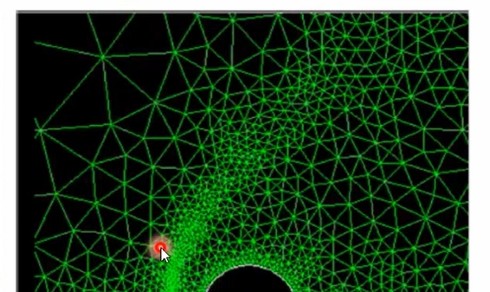
In CFD, a mesh is a discretized representation of the computational domain, and the quality of the mesh is one of the most important factors affecting the accuracy and convergence of the solution. Mesh generation techniques include:

  • Structured Meshes: These are regular grids where the elements (usually quadrilateral or hexahedral) are aligned along coordinate axes. They are easier to generate and solve but are limited in handling complex geometries.

  • Unstructured Meshes: These meshes use arbitrary shapes like triangles (2D) or tetrahedra (3D) to fill the domain. They are more flexible and can handle complex geometries, but they are computationally more expensive.

  • Hybrid Meshes: Combining structured and unstructured mesh techniques, hybrid meshes aim to take advantage of both methods, providing flexibility while maintaining some of the efficiency of structured grids.

  • Adaptive Mesh Refinement (AMR): This technique involves refining the mesh in regions with high gradients of flow variables (like velocity or temperature) to increase accuracy where needed, while coarsening the mesh in less critical areas to save computational resources.

  • Boundary Layer Meshes: In fluid dynamics problems with high shear stress near boundaries (e.g., walls), special attention must be paid to the boundary layer mesh, which involves finer mesh near the walls to capture the behavior of the flow.

Effective mesh generation is crucial because the mesh affects both the accuracy of the solution and the computational cost.

3. Mesh Quality Assessment

The quality of a mesh is directly linked to the accuracy and stability of the CFD solution. Poor mesh quality can lead to incorrect results, convergence issues, or unnecessarily high computational costs. Key aspects of mesh quality include:

  • Skewness: A measure of how much an element deviates from its ideal shape (for example, a perfect square or cube). High skewness can lead to numerical instabilities.

  • Orthogonality: This refers to how perpendicular the mesh cells are to each other. Poor orthogonality can lead to inaccuracies in the numerical scheme.

  • Aspect Ratio: This refers to the ratio of the longest to the shortest side of an element. A high aspect ratio (e.g., a very elongated element) can degrade the solution quality.

  • Smoothness: The smoothness of the transition between adjacent mesh elements is important. Sudden changes in mesh size or shape can cause inaccuracies in the numerical solution.

  • Element Size Distribution: Ideally, the mesh should have a uniform distribution of element sizes, with finer mesh areas in regions with high gradients of flow variables (like velocity or pressure). Uneven distribution can lead to computational inefficiency or inaccurate results.

Mesh quality assessment involves evaluating these parameters and applying techniques (like smoothing, refinement, or coarsening) to improve the mesh before running the simulation. Tools and algorithms exist to automatically detect and fix mesh quality issues, but they require careful attention and expertise to use effectively.

Course suitable for

  • Aerospace
  • Automotive
  • Mechanical

Key topics covered

- Different types of error in CFD

- Meshing Basics

- Different type of meshing

- Mesh generation techniques

- Grid Generation

Our Alumni Work At
wood/Bharath Engineering CollegeKBR/IRTTwood/Bharath Engineering CollegeMaryMount California UniversityKBR/IRTTGenser Energy Ghana LtdAeroDef Nexus LLPInventor Engineering solutionsEx-Tata Steel , Precision Engineering Division , West Bengal universityEEProCAD tech solutonsATKINSREALISMangalam college of EngineeringSearching for jobGulf Engineering & Consultant Gazprom International LimitedNAAir ProductsSPES Consultancy Tecnimont Spa Abu DhabiNIT SilcharJabalpur Engineering College Wex Technologies Pvt.LtdGARGI MEMORIAL INSTITUTE OF TECHNOLOGYSlimane DridiabdWhatispiping.comHoly Angel UniversityCYIENTEnergoprojektifluids engineeringairswiftIITBSusoptDESIGN AID ENGINEERINGURC Construction pvt.ltdGismic LLCAditya engineering college Advanced Piping SolutionsAutomotive MNCSPIE Oil and GasCollegiate collegemeChittagong University Of Engineering And technology XYZENGGENIOUS - (SAN Techno Mentors Private Limited)CAE Solutions Pvt.LtdJamia Millia Islamia New delhiJOHN DEEREGec Raipur Chhattisgarh C&T Engineers shreyashEMCOsrk instistute of technologysyn A.V.C college of Engineering Tecnimont Private LimitedIvory Lane ConsultantRSB Transmissions pune kazgasaadasdaDowRajalakshmi Engineering CollegeSmt Kashibai Navale College of Engineering PuneSamsungReliance Industries LimitedNot working right nowEnergyscape RenewablesTATA Advanced SystemsKamakhya groupGURU NANAK INSTITUTE OF TECHNOLOGYManipal Institute of TechnologyIdeal institute of technology Kakinada Malla Reddy Engineering College Telus digital intelous india pvt ltdTata Consultancy services Pvt. Ltd.Decimal Technologies Sinmec Enginnering services pvt ltdFederal University of Technology Akure Central Institute of Road TransportGovind Ballabh Pant Institute of Engineering and technology pauri garhwal Pal college of technology and management Paltech cooling towers and equipments limited TpgitThe Advice & AssistMicrosoftThink QVOITH PAPER INDIA PVT LTD.AmazonEast Point College of Engineering and TechnologyVivekananda global universityEast pointCollege aarvee consultancyQACAYenepoya school of business university of technology and applied scienceBajaj AutoDimension Consultant Pvt ltd Royal Enfield pvt ltd TradolgieYenepoya business schoolJoji ltdTew Dynamics Pravite Limited Center of Skill Development for Employability and Entrepreneurship East point college Green Star Central AC companyTarun Anand associate CMNSSolar turbinesBilfinger Tebodinenot wrkingEngineeringInstitute of High Pressure Physics. Finolex industries LTDSpray Engineering Devices ltdABBInfosys Ltdulm university Airbornics Defence And Space Private Limited Vancor ConsultPT Rapid Infrastruktur IndonesiaSatish Dhawan Space Centre, ISROProCAD tech solutionssilo granites india FREE SourcesAPD Global Trade Divith techno solutions compprofileENGGENIOUS

Why people choose EveryEng

Industry-aligned courses, expert training, hands-on learning, recognized certifications, and job opportunities—all in a flexible and supportive environment.

Team EveryEng

Team EveryEng

Mechanical Engineering

Questions and Answers

Q: You're sanity-checking a subcontractor CFD report and end up googling "CFD mesh independence study still wrong wall shear stress" after seeing warranty failures at 40,000 km tied to bearing overheating. The model claims mesh independence. If that safeguard actually failed, what physical consequence would you expect in the real hardware?

A: A would push you to add unnecessary mass and cost but wouldn’t explain a field overheat, B would crash residuals rather than give clean but wrong durability trends, C averages out numerically but doesn’t erase near-wall physics, D lets the model pass reviews while the hardware cooks itself over life.