Learn How to Read a Pipeline Alignment Drawing with Practical Example
Anup Kumar Dey
Owner of https://whatispiping.com/
$ 40
6 already enrolled!
Beginner course for learners
Foundational Learning
Access to Study Materials
Self-Paced Learning
Learn How to Read a Pipeline Alignment Drawing with Practical Example
Trainers feedback
4
(384 reviews)
Anup Kumar Dey
Owner of https://whatispiping.com/
Course type
Watch to learn anytime
Course duration
67 Min
Course start date & time
Access anytime
Language
English
This course format through pre-recorded video. You can buy and watch it to learn at any time.
Why enroll
The online course "How to Read Pipeline Alignment drawing" will explain most of the relevant details that a pipeline alignment sheet contains. Attending this course will enhance the skills of pipeline engineers to help them understand proper meaning of each terms and notations used in the drawing. By properly understanding the drawing he will be able to easily make necessary judgements to resolve any issues that may arise during construction. So it is a very important skill that every pipeline design or engineering job aspirant should possess. Broadly the course will be suitable for:
Fresh Mechanical Engineers who wish to join the pipeline team
Fresh Pipeline Engineers and designers
Piping Engineers who wish to switch to Pipeline Team
Construction engineers who plan to learn pipeline design
Construction Pipeline Engineers
Stress Engineers who want to perform buried pipeline stress analysis
Anyone who want to learn about pipeline alignment drawing
Course content
The course is readily available, allowing learners to start and complete it at their own pace.
Online Course on How to Read a Pipeline Alignment Drawing with Practical Example
5 Lectures
67 min
Introduction
13 min
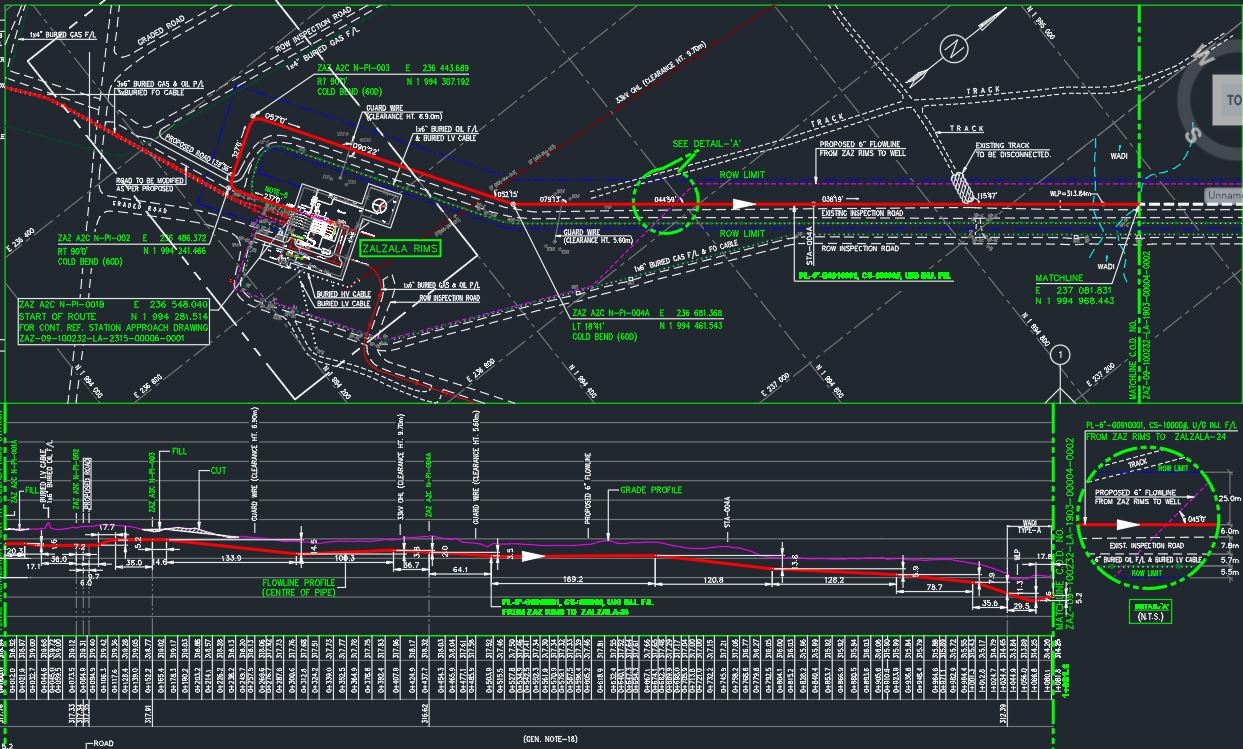
Information that a pipeline alignment sheet furnish
12 min
Benefits of a Pipeline Alignment Drawing
7 min
Steps involved in Pipeline Alignment Drawing Generation
11 min
Practical Case Study
24 min
Course details
Pipeline alignment drawing is crucial for pipeline design and construction. It requires technical skill, precision, and the right tools. Technology advances are making methods and tools for creating alignment drawings more sophisticated. This progress offers new ways to improve accuracy and efficiency. By understanding key elements, using the right technologies, and following best practices, professionals can excel in pipeline alignment drawing and contribute to successful infrastructure projects.
CAD software is essential for pipeline alignment drawing. Programs like AutoCAD, Civil 3D, and specialized pipeline design software help engineers create precise and detailed drawings. These tools offer features like layering, scaling, and annotation, which simplify the design process.
In engineering and construction, pipeline alignment drawing is a vital task. It is fundamental for installing, operating, and maintaining pipelines, which transport fluids and gases across various terrains. Accurate alignment is key for efficiency, safety, and regulatory compliance. This online course covers the importance of pipeline alignment drawing, its key elements, and the tools and best practices used by professionals.
Benefits of Completing an Online Pipeline Alignment Drawing Course:
Enhanced Skills: Gain a deep understanding of pipeline alignment principles and improve technical drawing skills, making you more effective and efficient.
Career Advancement: Advanced skills and certification can lead to better job opportunities and career growth in engineering and construction.
Increased Confidence: Mastery of pipeline alignment drawing will boost your confidence in handling complex projects and design challenges.
Networking Opportunities: Online courses often provide forums and networking opportunities to connect with other professionals and industry experts.
For professionals in pipeline design and installation, creating accurate and detailed pipeline alignment drawings is essential. These drawings ensure pipelines are installed correctly, efficiently, and in compliance with safety and regulatory standards. The course will teach you how to read pipeline alignment drawings and include a practical case study.
Course suitable for
Oil & Gas Onshore Pipeline
Key topics covered
The course will cover the following in details:
The meaning of a Pipeline Alignment Drawing
Information a Pipeline Alignment Drawing Contains
Benefits of Pipeline Alignment Sheet
Steps for generating Pipeline Alignment Drawing
Example of a Pipeline Alignment Drawing
Practical case study for Reading a Pipeline Alignment Sheet
Our Alumni Work At
Why people choose EveryEng
Industry-aligned courses, expert training, hands-on learning, recognized certifications, and job opportunities—all in a flexible and supportive environment.
- Industry Veteran
- Trainer Review

Petrofac
I was skeptical at first, but EveryEng's training programs really delivered. I gained the skills and confidence to take on challenging projects and advance my career. Highly recommended!


Nainesh Desai
Principal Project engineer
Sharjah, UAE

ITER
The user experience on EveryEng is fantastic! The platform is simple, efficient, and provides excellent educational content. It helps developing new skills and gain confidence in engineering career.

Nirbhay Naik
Engineer
France

Subsea7
I was searching for a reliable platform to expand my engineering knowledge, and EveryEng exceeded my expectations. The content and courses are well-structured, informative, and taught by experienced professionals. A great platform for Engineers!

C P Sharma
Principal Engineer
London

Technip
The content quality on EveryEng is outstanding! Every lesson is well-organized, and the instructors explain everything so clearly. This platform can help every engineer grow professionally in ways I never imagined.

Mulkita Sabharwal
Lead Engineer
Frankfrut, Germany

SLB
I never imagined an online learning platform could be this effective! EveryEng’s courses are top-notch, the mentors are industry experts, and the skills my team gained have made a real difference in the performance!"

Vishal Kokate
Engineering Team Lead
Pune, India
Anup Kumar Dey
Owner of https://whatispiping.com/
Questions and Answers
A: A would leave internal liquid pooling unaddressed and still allow corrosion under deposits. B would not address static liquid holdup during normal operation or shutdown. C confuses thermal stress control with fluid management and doesn’t remove trapped hydrocarbons. D ties the slope to controlled drainage so residual liquid doesn’t sit in the line and become an ignition or overpressure source.
A: A would cause you to misjudge spacing because elevation isn’t distance. B would understate true separation where the route has deflections. C would disconnect the stations from physical location control. D reflects how chainage tracks actual pipe length for spacing, drainage, and isolation checks.
A: A assumes a structural failure mode unrelated to trapped liquid. B mixes upstream rotating equipment behaviour with a static pipeline issue. C needs sustained high velocity rather than a restart transient. D follows from liquid holdup releasing as a slug that challenges MAWP downstream.
A: A is a QA convenience but not the primary integrity driver. B relates to external protection rather than weld performance. C doesn’t materially change pressure hold behaviour. D addresses how misalignment amplifies stress at the weld toe during pressure and thermal cycles.
A: A affects long-term corrosion but won’t stop today’s pour decision. B can be resolved later without affecting geometry. C belongs to the ITP rather than the alignment. D blocks confirmation of cover, slope, and trapped liquid risk before concrete placement.
A: A is unrelated to internal gas management. B depends on material toughness and test temperature, not venting. C confuses electrical continuity with fluid handling. D reflects how trapped gas compromises filling and causes transient overpressure when compressed.
A: A would imply civil works not shown elsewhere. B would normally be tagged and dimensioned differently. C is handled in construction method statements, not alignment drawings. D signals that the exact cut length is set in the field to close out dimensional tolerance.
A: A would be counterproductive for most buried lines. B benefits construction but doesn’t address integrity. C overstates the effect of soil on pressure containment. D links cover to restraint against uplift and expansion-driven movement.
A: A needs drainage and coating control rather than thickness. B depends on cover and physical protection. C is managed through corrosion allowance and inhibition. D arises from geometry-driven fluid behaviour that thickness increase doesn’t eliminate.
A: A risks building incorrect slopes and drainage. B can still misplace features along the route. C defers a known inconsistency into the field under audit conditions. D enforces data integrity so geometry, risk controls, and compliance are auditable and defensible.
More from Same Author
- Technical Courses
- Articles
4 (384)
3568
38
E-Learning
Unlimited access
Advanced
E-Learning
Unlimited access
Pre-recorded videos
4 (384)
14949
12
E-Learning
Unlimited access
Beginner
E-Learning
Unlimited access
Pre-recorded videos
4 (384)
6952
12
E-Learning
Unlimited access
Beginner
E-Learning
Unlimited access
Pre-recorded videos
Earning and Growth option in same Industry Domain
- Pre-recorded
- Online live session
- Offline
- Articles
4 (29)
2928
27
E-Learning
Unlimited access
Advanced
E-Learning
Unlimited access
Pre-recorded videos
4 (384)
1733
E-Learning
Unlimited access
Beginner
E-Learning
Unlimited access
Pre-recorded videos
1334
1
E-Learning
Unlimited access
E-Learning
Unlimited access
Pre-recorded videos

More Training & Development option to expand your reach
- Technical courses
- Soft-skills courses
- Seminars
- Articles & Blogs

4 (16)
1918
6
Online
Live courses
December 31
160 Hrs
Advanced
Online
Live courses
Interacting with trainer

4
156
Online
Live courses
February 21
25 Hrs
Advanced
Online
Live courses
Interacting with trainer

4 (16)
784
Online
Live courses
February 21
30 Hrs
Advanced
Online
Live courses
Interacting with trainer